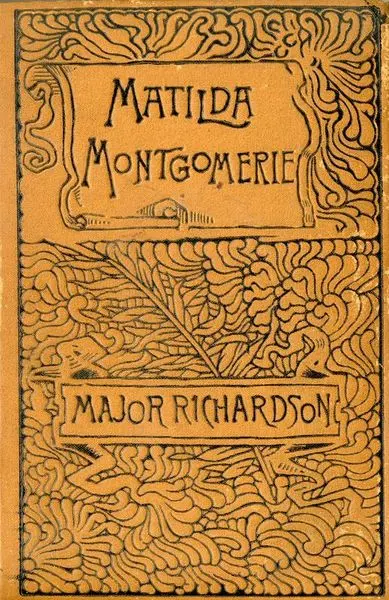
Matilda Montgomerie; Or, The Prophecy Fulfilled
Major (John) Richardson
THE CLASSIC COLLECTION · 1840
"The Canadian Brothers; Or, The Prophecy Fulfilled: A Tale of the Late American War" by John Richardson is a novel published in 1840. This sequel to Richardson's earlier work "Wacousta" follows British army officers Gerald and Henry Grantham during the War of 1812. Gerald falls for Matilda Montgomerie, an American woman whose father is the villainous Jeremiah Desborough, a spy and descendant of the previous novel's antagonist. As a dark prophecy unfolds, the brothers face treachery, mistaken identity, and tragic consequences amid the conflict between British and American forces.
Introduction adapted from the source catalogue; source summaries may be automatically generated.
Free to read · English · 75,312 words · No account needed
MAKE TIME FOR A GOOD BOOK
On by default. Untick to stop anonymous reading totals. Each page counts after 10 seconds in view. How this works.
Anonymous counting is on unless you have switched it off.
At that moment the sail was violently agitated--something struggling for freedom, cast the blankets on one side, and presently the figure of a man stood upright in the bows of the canoe, and gazed around him with an air of stupid astonishment.
"What," exclaimed Middlemore, retreating back a pace or two, in unfeigned surprise; "has that pistol started up, like the ghost in Hamlet, Ensign Paul, Emilius, Theophilus, Arnoldi, of the United States Michigan Militia--a prisoner on his parole of honor? and yet attempting a clandestine departure from the country--how is this?"
"Not this merely," exclaimed Grantham, "but a traitor to his country, and a deserter from our service. This fellow," he pursued, in answer to an inquiring look of his companion, "is a scoundrel, who deserted three years since from the regiment you relieved--I recognized him yesterday on his landing, as my brother Gerald, who proposed making his report to the General this morning, had done before. Let us secure both, Middlemore, for, thank Heaven we have been enabled to detect the traitor at last, in that which will excuse his final expulsion from the soil, even if no worse befall him. I have only tampered with him thus long to render his conviction more complete."
"Secure me! secure Jeremiah Desborough?" exclaimed the settler, with rage manifest in the clenching of his teeth and the tension of every muscle of his iron frame, "and that for jist tryin' to save a countryman--well, we'll see who'll have the best of it."
Before Grantham could anticipate the movement, the active and powerful Desborough had closed with him in a manner to prevent his making use of his pistol, had he even so desired. In the next instant it was wrested from him, and thrown far from the spot on which he struggled with his adversary, but at fearful odds, against himself. Henry Grantham, although well and actively made, was of slight proportion, and yet in boyhood. Desborough, on the contrary, was in the full force of a vigorous manhood. A struggle, hand to hand, between two combatants so disproportioned, could not, consequently, be long doubtful as to its issue. No sooner had the formidable Yankee closed with his enemy, than, pressing the knuckles of his iron hand which met round the body of the officer, with violence against his spine, he threw him backwards with force upon the sands. Grasping his victim with one hand as he lay upon him, he seemed, as Grantham afterwards declared, to be groping for his knife with the other. The settler was evidently anxious to despatch one enemy, in order that he might fly to the assistance of his son, for it was he whom Middlemore, with a powerful effort, had dragged from the canoe to the beach. While his right hand was still groping for the knife--an object which the powerful resistance of the yet unsubdued, though prostrate, officer rendered somewhat difficult of attainment --the report of a pistol was heard, fired evidently by one of the other combatants. Immediately the settler looked up to see who was the triumphant party. Neither had fallen, and Middlemore, if any thing, had the advantage of his enemy; but to his infinite dismay, Desborough beheld a horseman, evidently attracted by the report of the pistol, urging his course with the rapidity of lightning, along the firm sands, and advancing with cries and vehement gesticulations to the rescue.
Your reading position is saved on this browser. Take it to another device with a library code. Reading pages adapt to text, rather than matching a printed edition.
Major (John) Richardson
Major (John) Richardson
Major (John) Richardson
Major (John) Richardson
BEHIND THE BOOK
This eBook is for the use of anyone anywhere in the United States and most other parts of the world at no cost and with almost no restrictions whatsoever. You may copy it, give it away or re-use it under the terms of the Project Gutenberg License included with this eBook or online at www.gutenberg.org. If you are not located in the United States, you will have to check the laws of the country where you are located before using this eBook. Read the source licence.
The original source file, including credits and licence, is retained by this library. Request an original-format copy at no charge. Please include the book title and Project Gutenberg identifier #5106.
KEEP YOUR CURIOSITY GOING
Cécile Tormay

Moritz Busch
Coulson Kernahan
John L. Ransom

Maurice Baring
Frances Wright