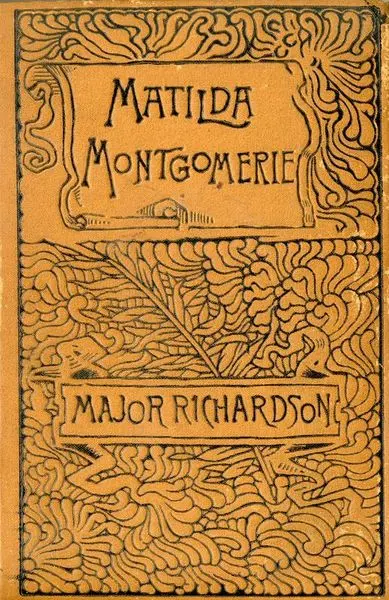
Matilda Montgomerie; Or, The Prophecy Fulfilled
Major (John) Richardson
THE CLASSIC COLLECTION · 1840
"The Canadian Brothers; Or, The Prophecy Fulfilled: A Tale of the Late American War" by John Richardson is a novel published in 1840. This sequel to Richardson's "Wacousta" follows British officers Gerald and Henry Grantham during the War of 1812. Gerald falls for Matilda Montgomerie, an American whose father is the villainous Jeremiah Desborough, descendant of the original novel's antagonist. As a dark prophecy unfolds, the brothers face betrayal, mistaken identity, and tragic fate along the Detroit River and Lake Erie.
Introduction adapted from the source catalogue; source summaries may be automatically generated.
Free to read · English · 149,184 words · No account needed
MAKE TIME FOR A GOOD BOOK
On by default. Untick to stop anonymous reading totals. Each page counts after 10 seconds in view. How this works.
Anonymous counting is on unless you have switched it off.
Nor must the reader picture to himself this combination of animal properties, either standing, or lying, or walking, or sitting; but in a measure glued, Centaur-like, to the back of a noble stallion, vigorous, active, and of a dark chesnut color, with silver mane and tail. In the course of many years that Sampson had resided in the neighbourhood, no one could remember to have seen him stand, or lie, or walk, or sit, while away from his home, unless absolutely compelled. Both horse and rider seemed as though they could not exist while separated, and yet Silvertail (thus was the stallion named) was not more remarkable in sleekness of coat, soundness of carcase, and fleetness of pace, than his rider was in the characteristics of corpulency and joviality.
Sampson Gattrie had passed the greater part of his younger days in America. He had borne arms in the revolution, and was one of those faithful loyalists, who, preferring rather to abandon a soil which, after all, was one of adoption, than the flag under which they had been nurtured, had, at the termination of that contest, passed over into Canada. Having served in one of those irregular corps, several of which had been employed with the Indians, during the revolutionary contest, he had acquired much of the language of these latter, and to this knowledge was indebted for the situation of interpreter which he had for years enjoyed. Unhappily for himself, however, the salary attached to the office was sufficient to keep him in independence, and, to the idleness consequent on this, (for the duties of an interpreter were only occasional,) might have been attributed the rapid growth of a vice--an addiction to liquor--which unchecked indulgence had now ripened into positive disease.
Great was the terror that Sampson was wont to excite in the good people of Amherstburg. With Silvertail at his speed, he would gallop into the town, brandishing his cudgel, and reeling from side to side, exhibiting at one moment the joyous character of a Silenus, at another, as we have already shown--that of an inebriated Centaur. Occasionally he would make his appearance, holding his sides convulsed with laughter, as he reeled and tottered in every direction, but without ever losing his equilibrium. At other times he would utter a loud shout, and, brandishing his cudgel, dart at full speed along the streets, as if he purposed singly to carry the town by (what Middlemore often facetiously called) a coup de main. At these moments were to be seen mothers rushing into the street to look for, and hurry away, their loitering offspring, while even adults were glad to hasten their movements, in order to escape collision with the formidable Sampson; not that either apprehended the slightest act of personal violence from the old man, for he was harmless of evil as a child, but because they feared the polished hoofs of Silvertail, which shone amid the clouds of dust they raised as he passed, like rings of burnished silver. Even the very Indians, with whom the streets were at this period habitually crowded, were glad to hug the sides of the houses, while Sampson passed; and they who, on other occasions, would have deemed it in the highest degree derogatory to their dignity to have stepped aside at the approach of danger, or to have relaxed a muscle of their stern countenances, would then open a passage with a rapidity which in them was remarkable, and burst into loud laughter as they fled from side to side to make way for Sampson. Sometimes, on these occasions, the latter would suddenly check Silvertail, while in full career, and, in a voice that could be beard from almost every quarter of the little town, harangue them for half an hour together in their own language, and with an air of authority that was ludicrous to those who witnessed it--and must have been witnessed to be conceived. Occasionally a guttural "ugh" would be responded in mock approval of the speech, but more frequently a laugh, on the part of the more youthful of his red auditors, was the only notice taken. His lecture concluded, Sampson would again brandish his cudgel, and vociferate another shout; then betaking himself to the nearest store, he would urge Silvertail upon the footway, and with a tap of his rude cudgel against the door, summon whoever was within, to appear with a glass of his favorite beverage. And this would he repeat, until he had drained what he called his stirrup cup, at every shop in the place where the poisonous liquor was vended.
Your reading position is saved on this browser. Take it to another device with a library code. Reading pages adapt to text, rather than matching a printed edition.
Major (John) Richardson
Major (John) Richardson
Major (John) Richardson
Major (John) Richardson
BEHIND THE BOOK
This eBook is for the use of anyone anywhere in the United States and most other parts of the world at no cost and with almost no restrictions whatsoever. You may copy it, give it away or re-use it under the terms of the Project Gutenberg License included with this eBook or online at www.gutenberg.org. If you are not located in the United States, you will have to check the laws of the country where you are located before using this eBook. Read the source licence.
The original source file, including credits and licence, is retained by this library. Request an original-format copy at no charge. Please include the book title and Project Gutenberg identifier #5108.
KEEP YOUR CURIOSITY GOING
Cécile Tormay

Moritz Busch
Coulson Kernahan
John L. Ransom

Maurice Baring
Frances Wright