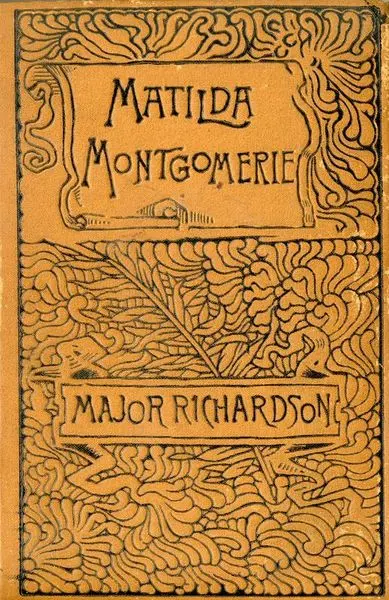
Matilda Montgomerie; Or, The Prophecy Fulfilled
Major (John) Richardson
THE CLASSIC COLLECTION · 1840
"The Canadian Brothers; Or, The Prophecy Fulfilled: A Tale of the Late American War" by John Richardson is a novel published in 1840. This sequel to Richardson's "Wacousta" follows British officers Gerald and Henry Grantham during the War of 1812. Gerald falls for Matilda Montgomerie, an American whose father is the villainous Jeremiah Desborough, descendant of the original novel's antagonist. As a dark prophecy unfolds, the brothers face betrayal, mistaken identity, and tragic fate along the Detroit River and Lake Erie.
Introduction adapted from the source catalogue; source summaries may be automatically generated.
Free to read · English · 149,184 words · No account needed
MAKE TIME FOR A GOOD BOOK
On by default. Untick to stop anonymous reading totals. Each page counts after 10 seconds in view. How this works.
Anonymous counting is on unless you have switched it off.
Springing with the quickness of thought from his victim, the settler was in the next moment at the side of Middlemore. Seizing him from behind by the arm within his nervous grasp, he pressed the latter with such prodigious force as to cause him to relinquish, by a convulsive movement, the firm hold he had hitherto kept of his adversary.
"In, boy, to the canoe for your life," he exclaimed hurriedly, as following up his advantage, he spun the officer round, and sent him tottering to the spot were Grantham lay, still stupified and half throttled. The next instant saw him heaving the canoe from the shore, with all the exertion called for by his desperate situation. And all this was done so rapidly, in so much less time than it will take our readers to trace it, that before the horseman, so opportunely arriving, had reached the spot, the canoe, with its inmates, had pushed from the shore.
Without pausing to consider the rashness and apparent impracticability of his undertaking, the strange horseman, checking his rein, and burying the rowels of his spurs deep into the flanks of his steed, sent him bounding and plunging into the lake, in pursuit of the fugitives.
He himself evinced every symptom of one in a state of intoxication. Brandishing a stout cudgel over his head, and pealing forth shouts of defiance, he rolled from side to side on his spirited charger, like some labouring bark careening to the violence of the winds, but ever, like that bark, regaining an equilibrium that was never thoroughly lost. Shallow as the lake was at this point for a considerable distance, it was long before the noble animal lost its footing, and thus had its rider been enabled to arrive within a few paces of the canoe, at the very moment when the increasing depth of the water, in compelling the horse to the less expeditions process of swimming, gave a proportionate advantage to the pursued. No sooner, however, did the Centaur-like rider find that he was losing ground, than, again darting his spurs into the flanks of his charger, he made every effort to reach the canoe, Maddened by the pain, the snorting beast half rose upon the calm element, like some monster of the deep, and, making two or three desperate plunges with his fore feet, succeeded in reaching the stern. Then commenced a short but extraordinary conflict. Bearing up his horse as he swam, with the bridle in his teeth, the bold rider threw his left hand upon the stern of the vessel, and brandishing his cudgel in the right, seemed to provoke both parties to the combat. Desborough, who had risen from the stern at his approach, stood upright in the centre, his companion still paddling at the bows; and between these two a singular contest now ensued. Armed with the formidable knife which he had about his person, the settler made the most desperate and infuriated efforts to reach his assailant; but in so masterly a manner did his adversary use his simple weapon, that every attempt was foiled, and more than once did the hard iron-wood descend upon his shoulders, in a manner to be heard from the shore. Once or twice the settler stooped to evade some falling blow, and, rushing forward, sought to sever the hand which still retained its hold of the stern; but, with an activity remarkable in so old a man as his assailant, for he was upwards of sixty years of age, the hand was removed--and the settler, defeated in his object, was amply repaid for his attempt, by a severe collision of his bones with the cudgel. At length, apparently enjoined by his companion, the younger removed his paddle, and, standing up also in the canoe, aimed a blow with its knobbed handle at the head of the horse, at a moment when his rider was fully engaged with Desborough. The quick-sighted old man saw the action, and, as the paddle descended, an upward stroke from his own heavy weapon sent it flying in fragments in the air, while a rapid and returning blow fell upon the head of the paddler, and prostrated him at length in the canoe. The opportunity afforded by this diversion, momentary as it was, was not lost upon Desborough. The horseman, who, in his impatience to avenge the injury offered to the animal, which seemed to form a part of himself, had utterly forgotten the peril of his hand; and before he could return from the double blow that had been so skilfully wielded, to his first enemy, the knife of the latter had penetrated his hand, which, thus rendered powerless now relinquished its grasp. Desborough, whose object--desperate character as he usually was--seemed now rather to fly than to fight, availed himself of this advantage to hasten to the bows of the canoe, where, striding across the body of his insensible companion, he, with a few vigorous strokes of the remaining paddle, urged the lagging bark rapidly a-head. In no way intimidated by his disaster, the courageous old man, again brandishing his cudgel, and vociferating taunts of defiance, would have continued the pursuit, but panting as he was, not only with the exertion he had made, but under the weight of his impatient rider, in an element in which he was supported merely by his own buoyancy, the strength and spirit of the animal began now perceptibly to fail him, and he turned, despite of every effort to prevent him, towards the shore. It was fortunate for the former that there were no arms in the canoe, or neither he nor the horse would, in all probability, have returned alive; such was the opinion, at least, pronounced by those who were witnesses of the strange scene, and who remarked the infuriated but impotent gestures of Desborough, as the old man, having once more gotten his steed into depth, slowly pursued his course towards the shore, but with the same wild brandishing of his enormous cudgel, and the same rocking from side to side, until his body was often at right angles with that of his jaded but sure-footed beast. As he is, however, a character meriting rather more than the casual notice we have bestowed, we shall take the opportunity while he is hastening to the discomfited officers on the beach, more particularly to describe him.
Your reading position is saved on this browser. Take it to another device with a library code. Reading pages adapt to text, rather than matching a printed edition.
Major (John) Richardson
Major (John) Richardson
Major (John) Richardson
Major (John) Richardson
BEHIND THE BOOK
This eBook is for the use of anyone anywhere in the United States and most other parts of the world at no cost and with almost no restrictions whatsoever. You may copy it, give it away or re-use it under the terms of the Project Gutenberg License included with this eBook or online at www.gutenberg.org. If you are not located in the United States, you will have to check the laws of the country where you are located before using this eBook. Read the source licence.
The original source file, including credits and licence, is retained by this library. Request an original-format copy at no charge. Please include the book title and Project Gutenberg identifier #5108.
KEEP YOUR CURIOSITY GOING
Cécile Tormay

Moritz Busch
Coulson Kernahan
John L. Ransom

Maurice Baring
Frances Wright