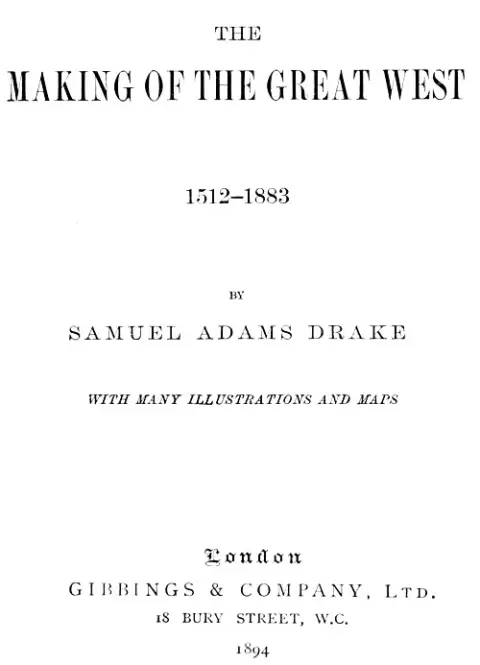
The Making of the Great West, 1512-1883
Samuel Adams Drake
THE CLASSIC COLLECTION · 1895
"The Campaign of Trenton 1776-77" by Samuel Adams Drake is a historical account written in the late 19th century. The book examines the significant military campaign during the American Revolutionary War, particularly focusing on the events surrounding the battles of Trenton and Princeton. Through its exploration of these critical military engagements, the text likely highlights the leadership of George Washington and the resilience of the Continental Army amidst adversity. The opening of the book establishes the context of the campaign, describing the dire situation faced by the American forces as they retreated through New Jersey after suffering defeats. Drake emphasizes the turning point for the Revolutionary cause, detailing the urgency for a surprise attack on the Hessian forces stationed in Trenton, which Washington ultimately executed during an unconventional winter's march. The author depicts Washington's strategic decisions, his interactions with his officers, and the morale boost that the Continental Army experienced following their unexpected victory at Trenton. This victory not only reinvigorated the American resolve but also marked a crucial shift in the momentum of the war.
Introduction adapted from the source catalogue; source summaries may be automatically generated.
Free to read · English · 18,880 words · No account needed
MAKE TIME FOR A GOOD BOOK
On by default. Untick to stop anonymous reading totals. Each page counts after 10 seconds in view. How this works.
Anonymous counting is on unless you have switched it off.
American Army, 12, 17 note;
marches to N. York, 12;
its efficiency, 14;
weakened by detachments, 19, 24 note;
reenforced, 19, 20;
effectives in summer of 1776, 22, 24 note;
defeated at L. Island, 29;
losses there, 31;
how posted after the battle, 31, 32;
driven from N. York, 39;
fights at White Plains and Fort Washington, 40;
losses there, 41;
is divided into two corps, 44;
dissension in, 49 note;
reduced numbers, 50;
summary of losses, 52, 53;
reaches the Delaware, 57;
in position there, 75;
is reenforced, 79;
time expiring, 80;
reenlistments, 97.
Bedford, L. I., seized by British, 27.
Bordentown, occupied by British troops, 71, 72;
evacuated, 95.
British Army of subjugation, 23;
by regiments, 25 note;
takes the field, 27;
drives the Americans from L. Island, 27 et seq.;
in winter quarters, 72, 76.
Brooklyn Heights fortified, 20, 24 note;
outer defences, 26;
turned by British, 27, 28.
Cadwalader, Col. John, 80, 87 note;
fails to get his troops across the Delaware, 83;
succeeds better in a second attempt, 94;
and occupies Bordentown, 95.
Clinton, Gen. Sir Henry, at N. York, 34;
moves to Throg's Neck, 36;
captures Newport, R. I., 70.
Cornwallis, Gen. Lord, surprises Fort Lee, 45;
is reenforced, 55;
pursues Washington, 55, 56, 57, 58 note;
is unable to follow him beyond Trenton, 62, 67 note;
has leave of absence, 71;
hastens back to Trenton, 97;
makes a forced march back to N. Brunswick, 106.
Declaration of Independence, read to the army, 23.
Donop, Col. Count, 72, 75;
abandons Bordentown, 95.
Ewing, Gen. James, 83, 87 note.
Fort Lee, 24 note;
evacuated, 45, 49 note.
Fort Washington, built, 21, 24 note;
assault and capture of, 40, 41, 42 note.
Gates, Gen. Horatio, brings troops from Ticonderoga, 63, 67 note;
refuses a command, 81.
Glover, Gen. John, at L. Island, 30;
at Trenton, 85, 88 note.
Greene, Gen. Nathaniel, advises the holding of Fort Washington, 40;
at Fort Lee, 45;
heads a column at Trenton, 87.
Griffin, Colonel, moves into the Jerseys, 82.
Hale, Capt. Nathan, taken and hanged, 36.
Harlem Heights, the army headquarters, 32, and note.
Haslet, Col. John, at Princeton, 105.
Heath, Gen. Wm., put in command in the Highlands, 44, 96, 106 note.
Howe, Gen. Sir William, lands at L. Island, 26;
his delays, 36;
moves into Westchester, 39;
fights at White Plains, 40;
and takes Fort Washington, 40;
inhumanity to prisoners by his permission, 52;
plans for next campaign, 70;
takes things easy, 71;
roused by Washington's bold strokes, 97.
King's Bridge, importance of, to N. York, 20, 21;
an outpost, 22, 24 note.
Kipp's Bay, landing-place of British, 34;
account by an eye-witness, 34, 35.
Knox, Gen. Henry, improves the artillery service, 16, 17;
at Trenton, 84, 85.
Lee, Gen. Charles, sent to N. York, 18 note;
ineffectually urges evacuation of Fort Washington, 41;
a rival of Washington, 41;
gets a separate command, 44;
moves to join Washington, 59;
his equivocal attitude, 50, 60;
his troops, 60, 67 note;
is reenforced, 61;
halts at Morristown, and is captured, 63;
probable aims, 65.
Long Island, campaign opened at, 26;
British plan of attack, 27;
flank march, 27, 28; evacuated, 30.
McDougall, Gen. Alexander, at Morristown, 96.
Mercer, Gen. Hugh, at Princeton, 104, 105, 107 note.
Mifflin, Gen. Thomas, at Trenton, 98.
New Jersey, invaded, 50;
apathy of people, 51;
military situation in, 71;
outrages perpetrated by the invaders, 77, 78;
arouse the people, 78;
mostly reconquered, 108, 112.
Your reading position is saved on this browser. Take it to another device with a library code. Reading pages adapt to text, rather than matching a printed edition.
Samuel Adams Drake
Samuel Adams Drake
Samuel Adams Drake
Samuel Adams Drake
BEHIND THE BOOK
This eBook is for the use of anyone anywhere in the United States and most other parts of the world at no cost and with almost no restrictions whatsoever. You may copy it, give it away or re-use it under the terms of the Project Gutenberg License included with this eBook or online at www.gutenberg.org. If you are not located in the United States, you will have to check the laws of the country where you are located before using this eBook. Read the source licence.
The original source file, including credits and licence, is retained by this library. Request an original-format copy at no charge. Please include the book title and Project Gutenberg identifier #24741.
KEEP YOUR CURIOSITY GOING
Cécile Tormay

Moritz Busch
John L. Ransom
Frances Wright
Cécile Tormay

Mabel Potter Daggett