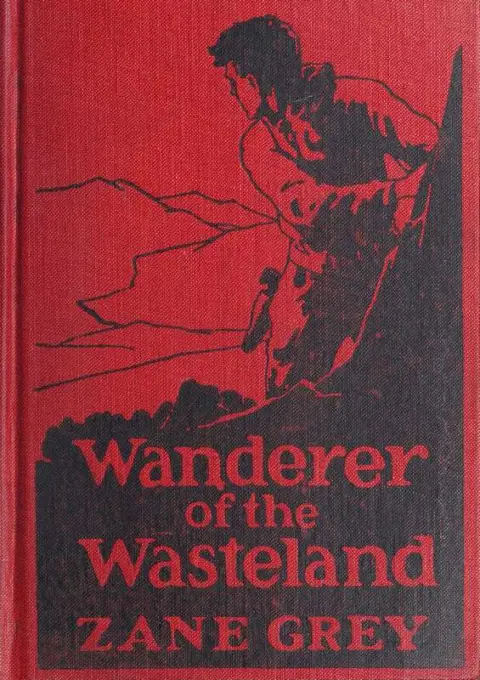
Wanderer of the Wasteland
Zane Grey
THE CLASSIC COLLECTION · 1921
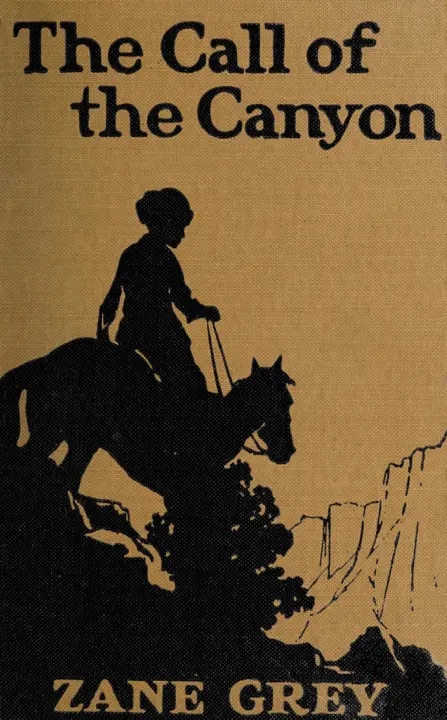
"The Call of the Canyon" by Zane Grey is a novel written in the early 20th century, capturing the essence of the American West following World War I. The story revolves around Carley Burch, a young woman from New York, who is drawn to the West by a letter from her fiancé, Glenn Kilbourne, who has returned from the war profoundly changed. The narrative explores themes of love, transformation, and the stark contrast between urban and rugged natural life through Carley's journey as she seeks to understand and reconnect with Glenn in his new world. At the start of the novel, Carley reflects on Glenn's haunting letter as she rides on a train toward Arizona, revealing her uncertainty and desire to find him. The opening details her memories of their last moments together before the war and her efforts to comprehend the deep changes Glenn has undergone. After arriving in Flagstaff and embarking on a challenging journey to reach Glenn's remote cabin, Carley grapples with the unfamiliarity of her surroundings, the harsh conditions of the West, and her inner anxieties about their relationship. As she meets Glenn, who has transformed into a rugged figure embodying the West's strength and harsh realities, the complexity of their love unfolds, hinting at the challenges that lie ahead for both as they navigate their altered lives.
Introduction adapted from the source catalogue; source summaries may be automatically generated.
Free to read · English · 74,985 words · No account needed
MAKE TIME FOR A GOOD BOOK
On by default. Untick to stop anonymous reading totals. Each page counts after 10 seconds in view. How this works.
Anonymous counting is on unless you have switched it off.
“Of course. I like dancing, and it’s about all the exercise I get,” she
replied.
“Have the dances changed—again?”
“It’s the music, perhaps, that changes the dancing. Jazz is becoming popular. And about all the crowd dances now is an infinite variation of fox-trot.”
“No waltzing?”
“I don’t believe I waltzed once this winter.”
“Jazz? That’s a sort of tinpanning, jiggly stuff, isn’t it?”
“Glenn, it’s the fever of the public pulse,” replied Carley. “The graceful waltz, like the stately minuet, flourished back in the days when people rested rather than raced.”
“More’s the pity,” said Glenn. Then after a moment, in which his gaze returned to the fire, he inquired rather too casually, “Does Morrison still chase after you?”
“Glenn, I’m neither old—nor married,” she replied, laughing.
“No, that’s true. But if you were married it wouldn’t make any
difference to Morrison.”
Carley could not detect bitterness or jealousy in his voice. She would not have been averse to hearing either. She gathered from his remark, however, that he was going to be harder than ever to understand. What had she said or done to make him retreat within himself, aloof, impersonal, unfamiliar? He did not impress her as loverlike. What irony of fate was this that held her there yearning for his kisses and caresses as never before, while he watched the fire, and talked as to a mere acquaintance, and seemed sad and far away? Or did she merely imagine that? Only one thing could she be sure of at that moment, and it was that pride would never be her ally.
“Glenn, look here,” she said, sliding her chair close to his and holding out her left hand, slim and white, with its glittering diamond on the third finger.
He took her hand in his and pressed it, and smiled at her. “Yes, Carley, it’s a beautiful, soft little hand. But I think I’d like it better if it were strong and brown, and coarse on the inside—from useful work.”
“Like Flo Hutter’s?” queried Carley.
“Yes.”
Carley looked proudly into his eyes. “People are born in different stations. I respect your little Western friend, Glenn, but could I wash and sweep, milk cows and chop wood, and all that sort of thing?”
“I suppose you couldn’t,” he admitted, with a blunt little laugh.
“Would you want me to?” she asked.
“Well, that’s hard to say,” he replied, knitting his brows. “I hardly know. I think it depends on you.... But if you did do such work wouldn’t you be happier?”
Your reading position is saved on this browser. Take it to another device with a library code. Reading pages adapt to text, rather than matching a printed edition.
Zane Grey
Zane Grey
Zane Grey
Zane Grey
BEHIND THE BOOK
This eBook is for the use of anyone anywhere in the United States and most other parts of the world at no cost and with almost no restrictions whatsoever. You may copy it, give it away or re-use it under the terms of the Project Gutenberg License included with this eBook or online at www.gutenberg.org. If you are not located in the United States, you will have to check the laws of the country where you are located before using this eBook. Read the source licence.
The original source file, including credits and licence, is retained by this library. Request an original-format copy at no charge. Please include the book title and Project Gutenberg identifier #1881.
KEEP YOUR CURIOSITY GOING
Coulson Kernahan

Maurice Baring
Frances Wright
Cécile Tormay

Frederic Jesup Stimson

W. H. P. (William Henry Pope) Jarvis