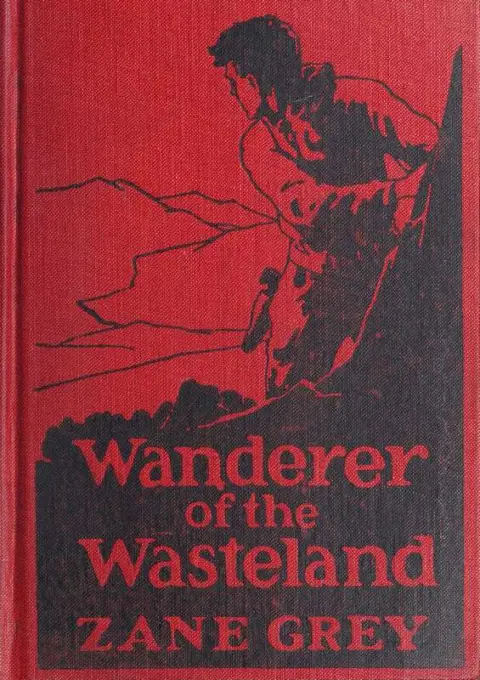
Wanderer of the Wasteland
Zane Grey
THE CLASSIC COLLECTION · 1921
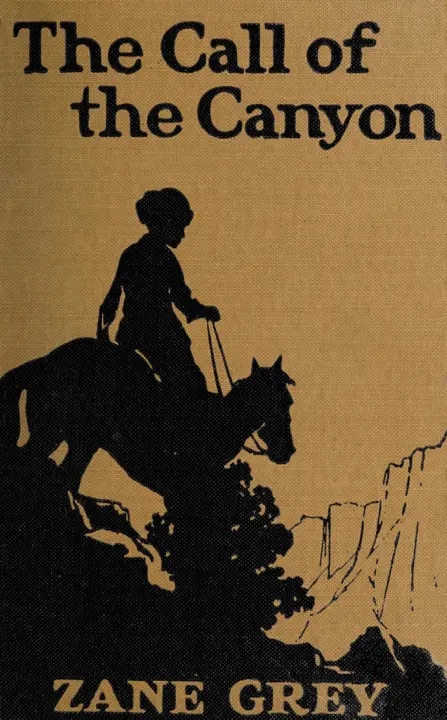
"The Call of the Canyon" by Zane Grey is a novel written in the early 20th century, capturing the essence of the American West following World War I. The story revolves around Carley Burch, a young woman from New York, who is drawn to the West by a letter from her fiancé, Glenn Kilbourne, who has returned from the war profoundly changed. The narrative explores themes of love, transformation, and the stark contrast between urban and rugged natural life through Carley's journey as she seeks to understand and reconnect with Glenn in his new world. At the start of the novel, Carley reflects on Glenn's haunting letter as she rides on a train toward Arizona, revealing her uncertainty and desire to find him. The opening details her memories of their last moments together before the war and her efforts to comprehend the deep changes Glenn has undergone. After arriving in Flagstaff and embarking on a challenging journey to reach Glenn's remote cabin, Carley grapples with the unfamiliarity of her surroundings, the harsh conditions of the West, and her inner anxieties about their relationship. As she meets Glenn, who has transformed into a rugged figure embodying the West's strength and harsh realities, the complexity of their love unfolds, hinting at the challenges that lie ahead for both as they navigate their altered lives.
Introduction adapted from the source catalogue; source summaries may be automatically generated.
Free to read · English · 74,985 words · No account needed
MAKE TIME FOR A GOOD BOOK
On by default. Untick to stop anonymous reading totals. Each page counts after 10 seconds in view. How this works.
Anonymous counting is on unless you have switched it off.
“I don’t know, Carley,” replied Eleanor, helplessly. “How you harp on things! We must dress to make other women jealous and to attract men. To be a sensation! Perhaps the word ‘immoral’ is not what I mean. A woman will be shocking in her obsession to attract, but hardly more than that, if she knows it.”
“Ah! So few women realize how they actually do look. Haze Ruff could
tell them.”
“Haze Ruff. Who in the world is he or she?” asked Eleanor.
“Haze Ruff is a he, all right,” replied Carley, grimly.
“Well, who is he?”
“A sheep-dipper in Arizona,” answered Carley, dreamily.
“Humph! And what can Mr. Ruff tell us?”
“He told me I looked like one of the devil’s angels—and that I dressed to knock the daylights out of men.”
“Well, Carley Burch, if that isn’t rich!” exclaimed Eleanor, with a peal of laughter. “I dare say you appreciate that as an original compliment.”
“No.... I wonder what Ruff would say about jazz—I just wonder,”
murmured Carley.
“Well, I wouldn’t care what he said, and I don’t care what you say,” returned Eleanor. “The preachers and reformers and bishops and rabbis make me sick. They rave about jazz. Jazz—the discordant note of our decadence! Jazz—the harmonious expression of our musicless, mindless, soulless materialism!—The idiots! If they could be women for a while they would realize the error of their ways. But they will never, never abolish jazz—never, for it is the grandest, the most wonderful, the most absolutely necessary thing for women in this terrible age of smotheration.”
“All right, Eleanor, we understand each other, even if we do not agree,” said Carley. “You leave the future of women to chance, to life, to materialism, not to their own conscious efforts. I want to leave it to free will and idealism.”
“Carley, you are getting a little beyond me,” declared Eleanor,
dubiously.
“What are you going to do? It all comes home to each individual woman. Her attitude toward life.”
“I’ll drift along with the current, Carley, and be a good sport,” replied Eleanor, smiling.
“You don’t care about the women and children of the future? You’ll not deny yourself now, and think and work, and suffer a little, in the interest of future humanity?”
“How you put things, Carley!” exclaimed Eleanor, wearily. “Of course I care—when you make me think of such things. But what have I to do with the lives of people in the years to come?”
Your reading position is saved on this browser. Take it to another device with a library code. Reading pages adapt to text, rather than matching a printed edition.
Zane Grey
Zane Grey
Zane Grey
Zane Grey
BEHIND THE BOOK
This eBook is for the use of anyone anywhere in the United States and most other parts of the world at no cost and with almost no restrictions whatsoever. You may copy it, give it away or re-use it under the terms of the Project Gutenberg License included with this eBook or online at www.gutenberg.org. If you are not located in the United States, you will have to check the laws of the country where you are located before using this eBook. Read the source licence.
The original source file, including credits and licence, is retained by this library. Request an original-format copy at no charge. Please include the book title and Project Gutenberg identifier #1881.
KEEP YOUR CURIOSITY GOING
Coulson Kernahan

Maurice Baring
Frances Wright
Cécile Tormay

Frederic Jesup Stimson

W. H. P. (William Henry Pope) Jarvis