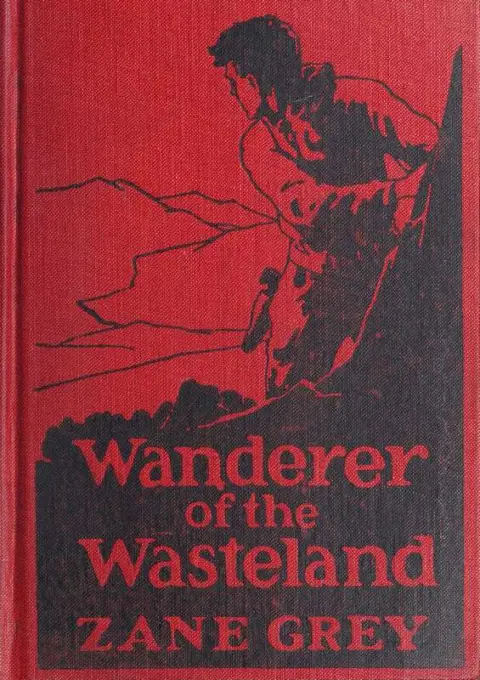
Wanderer of the Wasteland
Zane Grey
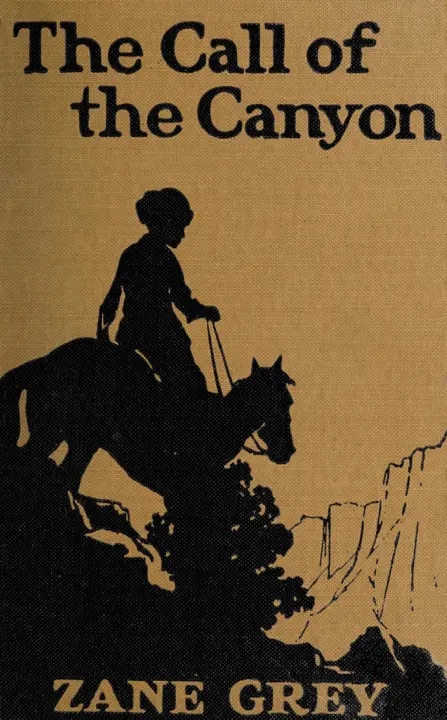
THE CLASSIC COLLECTION · 1921
"The Call of the Canyon" by Zane Grey is a novel written in the early 20th century, capturing the essence of the American West following World War I. The story revolves around Carley Burch, a young woman from New York, who is drawn to the West by a letter from her fiancé, Glenn Kilbourne, who has returned from the war profoundly changed. The narrative explores themes of love, transformation, and the stark contrast between urban and rugged natural life through Carley's journey as she seeks to understand and reconnect with Glenn in his new world. At the start of the novel, Carley reflects on Glenn's haunting letter as she rides on a train toward Arizona, revealing her uncertainty and desire to find him. The opening details her memories of their last moments together before the war and her efforts to comprehend the deep changes Glenn has undergone. After arriving in Flagstaff and embarking on a challenging journey to reach Glenn's remote cabin, Carley grapples with the unfamiliarity of her surroundings, the harsh conditions of the West, and her inner anxieties about their relationship. As she meets Glenn, who has transformed into a rugged figure embodying the West's strength and harsh realities, the complexity of their love unfolds, hinting at the challenges that lie ahead for both as they navigate their altered lives.
Introduction adapted from the source catalogue; source summaries may be automatically generated.
Free to read · English · 74,985 words · No account needed
MAKE TIME FOR A GOOD BOOK
On by default. Untick to stop anonymous reading totals. Each page counts after 10 seconds in view. How this works.
Anonymous counting is on unless you have switched it off.
Vivid and intense shone the images before her shut eyes. She saw the winding forest floor, green with grass and fern, colorful with flower and rock. A thousand aisles, glades, nooks, and caverns called her to come. Nature was every woman’s mother. The populated city was a delusion. Disease and death and corruption stalked in the shadows of the streets. But her canyon promised hard work, playful hours, dreaming idleness, beauty, health, fragrance, loneliness, peace, wisdom, love, children, and long life. In the hateful shut-in isolation of her room Carley stretched forth her arms as if to embrace the vision. Pale close walls, gleaming placid stretches of brook, churning amber and white rapids, mossy banks and pine-matted ledges, the towers and turrets and ramparts where the eagles wheeled—she saw them all as beloved images lost to her save in anguished memory.
She heard the murmur of flowing water, soft, low, now loud, and again lulling, hollow and eager, tinkling over rocks, bellowing into the deep pools, washing with silky seep of wind-swept waves the hanging willows. Shrill and piercing and far-aloft pealed the scream of the eagle. And she seemed to listen to a mocking bird while he mocked her with his melody of many birds. The bees hummed, the wind moaned, the leaves rustled, the waterfall murmured. Then came the sharp rare note of a canyon swift, most mysterious of birds, significant of the heights.
A breath of fragrance seemed to blow with her shifting senses. The dry, sweet, tangy canyon smells returned to her—of fresh-cut timber, of wood smoke, of the cabin fire with its steaming pots, of flowers and earth, and of the wet stones, of the redolent pines and the pungent cedars.
And suddenly, clearly, amazingly, Carley beheld in her mind’s sight the hard features, the bold eyes, the slight smile, the coarse face of Haze Ruff. She had forgotten him. But he now returned. And with memory of him flashed a revelation as to his meaning in her life. He had appeared merely a clout, a ruffian, an animal with man’s shape and intelligence. But he was the embodiment of the raw, crude violence of the West. He was the eyes of the natural primitive man, believing what he saw. He had seen in Carley Burch the paraded charm, the unashamed and serene front, the woman seeking man. Haze Ruff had been neither vile nor base nor unnatural. It had been her subjection to the decadence of feminine dress that had been unnatural. But Ruff had found her a lie. She invited what she did not want. And his scorn had been commensurate with the falsehood of her. So might any man have been justified in his insult to her, in his rejection of her. Haze Ruff had found her unfit for his idea of dalliance. Virgil Rust had found her false to the ideals of womanhood for which he had sacrificed all but life itself. What then had Glenn Kilbourne found her? He possessed the greatness of noble love. He had loved her before the dark and changeful tide of war had come between them. How had he judged her? That last sight of him standing alone, leaning with head bowed, a solitary figure trenchant with suggestion of tragic resignation and strength, returned to flay Carley. He had loved, trusted, and hoped. She saw now what his hope had been—that she would have instilled into her blood the subtle, red, and revivifying essence of calling life in the open, the strength of the wives of earlier years, an emanation from canyon, desert, mountain, forest, of health, of spirit, of forward-gazing natural love, of the mysterious saving instinct he had gotten out of the West. And she had been too little too steeped in the indulgence of luxurious life too slight-natured and pale-blooded! And suddenly there pierced into the black storm of Carley’s mind a blazing, white-streaked thought—she had left Glenn to the Western girl, Flo Hutter. Humiliated, and abased in her own sight, Carley fell prey to a fury of jealousy.
Your reading position is saved on this browser. Take it to another device with a library code. Reading pages adapt to text, rather than matching a printed edition.
Zane Grey
Zane Grey
Zane Grey
Zane Grey
BEHIND THE BOOK
This eBook is for the use of anyone anywhere in the United States and most other parts of the world at no cost and with almost no restrictions whatsoever. You may copy it, give it away or re-use it under the terms of the Project Gutenberg License included with this eBook or online at www.gutenberg.org. If you are not located in the United States, you will have to check the laws of the country where you are located before using this eBook. Read the source licence.
The original source file, including credits and licence, is retained by this library. Request an original-format copy at no charge. Please include the book title and Project Gutenberg identifier #1881.
KEEP YOUR CURIOSITY GOING
Coulson Kernahan

Maurice Baring
Frances Wright
Cécile Tormay

Frederic Jesup Stimson

W. H. P. (William Henry Pope) Jarvis