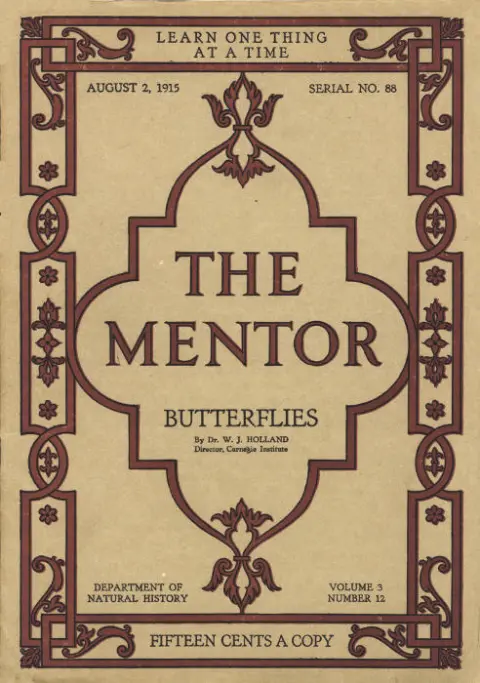
The Mentor: Butterflies, Vol. 3, Num. 12, Serial No. 88, August 2, 1915
W. J. (William Jacob) Holland
THE CLASSIC COLLECTION · 1915
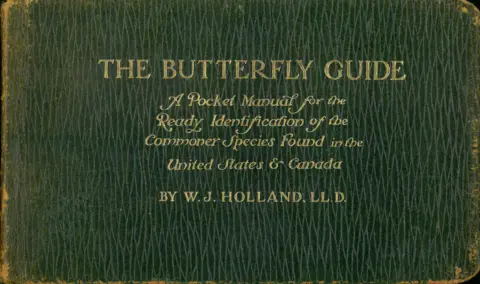
"The Butterfly Guide: A Pocket Manual for the Ready Identification of the Commoner Species Found in the United States and Canada" by W. J. Holland is a scientific publication written in the early 20th century. This comprehensive manual aims to assist readers in the identification of various butterfly species across North America, focusing primarily on those that are most commonly encountered. The work features detailed illustrations and descriptions of numerous species, making it a valuable resource for both amateur naturalists and entomologists alike. The opening of the manual outlines its purpose, detailing the drive behind creating a more accessible field guide following the success of Holland's previous works. It explains the significance of butterflies within the animal kingdom, introducing readers to the classification of these insects as part of the arthropods and their unique anatomical features. The preface also highlights the advances in printing technology that have allowed for more vivid and accurate representations of butterflies, which adorn the pages following the introductory remarks. Overall, this beginning establishes a foundation of knowledge that invites readers into the fascinating world of butterfly observation and study.
Introduction adapted from the source catalogue; source summaries may be automatically generated.
Free to read · English · 44,100 words · No account needed
MAKE TIME FOR A GOOD BOOK
On by default. Untick to stop anonymous reading totals. Each page counts after 10 seconds in view. How this works.
Anonymous counting is on unless you have switched it off.
rhodope, Argynnis, 80
Rhopalocera, Suborder, 12, 13
ridingsi, Neominois, 134
rosa, Euchloë, 177
rubricata, Neonympha, 130
rutulus, Papilio, 191
samoset, Amblyscirtes, 209
sara, Euchloë, 177
sassacus, Erynnis, 212
Satyrinæ, Subfamily, 60, 61, 124
Satyrodes, genus, 126;
canthus, 127
Satyrus, genus, 135;
alope, 137;
charon, 138;
meadi, 138;
nephele, 137;
paulus, 137;
pegala, 136;
sthenele, 139
scudderi, Lycæna, 164
semidea, Œneis, 141
silenus, Grapta, 95
simæthis, Thecla, 155
smintheus, Parnassius, 186
Smyrna, genus, 20, 118;
karwinskii, 118
sosybius, Neonympha, 129
steneles, Victorina, 124
sthenele, Satyrus, 139
Synchloë, genus, 91;
janais, 91
Tachyris, genus, 171;
ilaire, 171
tarquinius, Feniseca, 34, 160
Terias, genus, 181;
delia, 183;
elathea, 183;
jucunda, 184;
lisa, 183;
mexicana, 183;
nicippe, 182;
proterpia, 185
terissa, Kricogonia, 178
tessellata, Hesperia, 202
texana, Eresia, 90
textor, Amblyscirtes, 209
Thanaos, genus, 205;
brizo, 205;
funeralis, 207;
horatius, 207;
icelus, 205;
juvenalis, 206;
lucilius, 205;
martialis, 207;
petronius, 206
tharos, Phyciodes, 87
thaumas, Limochores, 217
Thecla, genus, 20, 22, 148;
acadica, 153;
augustus, 155;
autolycus, 151;
behri, 158;
calanus, 153;
clytie, 159;
crysalus, 150;
damon, 154;
discoidalis, 155;
dumetorum, 158;
edwardsi, 152;
favonius, 150;
grunus, 152;
halesus, 149;
henrici, 157;
irus, 156;
læta, 157;
liparops, 154;
m-album, 149;
melinus, 151;
niphon, 156;
simæthis, 155;
titus, 158;
wittfeldi, 151
theona, Lycæna, 167
thoë, Chrysophanus, 161
Thorybes, genus, 201;
bathyllus, 201;
pylades, 201
Thymelicus, genus, 213;
brettus, 213;
mystic, 214;
otho, 213
Timetes, genus, 107;
coresia, 108
titus, Thecla, 158
tityrus, Epargyreus, 200
tritonia, Gyrocheilus, 134
troilus, Papilio, 193
turnus, Papilio, 20, 188
uncas, Erynnis, 213
Vanessa, genus, 96;
antiopa, 97;
j-album, 98;
milberti, 98
vanillæ, Dione, 70
verna, Euphyes, 218
vialis, Amblyscirtes, 208
viator, Phycanassa, 219
Victorina, genus, 123;
steneles, 124
vitellius, Atrytone, 220
walshi, Papilio, 187
weidemeyeri, Basilarchia, 112
wittfeldi, Thecla, 151
wrighti, Copœodes, 211
xanthoides, Chrysophanus, 160
xanthus, Hesperia, 203
xicaque, Paramecera, 139
yuccæ, Megathymus, 223
zabulon, Atrytone, 221
zelicaon, Papilio, 196
zolicaon, Papilio, 197
By Dr. W. J. HOLLAND
This book on American butterflies, by Dr. W. J. Holland, has introduced thousands of readers to the delightful study of butterflies and their development. Its 48 color plates are the best which have been produced by the three-color process. In these and the text cuts are shown more than five hundred different species. Dr. Holland’s collection of these insects is the best in the United States, barring none, and he has throughout used his own specimens in preparing the plates. Chapters showing how to collect and preserve butterflies add greatly to the value of the book. It contains 382 text pages, 10 pages of index.
Attractively bound in green cloth, decorated in gold. Size of
volume 7 × 10.
=Price, $3.00 net; $3.30 postpaid=
By Dr. W. J. HOLLAND
This book serves as an introduction to the study of moths, but the student who has fully mastered the contents is as far advanced in his studies as are many men who were a few years ago regarded as eminent specialists. It is the standard reference book of North America on the subject.
Dr. Holland, Director of the Carnegie Museum, Pittsburgh, is one of the leading entomologists of the country and has had more experience in mounting and artistically posing moths and butterflies than any other living man.
There are 1,500 figures in the color plates and 300 text cuts illustrating 1,800 species of the moths of North America. This volume is the most complete on the subject which has thus far appeared, and contains 479 pages. Size 7 × 10.
=Price, $4.00 net; $4.40 postpaid=
Your reading position is saved on this browser. Take it to another device with a library code. Reading pages adapt to text, rather than matching a printed edition.
W. J. (William Jacob) Holland
W. J. (William Jacob) Holland
William T. (William Temple) Hornaday & W. J. (William Jacob) Holland
BEHIND THE BOOK
This eBook is for the use of anyone anywhere in the United States and most other parts of the world at no cost and with almost no restrictions whatsoever. You may copy it, give it away or re-use it under the terms of the Project Gutenberg License included with this eBook or online at www.gutenberg.org. If you are not located in the United States, you will have to check the laws of the country where you are located before using this eBook. Read the source licence.
The original source file, including credits and licence, is retained by this library. Request an original-format copy at no charge. Please include the book title and Project Gutenberg identifier #73524.
KEEP YOUR CURIOSITY GOING

Charles G. (Charles Griffith) Ross
Hannah Webster Foster

Emily Lawless
Edwin Hamlin Carr

Charles De Lano Hine
Andrew Ure