
The Mentor: Butterflies, Vol. 3, Num. 12, Serial No. 88, August 2, 1915
W. J. (William Jacob) Holland
THE CLASSIC COLLECTION · 1915
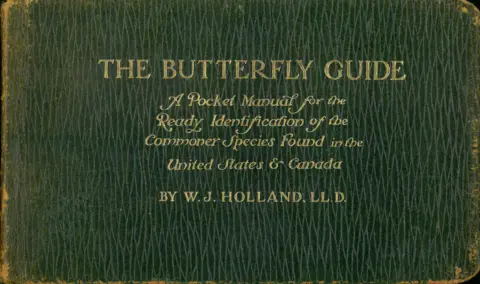
"The Butterfly Guide: A Pocket Manual for the Ready Identification of the Commoner Species Found in the United States and Canada" by W. J. Holland is a scientific publication written in the early 20th century. This comprehensive manual aims to assist readers in the identification of various butterfly species across North America, focusing primarily on those that are most commonly encountered. The work features detailed illustrations and descriptions of numerous species, making it a valuable resource for both amateur naturalists and entomologists alike. The opening of the manual outlines its purpose, detailing the drive behind creating a more accessible field guide following the success of Holland's previous works. It explains the significance of butterflies within the animal kingdom, introducing readers to the classification of these insects as part of the arthropods and their unique anatomical features. The preface also highlights the advances in printing technology that have allowed for more vivid and accurate representations of butterflies, which adorn the pages following the introductory remarks. Overall, this beginning establishes a foundation of knowledge that invites readers into the fascinating world of butterfly observation and study.
Introduction adapted from the source catalogue; source summaries may be automatically generated.
Free to read · English · 44,100 words · No account needed
MAKE TIME FOR A GOOD BOOK
On by default. Untick to stop anonymous reading totals. Each page counts after 10 seconds in view. How this works.
Anonymous counting is on unless you have switched it off.
On the wing looks like a small specimen of Prenes ocola, from which it may be distinguished at once by the white under side of the abdomen. Expanse 1.10-1.20 inch.
Not uncommon in Florida.
(1) Limochores thaumas (Fabricius), Plate CXLV, Fig. 1, ♂; Fig. 2, ♀ (The Fawn-edged Skipper).
Easily distinguished by means of our figures. Below in both sexes wings dull olive, with spots of upper side repeated; costa of male edged with red on this side as well as above. Expanse 1.00-2.07 inches.
Ranges from Canada to the Gulf, west to the Rocky Mountains.
(2) Limochores pontiac (Edwards), Plate CXLV, Fig. 3, ♂; Fig. 4, ♀
(Pontiac’s Skipper).
Well represented in our figures of both sexes. Expanse 1.15-1.25 inch.
Ranges from Massachusetts to Nebraska, being very common about the southern end of Lake Michigan.
(3) Limochores palatka (Edwards), Plate CXLV, Fig. 5, ♂ (The Palatka
Skipper). (See p. 217.)
A large and rather showy species, the female expanding as much as two inches. Expanse, ♂, 1.50 inch; ♀, 1.90-2.00 inches.
Found on Indian River, Florida.
(1) Euphyes verna (Edwards), Plate CXLVI, Fig. 1, ♂; Fig. 2, ♀ (The
Vernal Skipper).
Below wings paler, inclining to purplish red, about middle of hind wings a semicircle of pale spots. Expanse 1.15-1.35 inch.
Ranges from southern New England to Virginia, west to Kansas, and north to Alberta. Very common in Ohio, Indiana, and Illinois.
(2) Euphyes metacomet (Harris), Plate CXLVI, Fig. 3, ♂; Fig. 4, ♀
(The Dun Skipper).
The markings of upper side reappear on lower side, the ground-color
below ranging from pale brown to purplish brown. Expanse 1.15-1.30
inch.
Found from Quebec to the Carolinas, west to Texas and Alberta and
Assiniboia.
(1) Poanes massasoit (Scudder), Plate CXLVI, Fig. 5, ♂; Fig. 6, ♀
(The Mulberry-wing).
Below hind wings bright yellow, bordered on costa and outer margin with reddish brown; the wings of the female not so brightly colored as those of the male. Expanse 1.15-1.20 inch.
Ranging from New England to Nebraska, but not extending south of Pennsylvania in the east, though occurring in the west in Colorado and northern Texas.
(1) Phycanassa viator (Edwards), Plate CXLVII Fig. 1, ♂; Fig. 2, ♀ (The Broad-winged Skipper).
Below paler than above, the light spots of the upper side reappearing less distinctly; the hind wing traversed from base to middle of outer margin by a light-colored longitudinal ray which is not as plain in the female as in the male. Expanse 1.45-1.60 inch.
Rare in the Northern States from New Jersey to Wisconsin, but quite abundant in the Southern States as far west as Texas.
(2) Phycanassa aaroni Skinner, Plate CXLVII, Fig. 3, ♂ (Aaron’s
Skipper). (See p. 219.)
Your reading position is saved on this browser. Take it to another device with a library code. Reading pages adapt to text, rather than matching a printed edition.
W. J. (William Jacob) Holland
W. J. (William Jacob) Holland
William T. (William Temple) Hornaday & W. J. (William Jacob) Holland
BEHIND THE BOOK
This eBook is for the use of anyone anywhere in the United States and most other parts of the world at no cost and with almost no restrictions whatsoever. You may copy it, give it away or re-use it under the terms of the Project Gutenberg License included with this eBook or online at www.gutenberg.org. If you are not located in the United States, you will have to check the laws of the country where you are located before using this eBook. Read the source licence.
The original source file, including credits and licence, is retained by this library. Request an original-format copy at no charge. Please include the book title and Project Gutenberg identifier #73524.
KEEP YOUR CURIOSITY GOING

Charles G. (Charles Griffith) Ross
Hannah Webster Foster

Emily Lawless
Edwin Hamlin Carr

Charles De Lano Hine
Andrew Ure