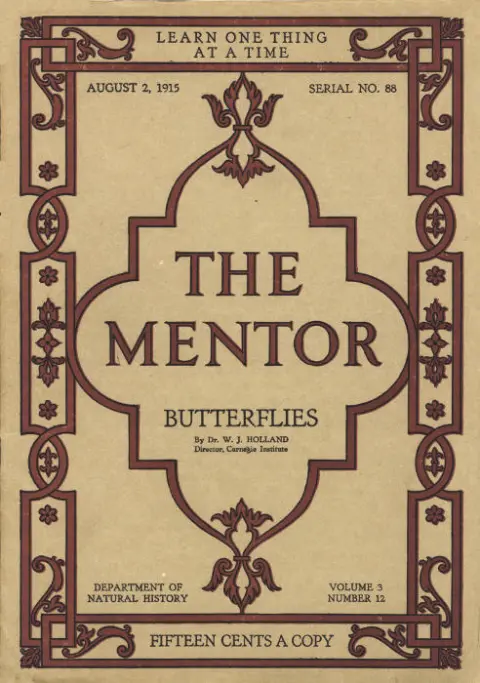
The Mentor: Butterflies, Vol. 3, Num. 12, Serial No. 88, August 2, 1915
W. J. (William Jacob) Holland
THE CLASSIC COLLECTION · 1915
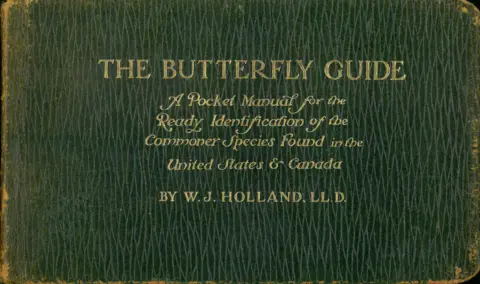
"The Butterfly Guide: A Pocket Manual for the Ready Identification of the Commoner Species Found in the United States and Canada" by W. J. Holland is a scientific publication written in the early 20th century. This comprehensive manual aims to assist readers in the identification of various butterfly species across North America, focusing primarily on those that are most commonly encountered. The work features detailed illustrations and descriptions of numerous species, making it a valuable resource for both amateur naturalists and entomologists alike. The opening of the manual outlines its purpose, detailing the drive behind creating a more accessible field guide following the success of Holland's previous works. It explains the significance of butterflies within the animal kingdom, introducing readers to the classification of these insects as part of the arthropods and their unique anatomical features. The preface also highlights the advances in printing technology that have allowed for more vivid and accurate representations of butterflies, which adorn the pages following the introductory remarks. Overall, this beginning establishes a foundation of knowledge that invites readers into the fascinating world of butterfly observation and study.
Introduction adapted from the source catalogue; source summaries may be automatically generated.
Free to read · English · 44,100 words · No account needed
MAKE TIME FOR A GOOD BOOK
On by default. Untick to stop anonymous reading totals. Each page counts after 10 seconds in view. How this works.
Anonymous counting is on unless you have switched it off.
(1) Ancyloxypha numitor Fabricius, Plate CXXXIX, Fig. 2, ♂ (The Least
Skipper).
Below fore wings black, bordered on costa and outer margin with reddish fulvous; hind wings pale fulvous. Expanse 0.75-0.95 inch.
Ranges from Quebec to Florida and westward to the Rocky Mountains.
(1) Copœodes procris (Edwards), Plate CXXXIX, Fig. 4, ♂ (The Golden
Skipper).
Below wings as on upper side, a trifle paler than on the upper side.
The fore wings blackish on inner margin near base. Expanse 0.80-1.00
inch.
Ranges from southern Texas to southern California.
(2) Copœodes wrighti (Edwards), Plate CXXXIX, Fig. 5, ♂ (Wright’s
Skipper).
Distinguished from C. procris by dark fringes on both wings and different arrangement of stigma on fore wings. Expanse 0.85-1.07 inch.
Found in southern California and eastward as far as eastern Arizona.
(1) Erynnis manitoba (Scudder), Plate CXL, Fig. 1, ♂ (The Canadian
Skipper).
On the lower side all the light spots of the upper side reappear, but more distinctly defined and pearly white in color.
Ranges north of the boundary between the United States and the Dominion of Canada, descending into the United States as far south as Colorado and northern California upon the high mountain ranges.
(2) Erynnis sassacus (Harris), Plate CXL, Fig. 2, ♂ (The Indian
Skipper). (See p. 211.)
Below wings pale fulvous, spots of upper side feebly reproduced as faint lighter spots; fore wings black at base on this side. Expanse 1.10-1.35 inch.
Ranges from New England to Georgia, west to Colorado.
(3) Erynnis attalus (Edwards), Plate CXL, Fig. 3, ♂ (The Wisconsin
Skipper). (See p. 211.)
Below both wings are dusky, with the light spots appearing in faint gray. The female is darker. Expanse 1.25-1.45 inch.
Ranges from New England to Wisconsin and Iowa, thence to the region of
the Gulf.
(4) Erynnis metea (Scudder), Plate CXL, Fig. 4, ♂ (The Cobweb
Skipper). (See p. 211.)
Below wings are brown, much darker than above, the pale marks of upper side repeated as pearly white spots, and on hind wings near base is a curved band of similar white spots. Expanse 1.20-1.30 inch.
Ranges from New England to Wisconsin.
(5) Erynnis uncas (Edwards), Plate CXLVIII, Fig. 4, ♂ (Uncas’
Skipper). (See p. 220.)
Below in both sexes wings beautifully marked with pearly white spots on greenish gray ground, the spots defined inwardly and outwardly by dark olive shades. Expanse 1.30-1.55 inch.
Ranges from Pennsylvania to Montana.
(6) Erynnis leonardus (Harris), Plate CXLI, Fig. 1, ♂; Fig. 2, ♀
(Leonard’s Skipper).
Larger than most of the preceding species. Below wings dark brick-red. Spots of upper side reappearing more or less faintly. Expanse 1.25-1.35 inch.
Ranges from New England and Ontario to Florida, west throughout the
Mississippi Valley.
(1) Thymelicus brettus (Boisduval & Leconte), Plate CXLI, Fig. 3, ♂; Fig. 4, ♀ (The Whirlabout).
Your reading position is saved on this browser. Take it to another device with a library code. Reading pages adapt to text, rather than matching a printed edition.
W. J. (William Jacob) Holland
W. J. (William Jacob) Holland
William T. (William Temple) Hornaday & W. J. (William Jacob) Holland
BEHIND THE BOOK
This eBook is for the use of anyone anywhere in the United States and most other parts of the world at no cost and with almost no restrictions whatsoever. You may copy it, give it away or re-use it under the terms of the Project Gutenberg License included with this eBook or online at www.gutenberg.org. If you are not located in the United States, you will have to check the laws of the country where you are located before using this eBook. Read the source licence.
The original source file, including credits and licence, is retained by this library. Request an original-format copy at no charge. Please include the book title and Project Gutenberg identifier #73524.
KEEP YOUR CURIOSITY GOING

Charles G. (Charles Griffith) Ross
Hannah Webster Foster

Emily Lawless
Edwin Hamlin Carr

Charles De Lano Hine
Andrew Ure