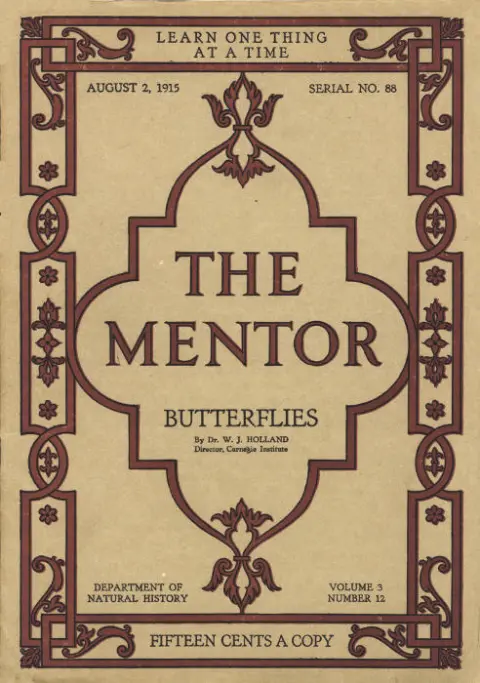
The Mentor: Butterflies, Vol. 3, Num. 12, Serial No. 88, August 2, 1915
W. J. (William Jacob) Holland
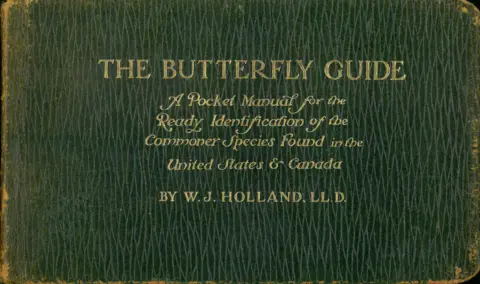
THE CLASSIC COLLECTION · 1915
"The Butterfly Guide: A Pocket Manual for the Ready Identification of the Commoner Species Found in the United States and Canada" by W. J. Holland is a scientific publication written in the early 20th century. This comprehensive manual aims to assist readers in the identification of various butterfly species across North America, focusing primarily on those that are most commonly encountered. The work features detailed illustrations and descriptions of numerous species, making it a valuable resource for both amateur naturalists and entomologists alike. The opening of the manual outlines its purpose, detailing the drive behind creating a more accessible field guide following the success of Holland's previous works. It explains the significance of butterflies within the animal kingdom, introducing readers to the classification of these insects as part of the arthropods and their unique anatomical features. The preface also highlights the advances in printing technology that have allowed for more vivid and accurate representations of butterflies, which adorn the pages following the introductory remarks. Overall, this beginning establishes a foundation of knowledge that invites readers into the fascinating world of butterfly observation and study.
Introduction adapted from the source catalogue; source summaries may be automatically generated.
Free to read · English · 44,100 words · No account needed
MAKE TIME FOR A GOOD BOOK
On by default. Untick to stop anonymous reading totals. Each page counts after 10 seconds in view. How this works.
Anonymous counting is on unless you have switched it off.
Small yellow butterflies margined with black. Fore wings somewhat narrow and produced; antennæ quite short; upper radial vein in fore wing wanting. There are three species found in the subtropical regions of the New World, one of which invades our territory.
(1) Nathalis iole, Boisduval Plate C, Fig. 1, ♂; Fig. 2, ♀ (The Dwarf
Yellow).
This little species, of which we give excellent figures, cannot be mistaken. Expanse 1.00-1.25 inch.
It ranges from southern Indiana and Illinois to Arizona, southern California, and northern Mexico. The larva feeds on Erodium cicutarium or pin-clover, and other Geraniaceæ.
Small butterflies, white in color, with the apex of the fore wings dark brown, marked with spots and bands of orange-yellow or crimson; on the under side the hind wings are generally more or less mottled with green spots and striæ. Eggs spindle-shaped; caterpillar relatively long, with small head; chrysalis with the head greatly produced, wing-cases compressed forming a keel-shaped projection.
(1) Euchloë ausonides (Lucas), Plate C, Fig. 3, ♂, under side (The
Western Orange-tip).
On upper side wings at apex tipped with dark fuscous, and lack altogether the orange or red which is characteristic of most of the other species of the genus. On under side fore wings have a very pale greenish tint; hind wings marked with three irregular green bands, more or less broken up, forking in various directions. Expanse 1.65-1.90 inch.
Ranging from Arizona to Alaska and eastward to Colorado.
(2) Euchloë genutia (Fabricius). Plate C, Fig. 4, ♂ (The Falcate
Orange-tip).
Readily recognized by the hooked tip of the fore wings. The female has no orange marking on the tip. Single-brooded in the Northern States, but double-brooded in the Carolinas. Expanse 1.30-1.50 inch. The caterpillar feeds on Sisybrium, Arabis, Cardamine, and other cruciferous plants.
Ranges from New England to Texas.
(3) Euchloë sara (Lucas) Plate CI, Fig. 1, ♂ (Lucas’ Orange-tip).
There are numerous varieties of this beautiful insect. On the under side the hind wings are marked with irregular patches of greenish scales having a “mossy” appearance. Expanse 1.75 inch. Occurs in Pacific States.
(4) Euchloë rosa (Edwards), Plate CI, Fig. 2, ♂, under side (The
Rosy Marble-wing).
Above pure white without any red at the tip of the primaries; a transapical black band, broken in the middle, and a small black bar closes the cell. Under side well shown in our figure except that there fails to appear a faint rosy tint in the hind wings which is characteristic of all specimens which we have examined. Expanse 1.35-1.40 inch. Found in Texas.
(5) Euchloë hyantis (Edwards), Plate CI, Fig. 3, ♀, under side
(Edwards’ Marble-wing).
Your reading position is saved on this browser. Take it to another device with a library code. Reading pages adapt to text, rather than matching a printed edition.
W. J. (William Jacob) Holland
W. J. (William Jacob) Holland
William T. (William Temple) Hornaday & W. J. (William Jacob) Holland
BEHIND THE BOOK
This eBook is for the use of anyone anywhere in the United States and most other parts of the world at no cost and with almost no restrictions whatsoever. You may copy it, give it away or re-use it under the terms of the Project Gutenberg License included with this eBook or online at www.gutenberg.org. If you are not located in the United States, you will have to check the laws of the country where you are located before using this eBook. Read the source licence.
The original source file, including credits and licence, is retained by this library. Request an original-format copy at no charge. Please include the book title and Project Gutenberg identifier #73524.
KEEP YOUR CURIOSITY GOING

Charles G. (Charles Griffith) Ross
Hannah Webster Foster

Emily Lawless
Edwin Hamlin Carr

Charles De Lano Hine
Andrew Ure