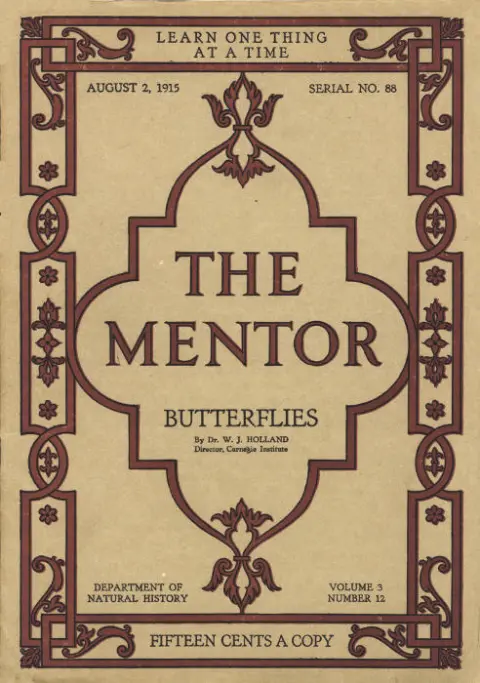
The Mentor: Butterflies, Vol. 3, Num. 12, Serial No. 88, August 2, 1915
W. J. (William Jacob) Holland

THE CLASSIC COLLECTION · 1915
"The Butterfly Guide: A Pocket Manual for the Ready Identification of the Commoner Species Found in the United States and Canada" by W. J. Holland is a scientific publication written in the early 20th century. This comprehensive manual aims to assist readers in the identification of various butterfly species across North America, focusing primarily on those that are most commonly encountered. The work features detailed illustrations and descriptions of numerous species, making it a valuable resource for both amateur naturalists and entomologists alike. The opening of the manual outlines its purpose, detailing the drive behind creating a more accessible field guide following the success of Holland's previous works. It explains the significance of butterflies within the animal kingdom, introducing readers to the classification of these insects as part of the arthropods and their unique anatomical features. The preface also highlights the advances in printing technology that have allowed for more vivid and accurate representations of butterflies, which adorn the pages following the introductory remarks. Overall, this beginning establishes a foundation of knowledge that invites readers into the fascinating world of butterfly observation and study.
Introduction adapted from the source catalogue; source summaries may be automatically generated.
Free to read · English · 44,100 words · No account needed
MAKE TIME FOR A GOOD BOOK
On by default. Untick to stop anonymous reading totals. Each page counts after 10 seconds in view. How this works.
Anonymous counting is on unless you have switched it off.
Mostly small butterflies. On the upper side very often colored with iridescent blue, green, or purple, sometimes reddish or dark brown; on the under side marked with lines and spots variously arranged and often very strikingly colored. What has been said as to the eggs, larvæ, and chrysalids of the family apply as well to this as to many of the following genera, and need not be here repeated.
While students of this group have subdivided extensively, and with scientific propriety have erected a number of genera which are acceptable to specialists, there seems to the writer no need for going into these things in this book, as most of the distinctions drawn are too fine to be appreciated by any but specialists.
(1) Thecla halesus (Cramer), Plate LXXIX, ♂ (The Great Purple
Hair-streak).
The upper side is deep purplish blue, as shown in our figure; on the lower side the thorax is black spotted with white, the abdomen orange-red; the wings warm sepia spotted with crimson at their bases, in the males glossed with a stripe of metallic green on the fore wings, and in both sexes adorned at the anal angle by spots of metallic green, red, and iridescent blue. Expanse 1.35-1.50 inch.
Common in Central America and Mexico, ranging north through the hotter parts of the Gulf States, and has been recorded from southern Illinois. Occurs in southern California and Arizona. The larva feeds on mistletoe.
(2) Thecla m-album Boisduval & Leconte, Plate LXXX, Fig. 1, ♂ (The
White-M Hair-streak).
Smaller than the preceding species, bluer, and not inclined to greenish at base of wings on upper side; on under side fore wing crossed by a submarginal and a median line of white, continued on the hind wings, zigzagged at anal angle so as to look like an inverted M; near this is a rounded crimson patch; anal angle black glossed with blue. Expanse 1.35-1.45 inch.
Ranges from New Jersey and Wisconsin to Venezuela.
(3) Thecla crysalus Edwards, Plate LXXX, Fig. 2, ♂ (The Colorado
Hair-streak).
Upper side as in our figure, under side marked with white lines edged with brown. Orange spots of upper side reappear below, but at anal angle are transformed into red eye-spots pupilled with black and margined with metallic green. Expanse 1.50 inch.
Ranges from Colorado to eastern Arizona.
(4) Thecla favonius Smith & Abbot, Plate LXXXI, Fig. 1, ♂ (The
Southern Hair-streak).
On the under side the wings are marked much as in T. m-album, but in the region of the median nervules is a rather broad transverse carmine streak inwardly edged with dark lines. Expanse 1.00-1.15 inch.
Found in the Gulf States and as far north as South Carolina.
(5) Thecla wittfeldi Edwards, Plate LXXXI, Fig. 2, ♀, Type
(Wittfeld’s Hair-streak).
Your reading position is saved on this browser. Take it to another device with a library code. Reading pages adapt to text, rather than matching a printed edition.
W. J. (William Jacob) Holland
W. J. (William Jacob) Holland
William T. (William Temple) Hornaday & W. J. (William Jacob) Holland
BEHIND THE BOOK
This eBook is for the use of anyone anywhere in the United States and most other parts of the world at no cost and with almost no restrictions whatsoever. You may copy it, give it away or re-use it under the terms of the Project Gutenberg License included with this eBook or online at www.gutenberg.org. If you are not located in the United States, you will have to check the laws of the country where you are located before using this eBook. Read the source licence.
The original source file, including credits and licence, is retained by this library. Request an original-format copy at no charge. Please include the book title and Project Gutenberg identifier #73524.
KEEP YOUR CURIOSITY GOING

Charles G. (Charles Griffith) Ross
Hannah Webster Foster

Emily Lawless
Edwin Hamlin Carr

Charles De Lano Hine
Andrew Ure