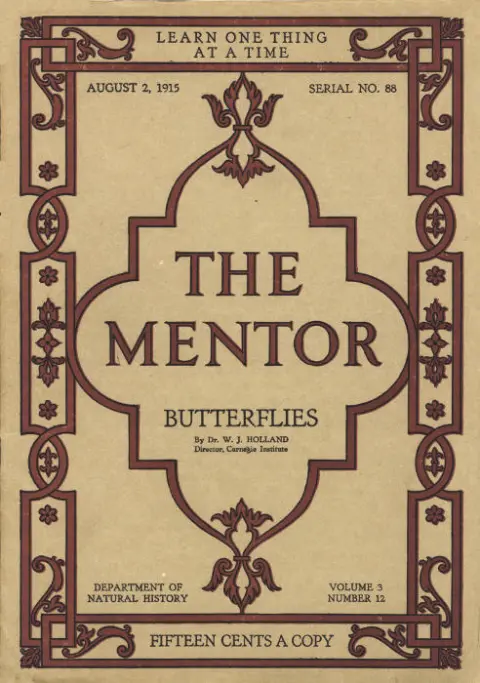
The Mentor: Butterflies, Vol. 3, Num. 12, Serial No. 88, August 2, 1915
W. J. (William Jacob) Holland
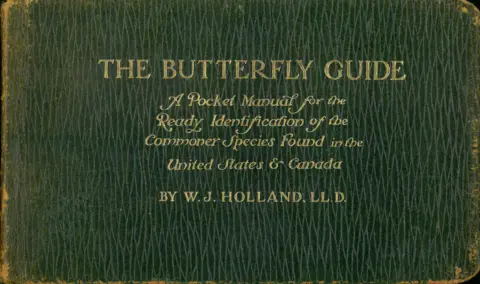
THE CLASSIC COLLECTION · 1915
"The Butterfly Guide: A Pocket Manual for the Ready Identification of the Commoner Species Found in the United States and Canada" by W. J. Holland is a scientific publication written in the early 20th century. This comprehensive manual aims to assist readers in the identification of various butterfly species across North America, focusing primarily on those that are most commonly encountered. The work features detailed illustrations and descriptions of numerous species, making it a valuable resource for both amateur naturalists and entomologists alike. The opening of the manual outlines its purpose, detailing the drive behind creating a more accessible field guide following the success of Holland's previous works. It explains the significance of butterflies within the animal kingdom, introducing readers to the classification of these insects as part of the arthropods and their unique anatomical features. The preface also highlights the advances in printing technology that have allowed for more vivid and accurate representations of butterflies, which adorn the pages following the introductory remarks. Overall, this beginning establishes a foundation of knowledge that invites readers into the fascinating world of butterfly observation and study.
Introduction adapted from the source catalogue; source summaries may be automatically generated.
Free to read · English · 44,100 words · No account needed
MAKE TIME FOR A GOOD BOOK
On by default. Untick to stop anonymous reading totals. Each page counts after 10 seconds in view. How this works.
Anonymous counting is on unless you have switched it off.
The time spent by the insect in the egg is generally short. The time passed in the larval state may be short or long. When butterflies hibernate, or pass the winter, as caterpillars, the time spent in this state is long, and especially in the case of those species which inhabit arctic regions. There are some butterflies which occur north of the Arctic Circle, and we have ascertained that these, because the summers are so short in the far north, pass two summers and the intervening winter in the larval condition, and another winter in the pupal stage, before they emerge and take wing. On the other hand, under more temperate conditions butterflies of certain species may produce two or even three broods in a summer, and in subtropical or tropical lands there may be even more broods produced.
While it is true that almost all the larvæ of lepidoptera subsist upon vegetable food, there are nevertheless exceptions, one of which is that of the Harvester, Feniseca tarquinius (see Plate LXXXVIII, Fig. 1), the slug-like larva of which feeds upon scale-insects, or mealy bugs, sharing the habit with certain allied species which occur in Africa and Asia, as the writer has had occasion to point out a number of years ago in certain of his writings.
The third stage in the life of lepidoptera is known as the pupal stage. The caterpillar, having undergone successive moults and reached maturity, is transformed into a pupa, or chrysalis (see Plate C, Figs. d and e). From having been an active, worm-like creature, greedily feeding upon its appropriate food, it reverts to a form which is stationary, as was the egg, and ceases to have the power of locomotion. An examination of the structure of all chrysalids shows that they contain an immature butterfly. The segments of the chrysalids enclose the corresponding segments of the body of the butterfly, and in sheathing plates of chitinous matter are enfolded the wings and all the other organs which are necessary to the life of the butterfly when it shall have emerged and taken wing. The act of transformation from the caterpillar stage to the pupal stage is very wonderful. The caterpillar makes provision for the great change by weaving a little button of silk and, in the case of many of those larvæ, the chrysalids of which are not pendant, by also weaving a little girdle of silk, which it passes around its back, and which holds it in place very much as an Indian baby is held by the strap which passes over the shoulders of the squaw (see Plate C, Fig. e). Having made these preliminary arrangements the caterpillar becomes very quiet, its hind pro-legs being securely hooked and tangled into the silken button to which it is attached. After a while, when the proper moment has arrived, the skin of the caterpillar splits, just as in the moults which preceded, and by a series of wriggling or vibratory motions the chrysalis succeeds in working off the skin of the caterpillar until it has all been shed except where near the end of the abdomen the skin is caught between the edges of two of the horny rings which form the abdomen. Then the insect with the cremaster, as it is called, a little spikelet at the very tip of the chrysalis, which is armed with small hooks, proceeds to feel about until these hooks become entangled in the silk of the button which has been provided on the under surface of the twig, the stone, or the fence rail, where the transformation is occurring. As soon as the chrysalis is securely hooked into the button of silk it lets go of the little section of the skin by which it has been supported and rapidly assumes the shape in which it will remain until the time of its emergence as a butterfly. These changes are illustrated on Plate C, Figs. a-d, which are reproduced from “The Butterfly Book” after the drawings of the late Prof. C. V. Riley. The chrysalids of all the Nymphalidæ are pendant; those of the other families, except the Hesperiidæ, are provided with girdles, as is shown on Plate C, in the figures which represent the chrysalis of Papilio philenor. The chrysalids of the Hesperiidæ, like the chrysalids of moths, are either formed in loosely woven coverings of leaves tacked together with silken threads, or lie free under leaves and rubbish upon the ground, thus resembling the chrysalids of moths.
Your reading position is saved on this browser. Take it to another device with a library code. Reading pages adapt to text, rather than matching a printed edition.
W. J. (William Jacob) Holland
W. J. (William Jacob) Holland
William T. (William Temple) Hornaday & W. J. (William Jacob) Holland
BEHIND THE BOOK
This eBook is for the use of anyone anywhere in the United States and most other parts of the world at no cost and with almost no restrictions whatsoever. You may copy it, give it away or re-use it under the terms of the Project Gutenberg License included with this eBook or online at www.gutenberg.org. If you are not located in the United States, you will have to check the laws of the country where you are located before using this eBook. Read the source licence.
The original source file, including credits and licence, is retained by this library. Request an original-format copy at no charge. Please include the book title and Project Gutenberg identifier #73524.
KEEP YOUR CURIOSITY GOING

Charles G. (Charles Griffith) Ross
Hannah Webster Foster

Emily Lawless
Edwin Hamlin Carr

Charles De Lano Hine
Andrew Ure