THE CLASSIC COLLECTION✦My diaries, being a personal narrative of events 1888-1914, Part 2 (1900-1914)CLASSIC FREE BOOKS
My diaries, being a personal narrative of events 1888-1914, Part 2 (1900-1914)
Wilfrid Scawen Blunt
THE CLASSIC COLLECTION · 1916
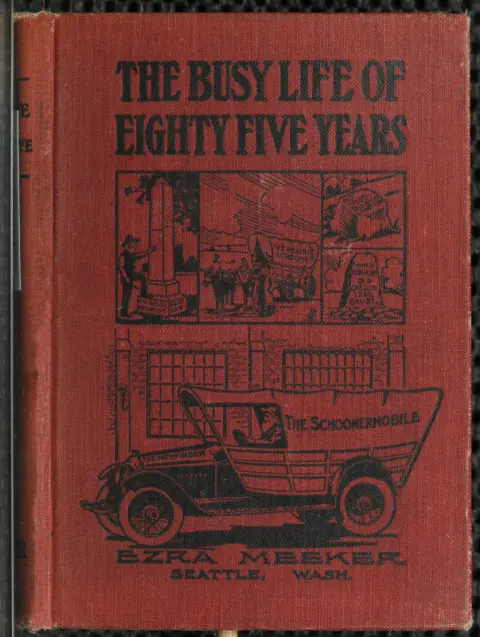
"The Busy Life of Eighty-Five Years of Ezra Meeker" by Ezra Meeker is an autobiographical account written in the early 20th century. It explores the life experiences of the author, who was a pioneer in the Old Oregon Country, detailing his adventures moving across the plains with an ox team and the various challenges faced throughout his life. The book paints a vivid picture of pioneering life during the 19th century, offering readers insights into both personal and collective experiences of those who ventured westward. At the start of the narrative, Ezra Meeker recounts his early life in Ohio, the background of his family, and the simplicity and hardships of his upbringing. He shares anecdotes about his childhood, his disdain for school, and the industrious spirit instilled in him by his hardworking parents. The opening sets the stage for a life dedicated to pioneering efforts that would eventually lead him on a monumental journey across the American frontier. Through his reflections, Meeker introduces readers to the values of hard work, family ties, and the pioneering spirit that defined a generation.
Introduction adapted from the source catalogue; source summaries may be automatically generated.
Free to read · English · 136,879 words · No account needed
MAKE TIME FOR A GOOD BOOK
On by default. Untick to stop anonymous reading totals. Each page counts after 10 seconds in view. How this works.
Anonymous counting is on unless you have switched it off.
We now pass over another ten years' period to the building of the Northern Pacific Railroad up the valley to the coal veins in the mountains, ending at the time at the point named Wilkeson. Twenty years before close observers noted the fact that float coal could be found on the bars of the Puyallup River. These small pieces, not bigger than a pea, became a matter of dispute as to whether the substance was coal or not. Finally, early in the seventies, a "chunk" as big as a man's fist was found imbedded in the gravel between the roots of a balm tree that had lodged, part of it burned, and all doubts removed as to the existence of coal on the headwaters of the river. John Gale prosecuted a diligent search and was rewarded by finding the vein to which the railroad was built.
The building of the railroad opened up the valley and give encouragement to those who had bided their time so long. The time had arrived when there came to be a money value to land. So long as the country was not subdivided, settlers could not obtain title to their land and transfers would become confusing as each had surveyed his own claim under the donation act. This act gave the head of a family 160 acres, and the same to the wife in her own right. Such delays on the part of the Government that followed seemed now almost incredible. I did not receive the patent for my donation claim for thirteen years after my settlement was made, and others had a similar experience and even a longer period. But with the coming of the surveys and the advent of the hops, values rose and became established at a rate that pioneers had never dreamed of and yet had advanced from year to year, or rather for the whole period, to a point that would then have seemed unthinkable. The first subdivision surveys by the Government were made in Puyallup during the year 1864. J. P. Stewart and George W. Sloan took the contract. Neither was well suited for the work, Stewart being too nervous and Sloan scarcely responsible for his acts. Up to the time of the survey all claims outside of the first taken under the donation act were mere squatters' claims upon the public land, but no recognition of any right could be had at the land office, then, as now, at Olympia. No serious trouble followed in adjusting the lines followed, as the donation claim lines were respected and had in fact for many years served as a guide to later claimants. As soon as the surveys were made, all parties made for the land office, the donation claimants to "prove up" the pre-emptions, and homesteaders to make application for their respective rights. I did not go with the rush for the reason that I wanted to take my claim under the homestead law, which required an outlay of sixteen dollars, and "for the life of me" I couldn't raise that much money. The fact was that, almost literally speaking, there was no money in the valley. Finally, becoming uneasy lest some one might "slip in" and pre-empt from under me, I walked to Olympia and pre-empted where the fee was but a dollar, and held under the entry for several months until money could be obtained, when a homestead was located upon the same land, thus expending both rights for the lack of $16.00. This to many would seem ludicrous, but the actors looked upon the serious side, and did not wish to take any chances of losing their homes. A few years later I sold one crop of hops for $75,000, which now looks as incredible as the other fact of inability to raise even so small an amount as $16.00. In the chapter on hops the reader will be told the whole story of the $75,000 hop crop. The reader may well wonder why I walked from Puyallup to Olympia, a distance of thirty-five miles, and back out of sympathy for conditions that would seem to call for such a "sacrifice" of personal comfort. To such, let me disabuse their minds, for it was indeed a pleasant day, if not of recreation—a day of self-communion with pleasant thoughts of the past and bright anticipations as to the future. Fatigued? Yes, but just enough to enjoy rest. Can we enjoy rest without first experiencing fatigue and withal with good appetite for a frugal meal? I did not think of it then as anything out of the ordinary, and for that matter do not now, as it was only one of the strenuous day's experiences of the time, besides to me long walks are conducive to good health—not so long a walk as that to Olympia, but the one or two hours' brisk walk in communion with nature and oneself.
Your reading position is saved on this browser. Take it to another device with a library code. Reading pages adapt to text, rather than matching a printed edition.
BEHIND THE BOOK
This eBook is for the use of anyone anywhere in the United States and most other parts of the world at no cost and with almost no restrictions whatsoever. You may copy it, give it away or re-use it under the terms of the Project Gutenberg License included with this eBook or online at www.gutenberg.org. If you are not located in the United States, you will have to check the laws of the country where you are located before using this eBook. Read the source licence.
The original source file, including credits and licence, is retained by this library. Request an original-format copy at no charge. Please include the book title and Project Gutenberg identifier #52652.
KEEP YOUR CURIOSITY GOING
Wilfrid Scawen Blunt
Wilfrid Scawen Blunt

E. W. (Edgar Watson) Howe
Cécile Tormay

Moritz Busch
John L. Ransom