THE CLASSIC COLLECTION✦An outlaw’s diary: the CommuneCLASSIC FREE BOOKS
An outlaw’s diary: the Commune
Cécile Tormay
THE CLASSIC COLLECTION · 1915
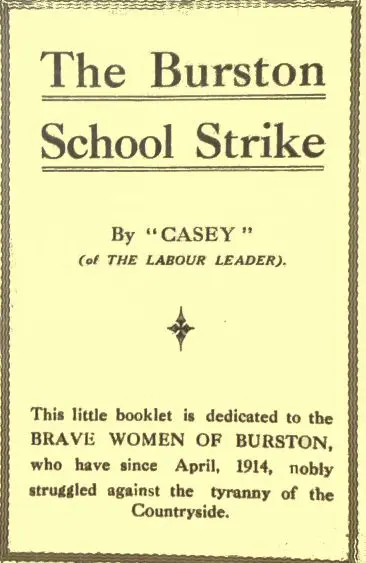
"The Burston School Strike" by Casey is a historical account written in the early 20th century. The book chronicles a significant event in the village of Burston, Norfolk, where teachers A.K. and T.G. Higdon faced unjust dismissal from their positions due to conflict with local authorities, particularly the Reverend Eland. The narrative focuses on the grassroots resistance led by the villagers, particularly the children, who refused to attend school until their beloved teachers were reinstated, highlighting themes of social justice and community solidarity. The content of the book details the Higdons' tenure at the Council School, their efforts to improve conditions for the local farming community, and the ensuing backlash from the established authorities as they challenged traditional hierarchies. When the Higdons were eventually dismissed on spurious charges, the students organized a strike in a show of loyalty, leading to wider support from the community. As the struggle continued amidst legal battles and fines, the parents rallied behind the children, holding public meetings and demonstrations for justice. The book portrays both the emotional struggles of the families and the broader implications of the teachers' fight against oppression, encapsulating a critical moment in the history of educational reform and labor rights in rural England.
Introduction adapted from the source catalogue; source summaries may be automatically generated.
Free to read · English · 7,357 words · No account needed
MAKE TIME FOR A GOOD BOOK
On by default. Untick to stop anonymous reading totals. Each page counts after 10 seconds in view. How this works.
Anonymous counting is on unless you have switched it off.
“If the history of England be ever written by one who has the knowledge and the courage, and both qualities are equally requisite for the undertaking, the world would be more astonished than when reading the Roman annals by Niebuhr.”—EARL OF BEACONSFIELD.
Burston village lies eighteen miles south of Norwich.
Four and a half years ago came to this village as schoolmistress and assistant-master, Mrs. A. K. Higdon, and her husband, T. G. Higdon. They were welcomed to the Council School by friends, parishioners, etc. They gained the affection of the scholars, the approval of the parents, and the blessing of His Majesty’s Inspector. Here it is:
The Government Report, October 11th, 1912.
The present mistress has had charge of the school a little over a year and a half, and its condition is very promising.
A good tone prevails; the scholars take a pride in their work, and the work done in some of the subjects of instruction is very creditable.
Mental arithmetic is well above the average, and the written arithmetic of the first class is generally praiseworthy. The singing and much of the drawing are good, and needlework is taught on sensible lines.
On the whole the infants and first-class children are making more progress than the scholars in the middle portion of the school.
(Signed) A. H. MOORE, H.M.I.
This is the last Government report under the Higdons’ régime.
Mr. T. G. Higdon, the assistant-master, possesses that dreadful modern
incumbrance, a heart.
The Daily Press oft contains an advertisement stating that “Hands are wanted,” but if they were to issue an advertisement re “Hearts,” the precedent might prove disastrous to most firms.
Higdon, looking upon the countryside with the eye of a person married to it, held high hopes of betterment. He could not help observing the long hours of toil, the scant incomes, the over-crowding, etc., which that noble soul, the Reverend Charles Kingsley, pictures in “Yeast.”
Higdon, after his day’s teaching, tramped the country lanes, and made first-hand acquaintance with the joys and sorrows, aspirations and hopes of Hodge and his helpmate. He spoke words of healing and helpfulness to the Lazarus of civilisation, Carlyle’s Dumdrudge, and our poor country cousins. He saw lean labour, wrinkled, seamed and scarred by grinding toil, privation, self-denial, and short commons; so, John Ball-like, he carried the message both on Sundays and weekdays.
Unfortunately, he did not attend the local Sunday services.
Your reading position is saved on this browser. Take it to another device with a library code. Reading pages adapt to text, rather than matching a printed edition.
BEHIND THE BOOK
This eBook is for the use of anyone anywhere in the United States and most other parts of the world at no cost and with almost no restrictions whatsoever. You may copy it, give it away or re-use it under the terms of the Project Gutenberg License included with this eBook or online at www.gutenberg.org. If you are not located in the United States, you will have to check the laws of the country where you are located before using this eBook. Read the source licence.
The original source file, including credits and licence, is retained by this library. Request an original-format copy at no charge. Please include the book title and Project Gutenberg identifier #61938.
KEEP YOUR CURIOSITY GOING
Cécile Tormay

Moritz Busch
John L. Ransom
Frances Wright
Cécile Tormay

Mabel Potter Daggett