THE CLASSIC COLLECTION✦The ocean wireless boys of the iceberg patrolCLASSIC FREE BOOKS
The ocean wireless boys of the iceberg patrol
John Henry Goldfrap
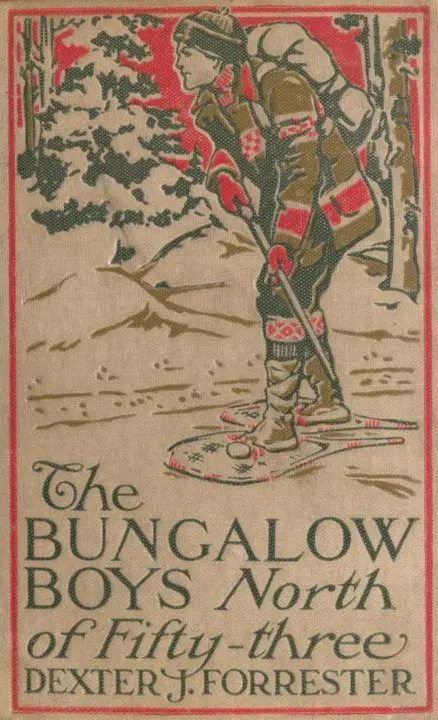
THE CLASSIC COLLECTION · 1914
"The Bungalow Boys North of Fifty-Three" by Dexter J. Forrester is an adventure novel written in the early 20th century. The story centers on the Bungalow Boys—Tom, Jack, and Sandy MacTavish—as they find themselves in the Alaskan wilderness, facing the challenges of winter and the pursuit of a fox thief. Their lively camaraderie and resilience hint at both the fun and peril that awaits. At the start of the narrative, the boys are enjoying winter activities on the frozen Porcupine River when an accident leads Sandy to fall through the ice. The ensuing chaos highlights their close-knit friendship as they quickly rally to rescue him. As they navigate the frozen landscape, the boys reminisce about their previous adventures, setting the stage for their current quest. When they discover that a thief has stolen valuable fox pelts from their camp, they resolve to track him down with the help of Joe Picquet, an experienced trapper. This sets up an adventurous pursuit full of challenges and teamwork, indicative of the engaging escapades to unfold in the story.
Introduction adapted from the source catalogue; source summaries may be automatically generated.
Free to read · English · 48,246 words · No account needed
MAKE TIME FOR A GOOD BOOK
On by default. Untick to stop anonymous reading totals. Each page counts after 10 seconds in view. How this works.
Anonymous counting is on unless you have switched it off.
As for Joe, he appeared to be equally dumfounded, but he soon recovered
his faculties.
“And so, mon ami, we have found you at zee last, eh?”
“Real pleased you come, too! Real pleased,” was the answer the little gray man gave in a high, piping treble.
The boys took in the details of the tent. The small sheet-iron stove with its pipe going through the roof, the queer-looking snowshoes, and the pile of duffle left in a corner just as it had been thrown from the sled. Old Joe looked more taken aback than ever. He had come prepared to fight some rascal who would put up a desperate resistance. Instead, he found a little wasted man who had nothing to say but that he was glad to see them.
There was a pause while Joe reconstructed things. It was broken in upon by another piping up of the thin voice of the man on the ground.
“See that sack over thar, stranger?” said the little man, indicating a partially filled pack-bag in one corner of the tent.
“Oui! I see heem,” rejoined Joe in a dazed voice.
“Wa’al, thar’s fish in thar. I’d take it real kind in yer ef yer’d jes’ feed my dorgs, mister. They ain’t hed much ter sot their teeth in lately, me being hurried like along the trail.”
The boys exchanged glances. They had met with many strange experiences, but this appeared to be the cap-sheaf of them all. Old Joe simply shrugged his shoulders; he was bereft of speech. In the face of this astonishing end to their long, grim chase, he was, for the time being, incapable of finding words.
He crossed over to the sack and began pulling out fish, but in the midst of the operation he found his voice again.
“Say, you, what’s zee matter weez you, anyhow?”
“I’m sick,” responded the man under the shabby blanket, “right sick.”
“I see you seeck, all right,” said Joe, “but what ails you? Boosh!” he concluded, puffing out his sun-burned cheeks.
“I don’t rightly know,” rejoined the other; “it’s a sorter pain all
over.”
He moved uneasily under the shabby blanket and the boys saw his hands, which lay outside the covering, clench and unclench, as if he were suffering a sudden spasm of pain.
Outside the tent there came a sound of plaintive yapping and howling. The little man’s mamelukes had smelled the fish.
“Reckon they’re hungry, poor beasts,” said the little man.
Your reading position is saved on this browser. Take it to another device with a library code. Reading pages adapt to text, rather than matching a printed edition.
John Henry Goldfrap
John Henry Goldfrap
John Henry Goldfrap

John Henry Goldfrap
BEHIND THE BOOK
This eBook is for the use of anyone anywhere in the United States and most other parts of the world at no cost and with almost no restrictions whatsoever. You may copy it, give it away or re-use it under the terms of the Project Gutenberg License included with this eBook or online at www.gutenberg.org. If you are not located in the United States, you will have to check the laws of the country where you are located before using this eBook. Read the source licence.
The original source file, including credits and licence, is retained by this library. Request an original-format copy at no charge. Please include the book title and Project Gutenberg identifier #44317.
KEEP YOUR CURIOSITY GOING
Coulson Kernahan

Maurice Baring
Frances Wright
Cécile Tormay

Frederic Jesup Stimson

W. H. P. (William Henry Pope) Jarvis