THE CLASSIC COLLECTION✦The ocean wireless boys of the iceberg patrolCLASSIC FREE BOOKS
The ocean wireless boys of the iceberg patrol
John Henry Goldfrap
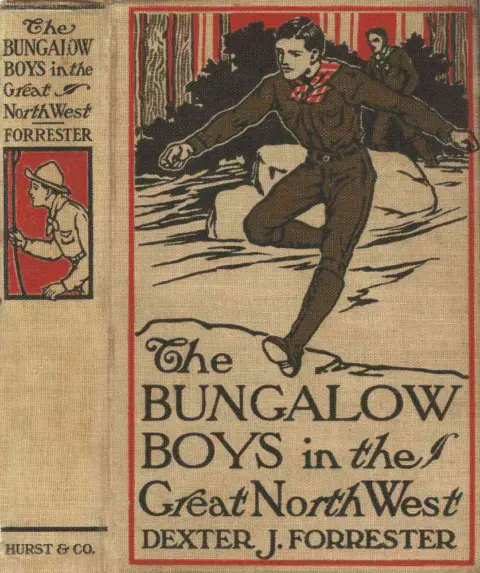
THE CLASSIC COLLECTION · 1911
"The Bungalow Boys in the Great Northwest" by John Henry Goldfrap is a novel written in the early 20th century. This adventure follows the escapades of two brothers, Tom and Jack Dacre, as they embark on a journey from their serene life in Maine to the great, untamed wilderness of Washington State. The story is filled with excitement and danger as the boys encounter new challenges, including the notorious Bully Banjo and his illegal activities. At the start of the narrative, Mr. Chisholm Dacre, the boys' uncle, receives a letter proposing a visit to Washington to explore investment opportunities in timber and fruit country. As their uncle suggests an upcoming trip, Tom and Jack express their growing feelings of restlessness from their once-exciting home. The opening chapters introduce a vibrant cast of characters, including their humorous neighbor, Mrs. Bijur, and hint at upcoming adventures involving the professor's dangerous experiments. The boys' lives soon intertwine with the criminal elements in the region, leading them to confront exciting and perilous situations that lie ahead.
Introduction adapted from the source catalogue; source summaries may be automatically generated.
Free to read · English · 54,192 words · No account needed
MAKE TIME FOR A GOOD BOOK
On by default. Untick to stop anonymous reading totals. Each page counts after 10 seconds in view. How this works.
Anonymous counting is on unless you have switched it off.
“Too old for ice cream since we defeated the wiles of Messrs. Walstein, Dampier and Co.—eh, Tom?” he exclaimed, leaning back in his big chair on the bungalow porch and laughing till the tears ran down his weather-beaten cheeks.
“It—it isn’t that, sir,” Jack had put in, “but a fellow—well, he objects to being slobbered over.”
“Better than being shot at, though, isn’t it, lads?” inquired Mr. Dacre, his gray eyes holding a merry twinkle.
“Um—well,” rejoined Tom, with a judicial air, “you know, Uncle, we’ve seen so much more exciting times in this old valley that it seems strange and unnatural to be overrun with Widow Bijur’s boarders. If it isn’t one of the little Soopendykes that’s in trouble, it’s Professor Dalhousie Dingle, with that inquiring child of his. I never saw such a child. Always asking questions. The other day the professor caught a bug and proceeded to stick a pin through it as he always does.
“‘Pa,’ asked Young Dingle, ‘does that hurt the bug?’
“‘I suppose so, my son,’ answered the professor.
“‘Then the bug doesn’t like it?’
“‘I guess not.’
“‘Will the bug die?’
“‘Undoubtedly, my boy.’
“‘Why do you kill bugs, papa?’
“‘For the purposes of science, my boy,’ answered the professor.
“‘Pa?’
“‘Yes, Douglas.’
“‘What is science?’
“‘It’s—it’s—ah, well, the art of explaining things, my boy.’
“‘Does it tell everything?’
“‘Yes, my boy.’
“‘Then what killed the Dead Sea, Pa?’”
Up to this point Mr. Dacre had listened gravely enough, but here he had to burst into a roar of laughter. When his merriment had subsided, he wished to know how the professor had dealt with such a “stumper.”
“What did he say to that, Tom?”
“Well,” laughed Tom, “I guess it was too much for him, for I heard him call Mrs. Bijur and ask her to give the lad a cookie. He said the boy’s brain was so large it was eating up his mind.”
This conversation is related so that the reader may form some idea of how the valley has changed from the last time we participated in the Bungalow Boys’ adventures therein. Mrs. Bijur had other boarders, but Mrs. Soopendyke, with her numerous progeny, and Professor Dingle and his inquiring son, were the most striking types. But while we have been relating something of the Bungalow Boys’ neighbors, they have run their canoe up to the wharf, made fast the painter, and, with paddles over their shoulders—for fear of predatory Soopendykes—made their way up to the porch.
“Out early to-day, Tom,” was Mr. Dacre’s greeting.
Your reading position is saved on this browser. Take it to another device with a library code. Reading pages adapt to text, rather than matching a printed edition.
John Henry Goldfrap
John Henry Goldfrap
John Henry Goldfrap

John Henry Goldfrap
BEHIND THE BOOK
This eBook is for the use of anyone anywhere in the United States and most other parts of the world at no cost and with almost no restrictions whatsoever. You may copy it, give it away or re-use it under the terms of the Project Gutenberg License included with this eBook or online at www.gutenberg.org. If you are not located in the United States, you will have to check the laws of the country where you are located before using this eBook. Read the source licence.
The original source file, including credits and licence, is retained by this library. Request an original-format copy at no charge. Please include the book title and Project Gutenberg identifier #45262.
KEEP YOUR CURIOSITY GOING
Coulson Kernahan

Maurice Baring
Frances Wright
Cécile Tormay

Frederic Jesup Stimson

W. H. P. (William Henry Pope) Jarvis