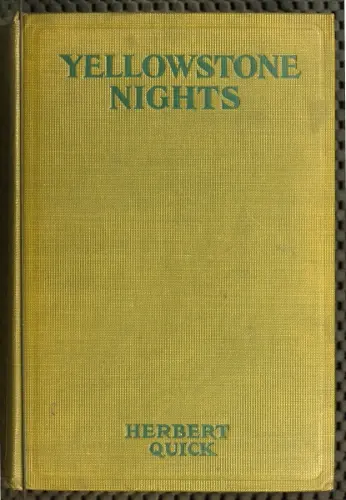
Yellowstone Nights
Herbert Quick
THE CLASSIC COLLECTION · 1915
"The Brown Mouse" by Herbert Quick is a novel written in the early 20th century. The story centers on Jim Irwin, a farmhand struggling with his identity and aspirations, as he unexpectedly finds himself appointed as a schoolteacher. The narrative explores themes of class, ambition, and the pursuit of a meaningful life against the backdrop of rural America. At the start of the novel, we are introduced to Jim Irwin and Jennie Woodruff, a farmer's daughter. Their interaction begins with a simple yet pivotal moment when Jennie dismisses the idea of Jim marrying her with a derisive "Humph!" This offhand comment triggers a chain of events that lead Jim to reflect on his stagnant life, prompting his decision to pursue a teaching position. The opening establishes Jim's internal conflict between his duties, his unfulfilled dreams, and his feelings for Jennie, while also hinting at the broader societal expectations and limitations placed on individuals in rural settings. The narrative teases the promise of transformation for both Jim and the community as they navigate the complexities of their relationships and aspirations.
Introduction adapted from the source catalogue; source summaries may be automatically generated.
Free to read · English · 53,726 words · No account needed
MAKE TIME FOR A GOOD BOOK
On by default. Untick to stop anonymous reading totals. Each page counts after 10 seconds in view. How this works.
Anonymous counting is on unless you have switched it off.
"Now get busy, here," cried Jim Irwin. "We're late! Raymond, you've a quick eye--you count seeds--and you, Calista, and Mary Smith--and mind, next year's crop may depend on making no mistakes!"
"Mistakes!" scoffed Mary Smith, a dumpy girl of fourteen. "We don't make mistakes any more, teacher."
It was a frolic, rather than a task. All had come with a perfect understanding that this early attendance was quite illegal, and not to be required of them--but they came.
"Newt," suggested Jim, "get busy on the percentage problems for that second class in arithmetic."
"Sure," said Newt. "Let's see.... Good seed is the base, and bad seed and dead seed the percentage--find the rate...."
"Oh, you know!" said Jim. "Make them easy and plain and as many as you can get out--and be sure that you name the farm every pop!"
"Got you!" answered Newton, and in a fine frenzy went at the job of creating a text-book in arithmetic.
"Buddy," said Jim, patting the youngest Simms on the head, "you and Virginia can print the reading lessons this morning, can't you?"
"Yes, Mr. Jim," answered both McGeehee Simms and his sister cheerily.
"Where's the copy?"
"Here," answered the teacher, handing each a typewritten sheet for use as the original from which the young mountaineers were to make hectograph copies, "and mind you make good copies! Bettina Hansen pretty nearly cried last night because she had to write them over so many times on the typewriter before she got them all right."
The reading lesson was an article on corn condensed from a farm paper, and a selection from Hiawatha--the Indian-corn myth.
"We'll be careful, Mr. Jim," said Buddy.
Half past eight, and only half an hour until school would officially be
"called."
Newton Bronson was writing in aniline ink for the hectographs, such
problems as these:
"If Mr. Ezra Bronson's seed wheat carries in each 250 grains, ten cockle grains, fifteen rye grains, twenty fox-tail seeds, three iron-weed seeds, two wild oats grains, twenty-seven wild buckwheat seeds, one wild morning-glory seed, and eighteen lamb's quarter seeds, what percentage of the seeds sown is wheat, and what foul seed?"
"If in each 250 grains of wheat in Mr. Bronson's bins, 30 are cracked, dead or otherwise not capable of sprouting, what per cent, of the seed sown will grow?"
"If the foul seed and dead wheat amount to one-eighth by weight of the mass, what did Mr. Bronson pay per bushel for the good wheat, if it cost him $1.10 in the bin, and what per cent, did he lose by the adulterations and the poor wheat?"
Your reading position is saved on this browser. Take it to another device with a library code. Reading pages adapt to text, rather than matching a printed edition.
BEHIND THE BOOK
This eBook is for the use of anyone anywhere in the United States and most other parts of the world at no cost and with almost no restrictions whatsoever. You may copy it, give it away or re-use it under the terms of the Project Gutenberg License included with this eBook or online at www.gutenberg.org. If you are not located in the United States, you will have to check the laws of the country where you are located before using this eBook. Read the source licence.
The original source file, including credits and licence, is retained by this library. Request an original-format copy at no charge. Please include the book title and Project Gutenberg identifier #26987.
KEEP YOUR CURIOSITY GOING
Coulson Kernahan

Maurice Baring
Frances Wright
Cécile Tormay

Frederic Jesup Stimson

W. H. P. (William Henry Pope) Jarvis