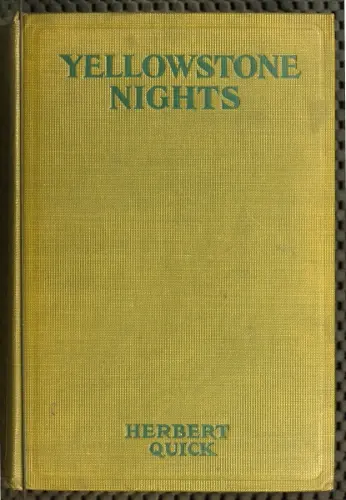
Yellowstone Nights
Herbert Quick
THE CLASSIC COLLECTION · 1915
"The Brown Mouse" by Herbert Quick is a novel written in the early 20th century. The story centers on Jim Irwin, a farmhand struggling with his identity and aspirations, as he unexpectedly finds himself appointed as a schoolteacher. The narrative explores themes of class, ambition, and the pursuit of a meaningful life against the backdrop of rural America. At the start of the novel, we are introduced to Jim Irwin and Jennie Woodruff, a farmer's daughter. Their interaction begins with a simple yet pivotal moment when Jennie dismisses the idea of Jim marrying her with a derisive "Humph!" This offhand comment triggers a chain of events that lead Jim to reflect on his stagnant life, prompting his decision to pursue a teaching position. The opening establishes Jim's internal conflict between his duties, his unfulfilled dreams, and his feelings for Jennie, while also hinting at the broader societal expectations and limitations placed on individuals in rural settings. The narrative teases the promise of transformation for both Jim and the community as they navigate the complexities of their relationships and aspirations.
Introduction adapted from the source catalogue; source summaries may be automatically generated.
Free to read · English · 53,726 words · No account needed
MAKE TIME FOR A GOOD BOOK
On by default. Untick to stop anonymous reading totals. Each page counts after 10 seconds in view. How this works.
Anonymous counting is on unless you have switched it off.
"Oh, Colonel!" The voice of Angie Talcott rose from away back near the kitchen. "Can Jennie keep on bein' county superintendent, now she's married?"
A great guffaw of laughter reduced poor Angie to tears; and Jennie had to go over and comfort her. It was all right for her to ask that, and they ought not to laugh at Angie, so there! Now, you're all right, and let's talk about the new schoolhouse, and so forth. Jennie brought the smiles back to Angle's face, just in time to hear Jim tell the people amid louder cheers that he had been asked to go into the rural-school extension work in two states, and had been offered a fine salary in either place, but that he wasn't even considering these offers. And about that time, the children began to get sleepy and cross and naughty, and the women set in motion the agencies which moved the crowd homeward.
Before a bright wood fire--which they really didn't need, but how else was Jim's mother to show off the little fireplace?--sat Jim and Jennie. They had been together for a week now--this being their home-coming--and had only begun to get really happy.
"Isn't it fine to have the fireplace?" said Jennie.
"Yes, but we can't really afford to burn a fire in it--in Iowa," said Jim. "Fuel's too everlastingly scarce. If we use it much, the fagots and deadwood on our 'glebe-land' won't last long."
"If you should take that Oklahoma position," said Jennie, "we could afford to have open wood fires all the time."
"It's warmer in Oklahoma," said Jim, "and wood's more plentiful. Yes"--contemplatively--"we could, dear."
"It would be nice, wouldn't it?" said Jennie.
"All right," said Jim briskly, "get me my writing materials, and we'll
accept. It's still open."
Jennie sat looking into the fire oblivious of the suggestion. She was smiling. Jim moved uneasily, and rose.
"Well," he said, "I believe I can better guess where mother would put those writing materials than you could, after all. I'll hunt them up."
As he passed, Jennie took him by the hand and pulled him down on the arm
of her chair.
"Jim," she said, "don't be mean to me! You know you wouldn't do such a wicked, wicked thing at this time as to leave the people here."
"All right," said Jim, "whatever you say is the law."
When Jennie spoke again things had taken place which caused her voice to emanate from Jim's shirt-front.
"Did you hear," said she, "what Angie Talcott asked?"
"M'h'm," said Jim.
"Well," said Jennie, "now that I'm married can I go on being county
superintendent?"
There was a long silence.
Your reading position is saved on this browser. Take it to another device with a library code. Reading pages adapt to text, rather than matching a printed edition.
BEHIND THE BOOK
This eBook is for the use of anyone anywhere in the United States and most other parts of the world at no cost and with almost no restrictions whatsoever. You may copy it, give it away or re-use it under the terms of the Project Gutenberg License included with this eBook or online at www.gutenberg.org. If you are not located in the United States, you will have to check the laws of the country where you are located before using this eBook. Read the source licence.
The original source file, including credits and licence, is retained by this library. Request an original-format copy at no charge. Please include the book title and Project Gutenberg identifier #26987.
KEEP YOUR CURIOSITY GOING
Coulson Kernahan

Maurice Baring
Frances Wright
Cécile Tormay

Frederic Jesup Stimson

W. H. P. (William Henry Pope) Jarvis