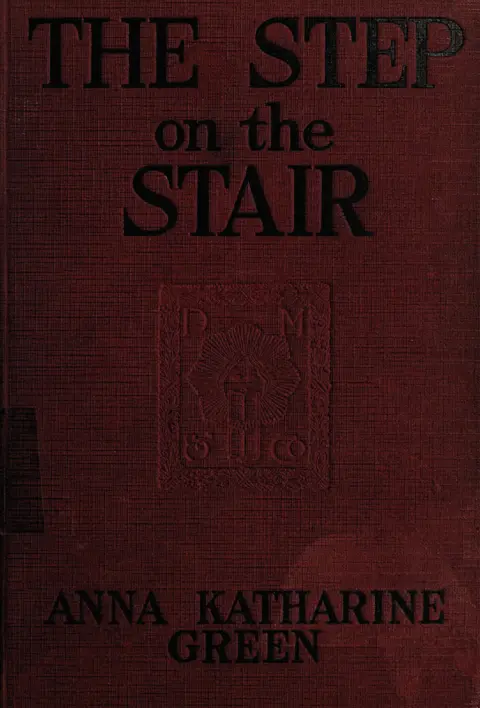
The step on the stair
Anna Katharine Green
THE CLASSIC COLLECTION · 1897
"The Bronze Hand" by Anna Katharine Green is a crime fiction novel written in the late 19th century. Set against the backdrop of political unrest in Baltimore during the tumultuous period leading up to the American Civil War, the book delves into themes of loyalty, intrigue, and the moral dilemmas faced by its characters. The plot centers around a mysterious bronze hand that holds the power to carry out arbitrary justice and intertwines the lives of several individuals caught up in a conspiracy. The story follows the protagonist, Abbott, who becomes entangled with the enigmatic Miss Calhoun. She enlists his help to recover a stolen ring of great significance to her, leading him on a perilous mission that reveals a secret political organization with dangerous intentions. As the narrative unfolds, Abbott discovers the true nature of the ring and its connection to a mechanism that dictates life and death within the organization. The stakes rise as he learns that the ring is linked to a judgment that could cost an innocent man's life. Caught between moral duty and personal loyalty, Abbott's quest culminates in a tragic confrontation that challenges the very notions of justice and sacrifice. The narrative not only weaves a thrilling tale of mystery but also highlights the personal and collective consequences of the political strife of the era.
Introduction adapted from the source catalogue; source summaries may be automatically generated.
Free to read · English · 15,867 words · No account needed
MAKE TIME FOR A GOOD BOOK
On by default. Untick to stop anonymous reading totals. Each page counts after 10 seconds in view. How this works.
Anonymous counting is on unless you have switched it off.
"I am under no oath," she ruminated. "I can tell this man what I will. Mr. Abbott, there has been formed in this city an organization against which the police are powerless. I am an involuntary member of it, and I know its power. It has constrained me and it has constrained others, and no one who has opposed it once has lived to do so twice. Yet it has no recognized head (though there is a chief to whom we may address ourselves), and it has no oaths of secrecy. All is left to the discretion of its members, and to their fears. The object of this society is the breaking of the power of the North, and the means by which it works is death. I joined it under a stress of feeling I called patriotism, and I believed myself right till the sword was directed against my own breast. Then I quailed; then I began to ask by what right we poor mortals constitute ourselves into instruments of destruction to our kind, and having once stopped to question, I saw the whole matter in such a different light that I knowingly put a stumbling-block in the path of so-called avenging justice, and thus courted the doom that at any moment may fall upon my head." And she actually looked up, as if expecting to see it fall then and there. "This Madame," she went on in breathless haste, "is doubtless one of the members. How so grotesque and yet redoubtable an individuality should have become identified with a cause demanding the coolest judgment as well as the most acute political acumen, I cannot stop to conjecture. But that she is a member of our organization, and an important one, too, her prophecies, which have so strangely become facts, are sufficient proof, even had you not seen my ring on her finger. Perhaps, incredible as it may appear, she is the chief. If so--But I do not make myself intelligible," she continued, meeting my eyes. "I will be more explicit. One peculiar feature of this organization is the complete ignorance which we all have concerning our fellow-members. We can reveal nothing, for we know nothing. I know that I am allied to a cause which has for its end the destruction of all who oppose the supremacy of the South, but I cannot give you the name of another person attached to this organization, though I feel the pressure of their combined power upon every act of my life. You may be a member without my knowing it--a secret and fearful thought, which forms one of the greatest safeguards to the institution, though it has failed in this instance, owing"--here her voice fell--"to my devotion to the man I love. What?"--(I had not spoken; my heart was dying within me, but I had given no evidence of a wish to interrupt her; she, however, feared a check, and rushed vehemently on.) "I shall have to tell you more. When, through pamphlets and unsigned letters--dangerous communications, which have long since become ashes--I was drawn into this society (and only those of the most radical and impressionable natures are approached) a ring and a key were sent me with this injunction: 'When the man or woman whose name will be forwarded to you in an otherwise empty envelope, shall have, in your honest judgment, proved himself or herself sufficiently dangerous to the cause we love, to merit removal, you are to place this ring on the middle finger of the bronze hand locked up in the box openly displayed in the office of a Dr. Merriam on ------ Street. With the pressure of the whole five rings on the fingers of this piece of mechanism, the guardian of our rights will be notified by a bell, that a victim awaits justice, and the end to be accomplished will be begun. As there are five fingers, and each one of these must feel the pressure of its own ring before connection can be made between this hand and the bell mentioned, no injustice can be done and no really innocent person destroyed. For, when five totally disconnected persons devoted to the cause agree that a certain individual is worthy of death, mistake is impossible. You are now one of the five. Use the key and the ring according to your conscience.' This was well, if I had been allowed to follow my conscience; but when, six weeks ago, they sent me the name of a man of lofty character and unquestioned loyalty, I recoiled, scarcely believing my eyes. Yet, fearing that my own judgment was warped, or that some hidden hypocrisy was latent in a man thus given over to our attention, I made it my business to learn this man's inner life. I found it so beautiful----" She choked, turned away for a moment, controlled herself, and went on rapidly and with increased earnestness: "I learned to love this man, and as I learned to love him I grew more and more satisfied of the dangerous character of the organization I was pledged to. But I had one comfort. He could not be doomed without my ring, and that was safe on my finger. Safe! You know how safe it was. The monster whom you have just seen, and who may have been the person to subject this noble man to suspicion, must have discovered my love and the safeguard it offered to this man. The ring, as you know, was stolen, and as you have failed to recover it, and I to get any reply from the chief to whom I forwarded my protest, to-morrow will without doubt see it placed upon the finger of the bronze hand. The result you know. Fantastic as this may strike you, it is the dreadful truth."
Your reading position is saved on this browser. Take it to another device with a library code. Reading pages adapt to text, rather than matching a printed edition.
Anna Katharine Green

Anna Katharine Green
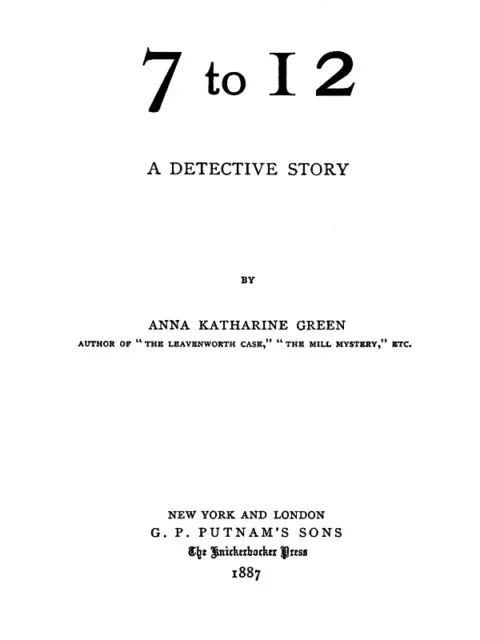
Anna Katharine Green
Anna Katharine Green
BEHIND THE BOOK
This eBook is for the use of anyone anywhere in the United States and most other parts of the world at no cost and with almost no restrictions whatsoever. You may copy it, give it away or re-use it under the terms of the Project Gutenberg License included with this eBook or online at www.gutenberg.org. If you are not located in the United States, you will have to check the laws of the country where you are located before using this eBook. Read the source licence.
The original source file, including credits and licence, is retained by this library. Request an original-format copy at no charge. Please include the book title and Project Gutenberg identifier #22806.
KEEP YOUR CURIOSITY GOING
Coulson Kernahan

Maurice Baring
Frances Wright
Cécile Tormay

Frederic Jesup Stimson

W. H. P. (William Henry Pope) Jarvis