THE CLASSIC COLLECTION✦An outlaw’s diary: the CommuneCLASSIC FREE BOOKS
An outlaw’s diary: the Commune
Cécile Tormay
THE CLASSIC COLLECTION · 1922
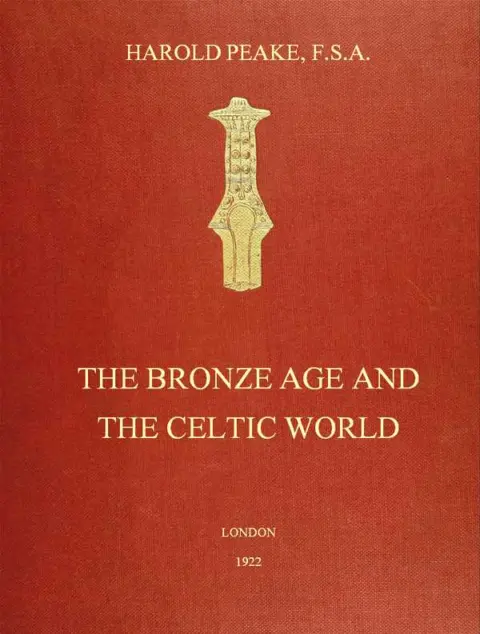
"The Bronze Age and the Celtic World" by Harold Peake is a historical account written in the early 20th century. The book explores the early inhabitants of Celtic lands and their interactions during the Bronze Age, with a specific focus on the evolution and spread of Celtic languages, cultures, and metallic trade. Likely appealing to readers interested in archaeology, anthropology, and the history of European prehistory, the text emphasizes how ancient cultures have influenced the modern understanding of Celtic origins. The opening of the book establishes the framework for Peake's examination of Celtic languages and their historical context. He outlines that for the last fifteen hundred years, the Celtic tongues have been confined mainly to regions in the north-west of Europe but were once more widespread. Peake discusses the significant role of Roman influence in the language's decline and presents complex questions regarding the languages' origin and spread, hinting at the diverse groups that occupied these regions before the Celts. The chapter sets the stage for a more in-depth exploration of prehistoric archaeology, physical anthropology, and comparative philology, all aimed at understanding the Celtic roots and their interactions with other cultures throughout history.
Introduction adapted from the source catalogue; source summaries may be automatically generated.
Free to read · English · 68,568 words · No account needed
MAKE TIME FOR A GOOD BOOK
On by default. Untick to stop anonymous reading totals. Each page counts after 10 seconds in view. How this works.
Anonymous counting is on unless you have switched it off.
Clark, W. E. le Gros: On a series of ancient Eskimo skulls from Greenland. J.R.A.I. l. (1920), 281-98.
Cook, O. F.: Milpa agriculture, a primitive tropical system. S.R. for 1919. Washington (1921), 307-26.
Conway, R. S.: The Italic Dialects, edited with a grammar and glossary.
Cambridge (1897).
Cordier, Henri: Histoire Générale de la Chine. Paris (1920).
Corréa, A. A. Mendes: Origin of the Portuguese. A.J.P.A., ii. (1919),
117-45.
Crawford, O. G. S. C.: The distribution of early bronze age settlements in Britain. G.J., Aug. and Sept. (1912). =1=.
Crawford, O. G. S. C.: On a gold torc. P.S.A., xxiv. (1912), 39-49.
=2=.
Crawford, O. G. S. C.: Man and his past. Oxford (1921).
Crawford, O. G. S. C.: A prehistoric invasion of England. A.J., ii.
(1922), 27-35.
Cunnington, M. E.: A village site of the Hallstatt period in Wiltshire.
A.J., ii. (1922), 13-9.
Cuno, J. G.: Forschungen im Gebiete der alten Völkerkunde. Berlin
(1871).
Dawson, C., Woodward, A. Smith and Smith, G. Elliot: On the discovery of a palæolithic human skull and mandible in a flint-bearing gravel overlying the Wealden (Hastings Beds) at Piltdown, Fletching (Sussex). Q.J.G.S.I., lxix. (1913), 117-51.
Déchelette, J.: Manuel d’archéologie. Paris (1908-14).
Deniker, J.: The Races of Man. London (1900).
Dennis, G.: The Cities and Cemeteries of Etruria. 3rd. Ed. London
(1883).
Dionysius Halicarnensis. Antiquitatum Romanorum.
Dörpfeld, W.: Troja und Ilion. Athens (1902).
Douglas, Robert K.: China. London (1899).
Duckworth, W. H. L.: The problem of the Galley Hill skeleton, in Essays and Studies presented to William Ridgeway. Cambridge (1913).
Dussaud, R.: Les civilisations préhelleniques dans le basin de la mer Egée. Paris (1910), 2nd Ed. (1914).
Ersch, J. S., and Grüber, J. C.: Allgemeine Encyklopädie der Wissenschaften, &c. Leipzig (1840).
Evans, J.: Ancient Stone Implements. 2nd Ed., London (1897).
Fergusson, James: Rude Stone Monuments. London (1872).
Fick, A.: Vergleichendes Wörterbuch der Indo-germanischen Sprachen.
Göttingen (1868).
Fleure, H. J.: Human Geography in Western Europe. London (1918). =1=.
Fleure, H. J.: The racial history of the British people. G.R., v.
(1918). =2=.
Fleure, H. J.: Some early neanthropic types in Europe and their modern representatives. J.R.A.I., i. (1920), 12-40.
Fleure, H. J.: The Peoples of Europe. London (1922).
Fleure, H. J., and James, T. C.: The geographical distribution of anthropological types in Wales. J.R.A.I., xlvi. (1916), 35-153.
Gardiner, Alan H.: The Admonitions of an Egyptian Sage, from a hieratic papyrus in Leiden. Leipzig (1909).
Gardiner, Alan H.: New literary works from ancient Egypt. J.E.A., i. London (1914), 20-36, 100-6.
Geer, Baron de: Om Skandinaviens Geografiska Utreckling. S.H.P.E.
Stockholm (1896).
Geer, Baron de: Die Veranderungen des Klimas, and A geochronology of the last 12,000 years. C.G.I., 11th sess. Stockholm, 1910. Stockholm (1912).
Your reading position is saved on this browser. Take it to another device with a library code. Reading pages adapt to text, rather than matching a printed edition.
BEHIND THE BOOK
This eBook is for the use of anyone anywhere in the United States and most other parts of the world at no cost and with almost no restrictions whatsoever. You may copy it, give it away or re-use it under the terms of the Project Gutenberg License included with this eBook or online at www.gutenberg.org. If you are not located in the United States, you will have to check the laws of the country where you are located before using this eBook. Read the source licence.
The original source file, including credits and licence, is retained by this library. Request an original-format copy at no charge. Please include the book title and Project Gutenberg identifier #46924.
KEEP YOUR CURIOSITY GOING
Cécile Tormay

Moritz Busch
John L. Ransom
Frances Wright
Cécile Tormay

Mabel Potter Daggett