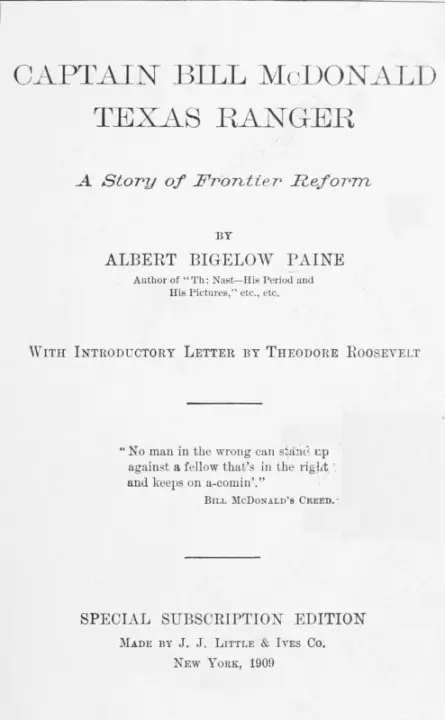
Captain Bill McDonald, Texas Ranger: A Story of Frontier Reform
Albert Bigelow Paine
THE CLASSIC COLLECTION · 1899
"The Bread Line: A Story of a Paper" by Albert Bigelow Paine is a novel written in the late 19th century. The story centers around a group of four friends—two artists and two writers—who embark on an ambitious endeavor to start a publication called the "Whole Family." It explores themes of aspiration, collaboration, and the contrasts between artistic dreams and harsh realities, offering insights into the struggles of bohemian life during a time of economic prosperity. At the start of the book, the narrative unfolds on New Year’s Eve, capturing the optimism and camaraderie among the four protagonists as they indulge in a lavish dinner at a café. As they discuss their dreams and frustrations with the publishing industry, one of the friends, Barrifield, proposes the idea of launching their own paper at a low subscription price, drawing inspiration from an existing successful model. The camaraderie comes to life through their banter and shared ambitions, and as events progress, they find themselves humbled by the social realities around them, exemplified by their encounter with those waiting in the bread line for assistance. This opening chapter establishes the characters' motivations while hinting at the challenges they will face in their entrepreneurial journey.
Introduction adapted from the source catalogue; source summaries may be automatically generated.
Free to read · English · 37,232 words · No account needed
MAKE TIME FOR A GOOD BOOK
On by default. Untick to stop anonymous reading totals. Each page counts after 10 seconds in view. How this works.
Anonymous counting is on unless you have switched it off.
He paused again. His words had not been without effect this time. The three listeners knew thoroughly the field of periodicals, and that no such paper as he proposed existed. His earnestness and eager whisper carried a certain weight, and then, as I have said before, he was strangely persuasive. Perner, who had once been engaged in business, and had, by some rare fortune, kept out of the bankruptcy court, was first to speak. His "ten years' successful business experience," which he referred to on occasion, gave his opinion value in matters of finance, though at present he was finding it no easy problem to keep up with the taxes on a certain tract of vacant property located rather vaguely somewhere in the Southwest and representing the residue of his commercial triumphs. He was a tall, large-featured man, cleanly shaven, and, like Van Dorn, wore glasses.
"Can you do it, Barry?" he said, looking up with an expression of wise and deep reflection. "Won't it cost you more than that to get up the paper?"
"That," observed Barrifield, calmly, "is the case with every great magazine in the country. The paper and printing cost more than they get for it."
"They make it out of the advertising, you know," put in Livingstone,
timidly.
Livingstone was younger than the others, and had a smooth, fresh face.
"Of course," snapped Perner; "I know that! But they've got to have circulation before they can get the advertising, and it takes time and money--barrels of it--to get circulation."
"We'll furnish the time," suggested Van Dorn, sawing at his meat, "if Barry'll put up the capital."
Barrifield looked up quickly.
"I'll do it!" he announced eagerly; "I'll do it!"
The others showed immediate interest. Barrifield looked from one to the other, repeating his assertion as if signing a verbal contract. Then his gaze wandered off into nowhere, and he absently fed himself and waited for the spirit to move further.
"I'll furnish the capital," he continued deliberately, at length, "and it won't be money, either." The three faces watching him fell. "That is, not much money. It'll take a little, of course. I think I know where I could get all the money I want--a dozen places, yes, fifty of them. But this isn't a money scheme. If it was I could get it. I know any number of men, capitalists, that would jump at it. But that isn't what we want. We want men who know what a paper is, and can do the work themselves."
"We want a good advertising man first," said Perner the businesslike.
"That's good sense," assented Barrifield, at which Perner felt complimented and began to assume proprietary airs.
Your reading position is saved on this browser. Take it to another device with a library code. Reading pages adapt to text, rather than matching a printed edition.
Albert Bigelow Paine
Albert Bigelow Paine
Albert Bigelow Paine
Albert Bigelow Paine
BEHIND THE BOOK
This eBook is for the use of anyone anywhere in the United States and most other parts of the world at no cost and with almost no restrictions whatsoever. You may copy it, give it away or re-use it under the terms of the Project Gutenberg License included with this eBook or online at www.gutenberg.org. If you are not located in the United States, you will have to check the laws of the country where you are located before using this eBook. Read the source licence.
The original source file, including credits and licence, is retained by this library. Request an original-format copy at no charge. Please include the book title and Project Gutenberg identifier #34023.
KEEP YOUR CURIOSITY GOING
Coulson Kernahan

Maurice Baring
Frances Wright
Cécile Tormay

Frederic Jesup Stimson

W. H. P. (William Henry Pope) Jarvis