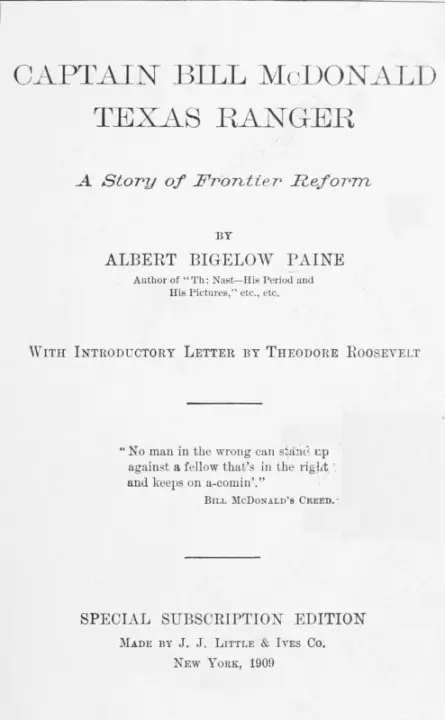
Captain Bill McDonald, Texas Ranger: A Story of Frontier Reform
Albert Bigelow Paine
THE CLASSIC COLLECTION · 1899
"The Bread Line: A Story of a Paper" by Albert Bigelow Paine is a novel written in the late 19th century. The story centers around a group of four friends—two artists and two writers—who embark on an ambitious endeavor to start a publication called the "Whole Family." It explores themes of aspiration, collaboration, and the contrasts between artistic dreams and harsh realities, offering insights into the struggles of bohemian life during a time of economic prosperity. At the start of the book, the narrative unfolds on New Year’s Eve, capturing the optimism and camaraderie among the four protagonists as they indulge in a lavish dinner at a café. As they discuss their dreams and frustrations with the publishing industry, one of the friends, Barrifield, proposes the idea of launching their own paper at a low subscription price, drawing inspiration from an existing successful model. The camaraderie comes to life through their banter and shared ambitions, and as events progress, they find themselves humbled by the social realities around them, exemplified by their encounter with those waiting in the bread line for assistance. This opening chapter establishes the characters' motivations while hinting at the challenges they will face in their entrepreneurial journey.
Introduction adapted from the source catalogue; source summaries may be automatically generated.
Free to read · English · 37,232 words · No account needed
MAKE TIME FOR A GOOD BOOK
On by default. Untick to stop anonymous reading totals. Each page counts after 10 seconds in view. How this works.
Anonymous counting is on unless you have switched it off.
"Didn't they have any thicker ones?" asked Livingstone.
"Well, of course," assented Barrifield, "it is a trifle thicker than a fine gold watch, but it's a perfect gem in other respects. The manufacturer of it told me he had carried one of them a year, and that it hadn't varied a second in that time."
"Maybe it was stopped," suggested Van Dorn, but Barrifield ignored this
libel.
"Every boy will want one of the 'Whole Family' watches," he went on. "We can sell a barrel of them in every town."
"How many of them come in a barrel?" interrupted Livingstone.
Barrifield leaned across the table.
"And I can buy them," he said eagerly, "I can buy them for seventy-five cents! Think of it! Seventy-five cents! A five-dollar watch, given with the finest weekly paper ever offered, for only one dollar a year!"
"How will you do that?" asked Perner.
"That leaves us twenty-five cents for the paper."
"Why, you know, we'll add something for postage and packing, as I said
before."
"Yes, and it will take something. By the time you get a box on that thrashing-machine, properly nailed and mailed, it will cost twenty-five cents." Perner's business experience was manifesting itself.
"Oh, pshaw, Perny!" protested Barrifield, "it won't cost half so much. We can get boys and girls for three dollars or so a week to attend to all that."
Perner closed his eyes for an instant and saw in fancy an army of youthful clerks packing various premiums for mailing. Then, remembering the difficulty with which he had managed even a small business with less than a dozen assistants, he sighed. He knew that big businesses really were conducted, and with a science and precision that was a constant source of wonder to him. Perhaps Barrifield knew the secret of their management.
"Even if it did cost that," proceeded Barrifield, "think of the quantity of them we will sell, and the immense circulation it will give us. We could afford to lose a little on each and make it back on the advertising."
Perner knew nothing of advertising, except that a certain paper received five thousand dollars a page for each issue, and Barrifield had assured them that the circulation of the "Whole Family" would be more than twice as great. He subsided, therefore, while Barrifield drew from his overcoat pocket a flat package of considerable size and weight. He undid the strings carefully, and a leather-bound, limp-covered book lay before them.
"That," he said triumphantly, "is the Bible!"
Van Dorn reached for it and turned some of the leaves curiously.
"First one Van ever saw," said Perner.
Livingstone took up the book with thoughtful regard.
Your reading position is saved on this browser. Take it to another device with a library code. Reading pages adapt to text, rather than matching a printed edition.
Albert Bigelow Paine
Albert Bigelow Paine
Albert Bigelow Paine
Albert Bigelow Paine
BEHIND THE BOOK
This eBook is for the use of anyone anywhere in the United States and most other parts of the world at no cost and with almost no restrictions whatsoever. You may copy it, give it away or re-use it under the terms of the Project Gutenberg License included with this eBook or online at www.gutenberg.org. If you are not located in the United States, you will have to check the laws of the country where you are located before using this eBook. Read the source licence.
The original source file, including credits and licence, is retained by this library. Request an original-format copy at no charge. Please include the book title and Project Gutenberg identifier #34023.
KEEP YOUR CURIOSITY GOING
Coulson Kernahan

Maurice Baring
Frances Wright
Cécile Tormay

Frederic Jesup Stimson

W. H. P. (William Henry Pope) Jarvis