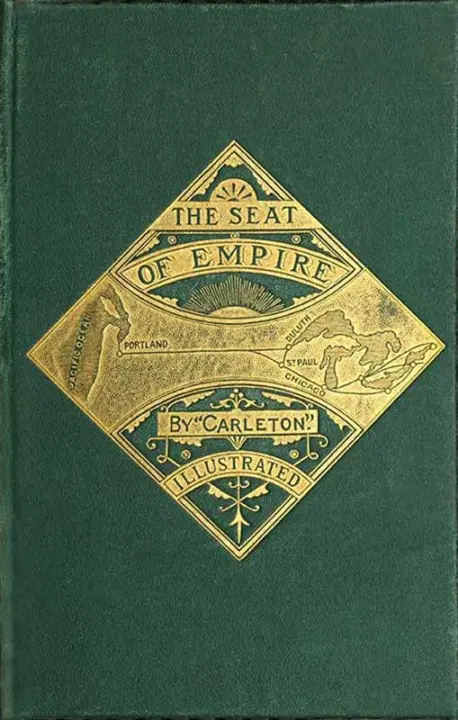
The Seat of Empire
Charles Carleton Coffin
THE CLASSIC COLLECTION · 1881
"The Boys of '61" by Charles Carleton Coffin is a historical account written in the late 19th century. The book documents the author's personal observations and experiences during the American Civil War, ranging from the first Battle of Bull Run to the fall of Richmond. Through a series of narratives, Coffin aims to paint a vivid picture of the war's events, heroes, and the profound struggles of the era, focusing particularly on community interactions, sentiments toward the Union, and the impact of slavery on various figures involved. The opening of the book establishes a backdrop of a nation grappling with the aftermath of the Civil War. Coffin reflects on the immense toll the conflict took on the country and his role as an army correspondent, vividly recounting key battles and moments that shaped the conflict. He shares experiences from both Union and Confederate perspectives, revealing the complexities of soldier life, public sentiment, and the societal divisions exacerbated by the war. As he recounts visits to various encampments and interactions with soldiers and civilians alike, we glimpse the nuanced dynamics present in the early days of the Civil War, setting the stage for a deeper understanding of this pivotal moment in American history.
Introduction adapted from the source catalogue; source summaries may be automatically generated.
Free to read · English · 204,637 words · No account needed
MAKE TIME FOR A GOOD BOOK
On by default. Untick to stop anonymous reading totals. Each page counts after 10 seconds in view. How this works.
Anonymous counting is on unless you have switched it off.
It was nearly four o'clock in the afternoon before the Sixth Corps came up with the Rebels. This corps had been marching southwest; but when the skirmishers discovered the enemy, Wright halted Seymour's division, which was in advance, faced it west, while Wheaton's division filed past Seymour's and took position on the left. The third division was in reserve. The cavalry was on the left of Wheaton. Sheridan found himself confronted by Ewell's and Kershaw's divisions, which were strongly intrenched.
Seymour and Wheaton moved from the road west, went down the steep declivity into the ravine, receiving the fire of the Rebels without flinching, crossed the creek, ascended the other bank, and dashed upon the intrenchments. At the same moment Custar's division of cavalry advanced with sabres drawn, their horses upon the run, goaded with spur and quickened by shout, till they caught the wild enthusiasm of their riders, and horses and men unitedly became as fiery Centaurs, the earth trembling beneath the tread of the thousands of hoofs, the air resounding with bugle-blasts and thrilling cheers!
The charge of this division was heroic. The Rebel artillery opened with shells, followed by canister. The infantry, protected by breastworks, were able to give a galling fire, but the squadrons swept everything before them, leaping the intrenchments, sabring all who resisted, crushing the whole of Lee's right wing by a single blow, gathering up thousands of prisoners, who stood as if paralyzed by the tremendous shock.
Entire regiments threw down their arms. Miles of wagons, caissons, ambulances, forges, arms, ammunition,--all that belonged to that portion of the line, was lost to Lee in a moment. Generals Ewell, Kershaw, Defoe, Barton, Custis Lee, Borden, and Corse were prisoners almost before they knew it.
"Further fighting is useless; it will be a waste of life," said Ewell
to Custar.
"Bravely done, Custar," said Sheridan, riding up, and complimenting his lieutenant in the presence of the whole division.
It was through the co-operation of the other cavalry divisions, Crook's and Devens's and Merritt's, and of the Sixth Corps, that Custar was enabled to strike such a crushing blow. Honor is due to all. Custar had his horse killed; Lieutenant Harwell, Captain Barnhart, Lieutenant Narvall, Lieutenant Main, and Lieutenant Custar, all belonging to his staff, also had their horses shot in the splendid charge, which of itself proves that it was gallant and desperate. Officers and men alike rushed upon the enemy, rivalling each other in deeds of daring.
After receiving this paralyzing blow Lee gave up all hope of reaching Danville. He could move only in the direction of Lynchburg. Caissons, wagons, and ambulances were burned, cannon abandoned, commissary supplies left by the roadside.
Your reading position is saved on this browser. Take it to another device with a library code. Reading pages adapt to text, rather than matching a printed edition.
Charles Carleton Coffin
Charles Carleton Coffin
Charles Carleton Coffin
Charles Carleton Coffin
BEHIND THE BOOK
This eBook is for the use of anyone anywhere in the United States and most other parts of the world at no cost and with almost no restrictions whatsoever. You may copy it, give it away or re-use it under the terms of the Project Gutenberg License included with this eBook or online at www.gutenberg.org. If you are not located in the United States, you will have to check the laws of the country where you are located before using this eBook. Read the source licence.
The original source file, including credits and licence, is retained by this library. Request an original-format copy at no charge. Please include the book title and Project Gutenberg identifier #34843.
KEEP YOUR CURIOSITY GOING
Cécile Tormay

Moritz Busch
John L. Ransom
Frances Wright
Cécile Tormay

Mabel Potter Daggett