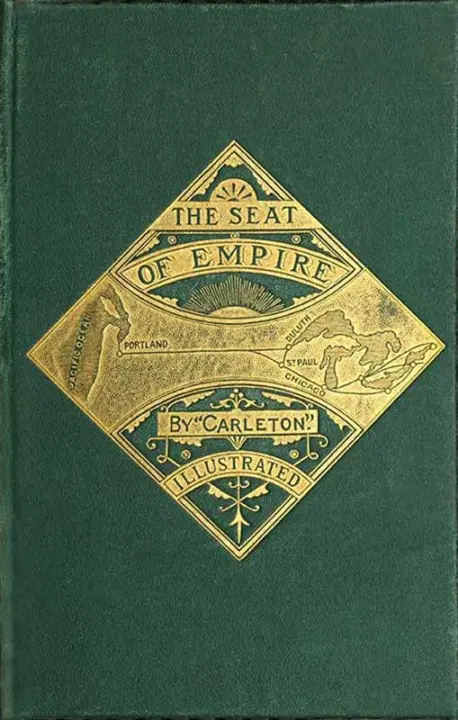
The Seat of Empire
Charles Carleton Coffin
THE CLASSIC COLLECTION · 1881
"The Boys of '61" by Charles Carleton Coffin is a historical account written in the late 19th century. The book documents the author's personal observations and experiences during the American Civil War, ranging from the first Battle of Bull Run to the fall of Richmond. Through a series of narratives, Coffin aims to paint a vivid picture of the war's events, heroes, and the profound struggles of the era, focusing particularly on community interactions, sentiments toward the Union, and the impact of slavery on various figures involved. The opening of the book establishes a backdrop of a nation grappling with the aftermath of the Civil War. Coffin reflects on the immense toll the conflict took on the country and his role as an army correspondent, vividly recounting key battles and moments that shaped the conflict. He shares experiences from both Union and Confederate perspectives, revealing the complexities of soldier life, public sentiment, and the societal divisions exacerbated by the war. As he recounts visits to various encampments and interactions with soldiers and civilians alike, we glimpse the nuanced dynamics present in the early days of the Civil War, setting the stage for a deeper understanding of this pivotal moment in American history.
Introduction adapted from the source catalogue; source summaries may be automatically generated.
Free to read · English · 204,637 words · No account needed
MAKE TIME FOR A GOOD BOOK
On by default. Untick to stop anonymous reading totals. Each page counts after 10 seconds in view. How this works.
Anonymous counting is on unless you have switched it off.
Entering the head-quarters of the commanding officer one day, I saw a thin, spare colored woman sitting before the fire. She nodded and smiled, ran her eyes over me, as if to take in every feature or peculiarity of my person and dress, then gazed into the fire and seemed absorbed in her own thoughts. A friend said, "That is our Sojourner Truth."
She had brought off several companies of negroes from the mainland, and had given a great deal of information concerning the movements of the Rebels. She had penetrated swamps, endured hardships, eluded Rebel pickets, visiting the plantations at midnight, and conversing with the slaves.
"I can travel all through the South, I reckon," she said.
"Are you not afraid that the Rebels will catch you?"
"Well, honey, I reckon they couldn't keep me," she said, with a smile.
She had exhibited such remarkable shrewdness and finesse in her exploits, and had rendered such valuable services to the department, that she was held in high esteem.
At that time, Mrs. Frances D. Gage, favorably known as a writer for the press, was residing on Paris Island. Seated one evening by the bright fire blazing on her hearth, I listened to her narrative of Sojourner Truth, who had been a slave, who had penetrated the far South in search of her lost children, who had run off many slaves to Canada, and who went round the country, impelled by the conviction that she had been called of God to testify against the sins of the people; hence her name, "Sojourner Truth."
The narration revealed traits of character, not unfrequently seen in the negro race, and it will not be out of place in this chapter, which is intended to give the position of a race at its lowest plane of life.
This wonderful woman lives in modern art. She is the original Libyan Sibyl, a statue by Mr. Story, which was more impressive than all others in the gallery of the World's Exhibition in London in 1862. Sojourner once called upon Mrs. Stowe, who has given us this account of the interview:[44]--
[Footnote 44: Atlantic Monthly, April, 1863.]
On her head she wore a bright Madras handkerchief, arranged as a turban, after the manner of her race. She seemed perfectly self-possessed and at her ease,--in fact, there was almost an unconscious superiority, not unmixed with a solemn twinkle of humor, in the odd, composed manner in which she looked down on me. Her whole air had at times a gloomy sort of drollery which impressed one strangely.
"So, this is you," she said.
"Yes," I answered.
Your reading position is saved on this browser. Take it to another device with a library code. Reading pages adapt to text, rather than matching a printed edition.
Charles Carleton Coffin
Charles Carleton Coffin
Charles Carleton Coffin
Charles Carleton Coffin
BEHIND THE BOOK
This eBook is for the use of anyone anywhere in the United States and most other parts of the world at no cost and with almost no restrictions whatsoever. You may copy it, give it away or re-use it under the terms of the Project Gutenberg License included with this eBook or online at www.gutenberg.org. If you are not located in the United States, you will have to check the laws of the country where you are located before using this eBook. Read the source licence.
The original source file, including credits and licence, is retained by this library. Request an original-format copy at no charge. Please include the book title and Project Gutenberg identifier #34843.
KEEP YOUR CURIOSITY GOING
Cécile Tormay

Moritz Busch
John L. Ransom
Frances Wright
Cécile Tormay

Mabel Potter Daggett