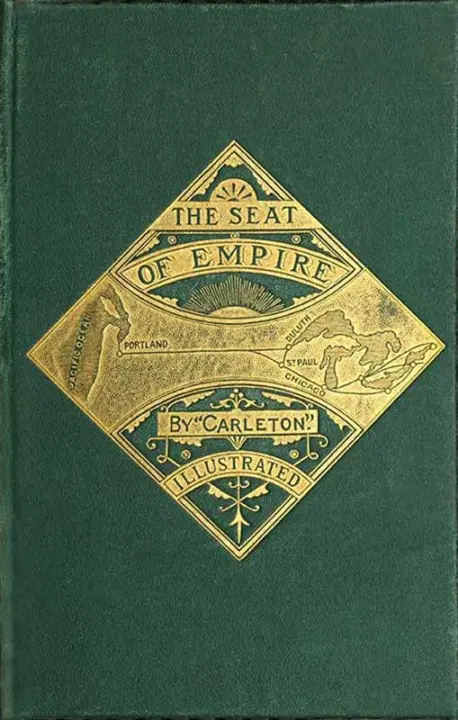
The Seat of Empire
Charles Carleton Coffin
THE CLASSIC COLLECTION · 1881
"The Boys of '61" by Charles Carleton Coffin is a historical account written in the late 19th century. The book documents the author's personal observations and experiences during the American Civil War, ranging from the first Battle of Bull Run to the fall of Richmond. Through a series of narratives, Coffin aims to paint a vivid picture of the war's events, heroes, and the profound struggles of the era, focusing particularly on community interactions, sentiments toward the Union, and the impact of slavery on various figures involved. The opening of the book establishes a backdrop of a nation grappling with the aftermath of the Civil War. Coffin reflects on the immense toll the conflict took on the country and his role as an army correspondent, vividly recounting key battles and moments that shaped the conflict. He shares experiences from both Union and Confederate perspectives, revealing the complexities of soldier life, public sentiment, and the societal divisions exacerbated by the war. As he recounts visits to various encampments and interactions with soldiers and civilians alike, we glimpse the nuanced dynamics present in the early days of the Civil War, setting the stage for a deeper understanding of this pivotal moment in American history.
Introduction adapted from the source catalogue; source summaries may be automatically generated.
Free to read · English · 204,637 words · No account needed
MAKE TIME FOR A GOOD BOOK
On by default. Untick to stop anonymous reading totals. Each page counts after 10 seconds in view. How this works.
Anonymous counting is on unless you have switched it off.
This was too much for the Colonel. He could no longer restrain his indignation. Looking the Judge squarely in the face, he vented his anger in scathing words.
The Judge departed, and at the next session of the Court Colonel Utley was indicted for man-stealing; but he has not yet been brought to trial. The case is postponed till the day of Judgment, when a righteous verdict will be rendered.
The Judge returned to Lexington, called a public meeting, at which he made a speech, denouncing the Twenty-Second Wisconsin as an abolition regiment, and introducing resolutions declaring that the Union never could be restored if the laws of the State of Kentucky were thus set at defiance. This from the Judge, while his son was in the Rebel service, fighting against the Union.
But the matter was not yet over. A few days later, the division containing the Twenty-Second Wisconsin, commanded by General Baird, vice Gillmore, was ordered down the river. It went to Louisville, followed by the slave-hunters, who were determined to have their negroes.
Orders were issued to the colonels not to take any contrabands on
board the boats, and most of them obeyed. Colonel Utley issued no
orders.
A citizen called upon him and said,--
"Colonel, you will have trouble in going through the city unless you give up the negroes in your lines."
The regiment was then on its march to the wharf.
"They have taken all the negroes from the ranks of the other regiments, and they intend to take yours."
The Colonel turned to his men and said, quietly, "Fix bayonets."
The regiment moved on through the streets, and reached the Gault House, where the slaveholders had congregated. A half-dozen approached the regiment rather cautiously, but one bolder than the rest sprang into the ranks and seized a negro by the collar.
A dozen bayonets came down around him, some not very gently. He let go
his hold and sprang back again quite as quickly as he entered the
lines.
There was a shaking of fists and muttered curses, but the regiment passed on to the landing, just as if nothing had happened.
General Granger, who had charge of the transportation, had issued
orders that no negro should be allowed on the boats without free
papers.
General Baird saw the negroes on the steamer, and approaching Colonel
Utley, said,--
"Why, Colonel, how is this? Have all of these negroes free papers?"
"Perhaps not all, but those who haven't, have declared their
intentions!" said the Colonel.
Your reading position is saved on this browser. Take it to another device with a library code. Reading pages adapt to text, rather than matching a printed edition.
Charles Carleton Coffin
Charles Carleton Coffin
Charles Carleton Coffin
Charles Carleton Coffin
BEHIND THE BOOK
This eBook is for the use of anyone anywhere in the United States and most other parts of the world at no cost and with almost no restrictions whatsoever. You may copy it, give it away or re-use it under the terms of the Project Gutenberg License included with this eBook or online at www.gutenberg.org. If you are not located in the United States, you will have to check the laws of the country where you are located before using this eBook. Read the source licence.
The original source file, including credits and licence, is retained by this library. Request an original-format copy at no charge. Please include the book title and Project Gutenberg identifier #34843.
KEEP YOUR CURIOSITY GOING
Cécile Tormay

Moritz Busch
John L. Ransom
Frances Wright
Cécile Tormay

Mabel Potter Daggett