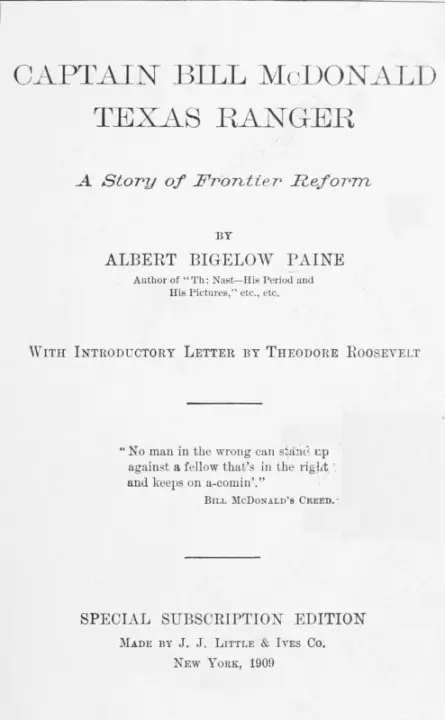
Captain Bill McDonald, Texas Ranger: A Story of Frontier Reform
Albert Bigelow Paine
THE CLASSIC COLLECTION · 1916
"The Boys' Life of Mark Twain" by Albert Bigelow Paine is a biographical account written in the early 20th century. The book chronicles the formative years of Samuel Langhorne Clemens, who later became widely known as Mark Twain, exploring his early life, family background, childhood experiences, and the influences that shaped his remarkable character and literary career. The opening of the narrative introduces readers to the humble beginnings of the Clemens family, detailing their migration from Tennessee to Missouri, where Samuel was born. The text paints a vivid picture of his early home life, highlighting interactions with family members and the complex social environment of a slave state. It discusses Samuel's delicate health and his imaginative nature, nurtured by the stories told during family gatherings. As the narrative progresses, it emphasizes how his experiences and observations during childhood—such as his adventures by the Mississippi River and the colorful characters he encountered—foreshadow the creativity and depth that would later characterize his writing. The opening concludes with glimpses of the adventures and mischief that would inspire his future literary works, offering insights into how the boy who would become Mark Twain was molded by his upbringing.
Introduction adapted from the source catalogue; source summaries may be automatically generated.
Free to read · English · 80,509 words · No account needed
MAKE TIME FOR A GOOD BOOK
On by default. Untick to stop anonymous reading totals. Each page counts after 10 seconds in view. How this works.
Anonymous counting is on unless you have switched it off.
"Ed, come here!"
Brownell poked his head in the door. The two were great chums.
"What will you have, Sam?" he asked.
"Come in, Ed; Henry's asleep, and I'm in trouble. I want somebody to
light my pipe."
"Why don't you light it yourself?" Brownell asked.
"I would, only I knew you'd be along in a few minutes and would do it for
me."
Brownell scratched a match, stooped down, and applied it.
"What are you reading, Sam?"
"Oh, nothing much--a so-called funny book. One of these days I'll write
a funnier book myself."
Brownell laughed. "No, you won't, Sam," he said. "You're too lazy ever
to write a book."
Years later, in the course of a lecture which he delivered in Keokuk, Mark Twain said that he supposed the most untruthful man in the world lived right there in Keokuk, and that his name was Ed Brownell.
Orion Clemens did not have the gift of prosperity, and his printing-office did not flourish. When he could no longer pay Sam's wages he took him into partnership, which meant that Sam got no wages at all, though this was of less consequence, since his mother, now living with Pamela, was well provided for. The disorder of the office, however, distressed him. He wrote home that he could not work without system, and, a little later, that he was going to leave Keokuk, that, in fact, he was planning a great adventure--a trip to the upper Amazon!
His interest in the Amazon had been awakened by a book. Lynch and Herndon had surveyed the upper river, and Lieutenant Herndon's book was widely read. Sam Clemens, propped up in bed, pored over it through long evenings, and nightly made fabulous fortunes collecting cocoa and other rare things--resolving, meantime, to start in person for the upper Amazon with no unnecessary delay. Boy and man, Samuel Clemens was the same. His vision of grand possibilities ahead blinded him to the ways and means of arrival. It was an inheritance from both sides of his parentage. Once, in old age, he wrote:
"I have been punished many and many a time, and bitterly, for doing things and reflecting afterward . . . . When I am reflecting on these occasions, even deaf persons can hear me think."
He believed, however, that he had reflected carefully concerning the Amazon, and that in a brief time he should be there at the head of an expedition, piling up untold wealth. He even stirred the imaginations of two other adventurers, a Dr. Martin and a young man named Ward. To Henry, then in St. Louis, he wrote, August 5, 1856:
Your reading position is saved on this browser. Take it to another device with a library code. Reading pages adapt to text, rather than matching a printed edition.
Albert Bigelow Paine
Albert Bigelow Paine
Albert Bigelow Paine
Albert Bigelow Paine
BEHIND THE BOOK
This eBook is for the use of anyone anywhere in the United States and most other parts of the world at no cost and with almost no restrictions whatsoever. You may copy it, give it away or re-use it under the terms of the Project Gutenberg License included with this eBook or online at www.gutenberg.org. If you are not located in the United States, you will have to check the laws of the country where you are located before using this eBook. Read the source licence.
The original source file, including credits and licence, is retained by this library. Request an original-format copy at no charge. Please include the book title and Project Gutenberg identifier #3463.
KEEP YOUR CURIOSITY GOING
John L. Ransom

Herman W. Mudgett

Harriet Monroe
Daniel Dulany Addison
Charles Lanman

Harold Rosher