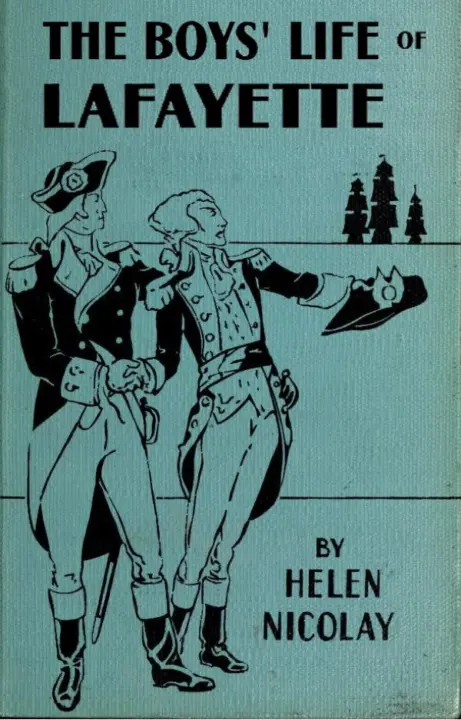
The Boys’ Life of Lafayette
Helen Nicolay
THE CLASSIC COLLECTION · 1911
"The Boys' Life of Abraham Lincoln" by Helen Nicolay is a historical account likely written in the late 19th century. The book chronicles the formative years and early life of Abraham Lincoln, detailing his humble beginnings, family history, and the challenges he faced growing up in a frontier environment. At the start of the work, the narrative introduces Lincoln's ancestry as pioneers who settled in America, illuminating the difficulties of their lives. It then delves into Lincoln's childhood, marked by poverty and tragedy—his mother’s death from sickness, which deeply impacted him and his family. These early events shape Lincoln's character and future ambitions. The beginning of this biography sets a tone of resilience, as it highlights not only the harsh realities he faced but also his thirst for knowledge, hinting at the remarkable journey he is destined to undertake toward becoming one of America’s greatest presidents.
Introduction adapted from the source catalogue; source summaries may be automatically generated.
Free to read · English · 56,248 words · No account needed
MAKE TIME FOR A GOOD BOOK
On by default. Untick to stop anonymous reading totals. Each page counts after 10 seconds in view. How this works.
Anonymous counting is on unless you have switched it off.
"He that is slow to anger," says the proverb, "is better than the mighty, and he that ruleth his spirit than he that taketh a city." Great as was his self-control in other matters, nowhere did Mr. Lincoln's slowness to anger and nobility of spirit show itself more than in his dealings with the generals of the Civil War. He had been elected President. Congress had given him power far exceeding that which any President had ever exercised before. As President he was also Commander-in-Chief of the Army and Navy of the United States. By proclamation he could call forth great armies and he could order those armies to go wherever he chose to send them; but even he had no power to make generals with the genius and the training necessary to lead them instantly to success. He had to work with the materials at hand, and one by one he tried the men who seemed best fitted for the task, giving each his fullest trust and every aid in his power. They were as eager for victory and as earnest of purpose as himself, but in every case some misfortune or some fault marred the result, until the country grew weary with waiting; discouragement overshadowed hope, and misgiving almost engulfed his own strong soul. Then, at last, the right men were found, the battles were all fought, and the war was at an end.
His kindness and patience in dealing with the generals who did not succeed is the wonder of all who study the history of the Civil War. The letters he wrote to them show better than whole volumes of description could do the helpful and forbearing spirit in which he sought to aid them. First among these unsuccessful generals was George B. McClellan, who had been called to Washington after the battle of Bull Run and placed in charge of the great new army of three years' volunteers that was pouring so rapidly into the city. McClellan proved a wonderful organizer. Under his skilful direction the raw recruits went to their camps of instruction, fell without confusion or delay into brigades and divisions, were supplied with equipments, horses and batteries, and put through a routine of drill, tactics and reviews that soon made this Army of the Potomac, as it was called, one of the best prepared armies the world has ever seen--a perfect fighting machine of over 150,000 men and more than 200 guns. General McClellan excelled in getting soldiers ready to fight, but he did not succeed in leading them to fruitful victory. At first the administration had great hopes of him as a commander. He was young, enthusiastic, winning, and on arriving in Washington seemed amazed and deeply touched by the confidence reposed in him. "I find myself," he wrote to his wife, "in a new and strange position here, President, cabinet, General Scott, and all, deferring to me. By some strange operation of magic I seem to have become the power of the land." His rise in military rank had equaled the inventions of fairy tales. He had been only a captain during the Mexican war. Then he resigned. Two months after volunteering for the Civil War he found himself a Major General in the Regular Army. For a short time his zeal and activity seemed to justify this amazing good fortune. In a fortnight however he began to look upon himself as the principal savior of his country. He entered upon a quarrel with General Scott which soon drove that old hero into retirement and out of his pathway. He looked upon the cabinet as a set of "geese," and seeing that the President was kind and unassuming in discussing military affairs, he formed the habit of expressing contempt for him in letters to confidential friends. This feeling grew until it soon reached a mark of open disrespect, but the President's conduct toward him did not change. Mr. Lincoln's nature was too forgiving, and the responsibility that lay upon him was too heavy for personal resentment. For fifteen months he strove to make McClellan succeed even in spite of himself. He gave him help, encouragement, the most timely suggestions. He answered his ever-increasing complaints with unfailing self-control. It was not that he did not see McClellan's faults. He saw them, and felt them keenly. "If Gen. McClellan does not want to use the army, I would like to borrow it," he said one day, stung by the General's inactivity into a sarcasm he seldom allowed himself to use. But his patience was not exhausted. McClellan had always more soldiers than the enemy, at Antietam nearly double his numbers, yet his constant cry was for re-enforcements. Regiments were sent him that could ill be spared from other points. Even when his fault-finding reached the height of telegraphing to the Secretary of War, "If I save this army now I tell you plainly that I owe no thanks to you or to any other persons in Washington. You have done your best to sacrifice this army," the President answered him kindly and gently, without a sign of resentment, anxious only to do everything in his power to help on the cause of the war. It was of no avail. Even the great luck of finding a copy of General Lee's orders and knowing exactly what his enemy meant to do, at a time when the Confederate general had only about half as many troops as he had, and these were divided besides, did not help him to success. All he could do even then was to fight the drawn battle of Antietam, and allow Lee to get away safely across the Potomac River into Virginia. After this the President's long-suffering patience was at an end, but he did not remove McClellan until he had visited the Army of the Potomac in person. What he saw on that visit assured him that it could never succeed under such a general. "Do you know what that is?" he asked a friend, waving his arm towards the white tents of the great army. "It is the Army of the Potomac, I suppose," was the wondering answer. "So it is called," replied the President, in a tone of suppressed indignation. "But that is a mistake. It is only McClellan's bodyguard." On November 5, 1862, McClellan was relieved from command, and this ended his military career.
Your reading position is saved on this browser. Take it to another device with a library code. Reading pages adapt to text, rather than matching a printed edition.
Helen Nicolay
BEHIND THE BOOK
This eBook is for the use of anyone anywhere in the United States and most other parts of the world at no cost and with almost no restrictions whatsoever. You may copy it, give it away or re-use it under the terms of the Project Gutenberg License included with this eBook or online at www.gutenberg.org. If you are not located in the United States, you will have to check the laws of the country where you are located before using this eBook. Read the source licence.
The original source file, including credits and licence, is retained by this library. Request an original-format copy at no charge. Please include the book title and Project Gutenberg identifier #1815.
KEEP YOUR CURIOSITY GOING
Cécile Tormay

Moritz Busch
John L. Ransom
Frances Wright
Cécile Tormay

Mabel Potter Daggett