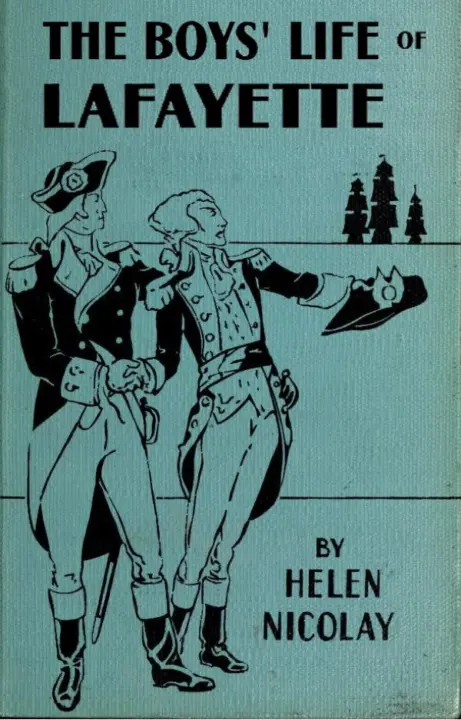
The Boys’ Life of Lafayette
Helen Nicolay
THE CLASSIC COLLECTION · 1911
"The Boys' Life of Abraham Lincoln" by Helen Nicolay is a historical account likely written in the late 19th century. The book chronicles the formative years and early life of Abraham Lincoln, detailing his humble beginnings, family history, and the challenges he faced growing up in a frontier environment. At the start of the work, the narrative introduces Lincoln's ancestry as pioneers who settled in America, illuminating the difficulties of their lives. It then delves into Lincoln's childhood, marked by poverty and tragedy—his mother’s death from sickness, which deeply impacted him and his family. These early events shape Lincoln's character and future ambitions. The beginning of this biography sets a tone of resilience, as it highlights not only the harsh realities he faced but also his thirst for knowledge, hinting at the remarkable journey he is destined to undertake toward becoming one of America’s greatest presidents.
Introduction adapted from the source catalogue; source summaries may be automatically generated.
Free to read · English · 56,248 words · No account needed
MAKE TIME FOR A GOOD BOOK
On by default. Untick to stop anonymous reading totals. Each page counts after 10 seconds in view. How this works.
Anonymous counting is on unless you have switched it off.
The new stepmother quickly became very fond of Abraham, and encouraged him in every way in her power to study and improve himself. The chances for this were few enough. Mr. Lincoln has left us a vivid picture of the situation. "It was," he once wrote, "a wild region, with many bears and other wild animals still in the woods. There I grew up. There were some schools, so-called, but no qualification was ever required of a teacher beyond "readin', writin', and cipherin' to the Rule of Three. If a straggler supposed to understand Latin happened to sojourn in the neighborhood, he was looked upon as a wizard."
The school-house was a low cabin of round logs, with split logs or "puncheons" for a floor, split logs roughly leveled with an ax and set up on legs for benches, and holes cut out in the logs and the space filled in with squares of greased paper for window-panes. The main light came in through the open door. Very often Webster's "Elementary Spelling-book" was the only text-book. This was the kind of school most common in the middle West during Mr. Lincoln's boyhood, though already in some places there were schools of a more pretentious character. Indeed, back in Kentucky, at the very time that Abraham, a child of six, was learning his letters from Zachariah Riney, a boy only a year older was attending a Catholic seminary in the very next county. It is doubtful if they ever met, but the destinies of the two were strangely interwoven, for the older boy was Jefferson Davis, who became head of the Confederate government shortly after Lincoln was elected President of the United States.
As Abraham had been only seven years old when he left Kentucky, the little beginnings he learned in the schools kept by Riney and Hazel in that State must have been very slight, probably only his alphabet, or at most only three or four pages of Webster's "Elementary Spelling-book." The multiplication-table was still a mystery to him, and he could read or write only the words he spelled. His first two years in Indiana seem to have passed without schooling of any sort, and the school he attended shortly after coming under the care of his stepmother was of the simplest kind, for the Pigeon Creek settlement numbered only eight or ten poor families, and they lived deep in the forest, where, even if they had had the money for such luxuries, it would have been impossible to buy books, slates, pens, ink, or paper. It is worthy of note, however, that in our western country, even under such difficulties, a school-house was one of the first buildings to rise in every frontier settlement. Abraham's second school in Indiana was held when he was fourteen years old, and the third in his seventeenth year. By that time he had more books and better teachers, but he had to walk four or five miles to reach them. We know that he learned to write, and was provided with pen, ink, and a copy-book, and a very small supply of writing-paper, for copies have been printed of several scraps on which he carefully wrote down tables of long measure, land measure, and dry measure, as well as examples in multiplication and compound division, from his arithmetic. He was never able to go to school again after this time, and though the instruction he received from his five teachers--two in Kentucky and three in Indiana--extended over a period of nine years, it must be remembered that it made up in all less than one twelve-month; "that the aggregate of all his schooling did not amount to one year." The fact that he received this instruction, as he himself said, "by littles," was doubtless an advantage. A lazy or indifferent boy would of course have forgotten what was taught him at one time before he had opportunity at another; but Abraham was neither indifferent nor lazy, and these widely separated fragments of instruction were precious steps to self-help. He pursued his studies with very unusual purpose and determination not only to understand them at the moment, but to fix them firmly in his mind. His early companions all agree that he employed every spare moment in keeping on with some one of his studies. His stepmother tells us that "When he came across a passage that struck him, he would write it down on boards if he had no paper, and keep it there until he did get paper. Then he would rewrite it, look at it, repeat it. He had a copy-book, a kind of scrap-book, in which he put down all things, and thus preserved them." He spent long evenings doing sums on the fire-shovel. Iron fire-shovels were a rarity among pioneers. Instead they used a broad, thin clapboard with one end narrowed to a handle, arranging with this the piles of coals upon the hearth, over which they set their "skillet" and "oven" to do their cooking. It was on such a wooden shovel that Abraham worked his sums by the flickering firelight, making his figures with a piece of charcoal, and, when the shovel was all covered, taking a drawing-knife and shaving it off clean again.
Your reading position is saved on this browser. Take it to another device with a library code. Reading pages adapt to text, rather than matching a printed edition.
Helen Nicolay
BEHIND THE BOOK
This eBook is for the use of anyone anywhere in the United States and most other parts of the world at no cost and with almost no restrictions whatsoever. You may copy it, give it away or re-use it under the terms of the Project Gutenberg License included with this eBook or online at www.gutenberg.org. If you are not located in the United States, you will have to check the laws of the country where you are located before using this eBook. Read the source licence.
The original source file, including credits and licence, is retained by this library. Request an original-format copy at no charge. Please include the book title and Project Gutenberg identifier #1815.
KEEP YOUR CURIOSITY GOING
Cécile Tormay

Moritz Busch
John L. Ransom
Frances Wright
Cécile Tormay

Mabel Potter Daggett