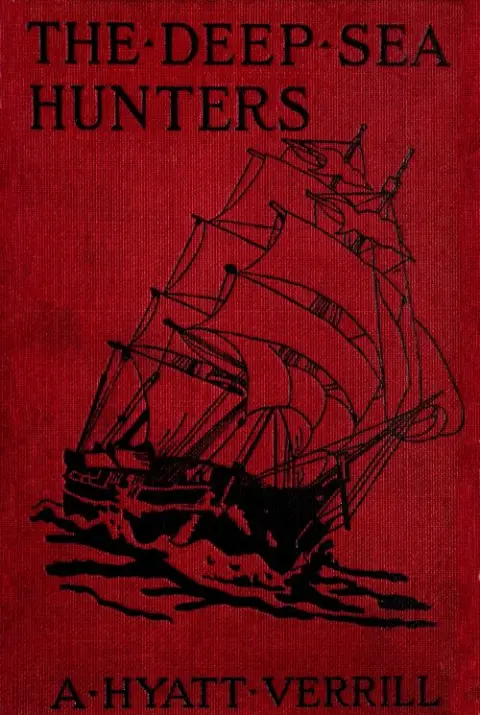
The Deep Sea Hunters: Adventures on a Whaler
A. Hyatt (Alpheus Hyatt) Verrill
THE CLASSIC COLLECTION · 1923
"The Boys' Book of Buccaneers" by A. Hyatt Verrill is a historical account written in the early 20th century. This book explores the intriguing world of buccaneers, highlighting their origins, exploits, and distinguishing them from common pirates. It delves into the lives of notable figures such as Sir Henry Morgan and provides insights into the adventurous, yet often brutal, naval history of the Caribbean. The opening of the book introduces us to Jack, a young boy who, curious about buccaneers, seeks clarification from his father, Mr. Bickford. As they discuss the difference between buccaneers and pirates, Mr. Bickford explains the historical context that led to the emergence of buccaneers during England's conflict with Spain. He recounts how settlers turned warriors began raiding Spanish ships and settlements, forming a crucial part of Caribbean history. The narrative sets the stage for further exploration of famous buccaneers and reveals the themes of bravery, adventure, and the harsh realities of their exploits.
Introduction adapted from the source catalogue; source summaries may be automatically generated.
Free to read · English · 51,074 words · No account needed
MAKE TIME FOR A GOOD BOOK
On by default. Untick to stop anonymous reading totals. Each page counts after 10 seconds in view. How this works.
Anonymous counting is on unless you have switched it off.
“This exactly suited the assembled buccaneers; it was unanimously agreed to join fortunes with the Frenchman, and, supplying their ships with sea turtles and maize, the captains set sail for Darien. The fleet consisted of nine vessels with four hundred and seventy-seven men and without adventure they arrived at the San Blas Islands. Here the Indians welcomed them, for the San Blas tribe had, from time immemorial, been allies of the corsairs, but when they learned of the buccaneers’ purpose they frowned upon it. Tocamora, they said, was in a mountainous country; the way was long and rough, it was in an uninhabited district where food was scarce, and the place was not as rich as had been reported. Instead, the Indians suggested that the buccaneers should cross the Isthmus, take the outlying city of El Real de Santa Maria, which was the depot for all the gold from the incredibly rich mines of Darien, and then proceed to attack the new city of Panama. It was a wild, harebrained, daring and almost hopeless scheme, but it appealed to the buccaneers and, aside from Captain Row and Bournano, all agreed to follow the Indians’ advice.
“On April 5, 1680, the buccaneers landed on the mainland three hundred and thirty-one strong, and, leaving a few men and Captains Alleston and Macket to guard the ships, the dauntless buccaneers started on their terrible march, carrying for provisions but three cakes of cassava each and all heavily armed.
“Following their Indian guides, the buccaneers divided into six companies and entered the jungle. The very first day their hardships began. So impenetrable was the forest that it was necessary to hew a way every yard, there were rivers to cross, swamps to wade through, and clouds of mosquitoes made life miserable. The first day four men gave up and returned to the coast, but the others, of whom, as I have said, Dampier was a member, kept doggedly on. Through pouring rain, climbing precipitous mountains, swimming rivers, the buccaneers proceeded on their way and at the close of the second day had covered nearly eighteen miles. Often, as Ringrose tells us, they were obliged to cross the same river over and over again, but at noon of the third day they came to a village of the wild Kuna Indians. Ringrose and Dampier describe the Indians very well, speaking particularly of the painted wooden crowns, the red caps and the gold nose rings worn by the chiefs, exactly as they are to-day. The Indians were friendly, they supplied the buccaneers fruit and provisions, and the footsore corsairs spent the day resting in the Indians’ huts. On the tenth of April a river large enough to be navigable by canoes was reached, and Captains Sharp, Coxon, Cook and Ringrose, with seventy men, embarked in fourteen dugouts. But they soon found that gliding down the Chukunaque River was by no means a relief from the overland tramp. Fallen trees and bars filled the stream; at every few yards the buccaneers were compelled to haul their craft bodily over the obstructions, and, being separated from their comrades, they began to fear the Indians intended to cut them off and betray them to the Spaniards. On April 13th they reached the junction of the Tuira and Chukunaque Rivers, and in the afternoon of the same day they were overjoyed to see their missing companions who had come through the jungle in safety. Throughout this awful trip, Dampier had preserved his writings in his ‘joyente of bamboo,’ carefully jotting down, despite all difficulties, his observations of bird and animal life, notes on plants and descriptions of the Indians and their lives. But the difficulties of the crossing were practically over. In sixty-eight canoes the three hundred and twenty-seven men embarked with fifty Indians and swept swiftly down stream towards unsuspecting El Real. Camping a scant half mile above the town, the buccaneers prepared to attack at dawn and were awakened by the drums of the garrison. Priming their pistols and muskets, the buccaneers marched on the village, which was surrounded by a twelve-foot palisade, but the corsairs made short work of this and took the town with a loss of but two men wounded. Within were two hundred and sixty men, but the buccaneers soon learned, to their chagrin, why no resistance had been made. The gold, brought from the mines, and, which they had hoped to gain, had been taken the day before to Panama—a treasure of three hundred pounds of bullion—and there was utterly nothing worth taking in the place, which was a mere outpost of straw and palm-thatched huts. Unlike Morgan and his fellows, Sharp and his men treated the Dons humanely and even prevented their Indian allies from butchering the captives, a diversion they had started the moment they had entered the place. Disappointed at their ill luck, the buccaneers were more than ever determined to attack Panama, and, choosing Captain Coxon as commander, the buccaneers, deserted by all but three Indians, prepared for the most hazardous venture ever attempted. Cut off, as they were, from retreat by the long journey through the jungle, in a hostile country, without provisions or ships, yet these fearless, indomitable men were about to hurl themselves upon the most strongly fortified town on the Pacific, and attack a city of thousands with less than three hundred and twenty men, for twelve of their number had left and had gone back with the Indians after taking El Real.
Your reading position is saved on this browser. Take it to another device with a library code. Reading pages adapt to text, rather than matching a printed edition.
A. Hyatt (Alpheus Hyatt) Verrill
A. Hyatt (Alpheus Hyatt) Verrill
A. Hyatt (Alpheus Hyatt) Verrill
A. Hyatt (Alpheus Hyatt) Verrill
BEHIND THE BOOK
This eBook is for the use of anyone anywhere in the United States and most other parts of the world at no cost and with almost no restrictions whatsoever. You may copy it, give it away or re-use it under the terms of the Project Gutenberg License included with this eBook or online at www.gutenberg.org. If you are not located in the United States, you will have to check the laws of the country where you are located before using this eBook. Read the source licence.
The original source file, including credits and licence, is retained by this library. Request an original-format copy at no charge. Please include the book title and Project Gutenberg identifier #68949.
KEEP YOUR CURIOSITY GOING
Cécile Tormay

Moritz Busch
John L. Ransom
Frances Wright
Cécile Tormay

Mabel Potter Daggett