THE CLASSIC COLLECTION✦An outlaw’s diary: the CommuneCLASSIC FREE BOOKS
An outlaw’s diary: the Commune
Cécile Tormay
THE CLASSIC COLLECTION · 1885
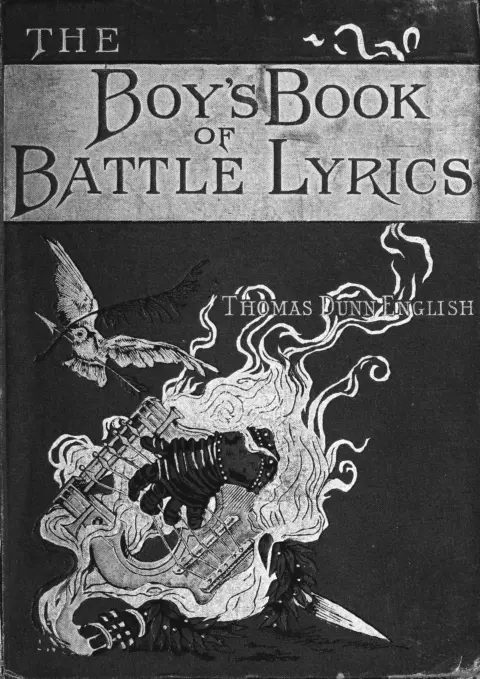
"The Boy’s Book of Battle-Lyrics" by Thos. Dunn English is a collection of verses written in the late 19th century, focusing on significant battles and historical events in the history of the United States from the colonial era up to the outbreak of the sectional war. The text aims to present metrical narratives that highlight the courage and patriotism of those involved in these conflicts, making it an engaging blend of poetry and history. The opening of the collection introduces the author and provides context for the work, outlining his intentions to immortalize notable events through lyrical storytelling. Themes of bravery and loss are prevalent, as demonstrated in accounts from battles such as De Soto's expedition, Bacon's Rebellion, and the Siege of Trenton. The author emphasizes both the valor of the soldiers and the harrowing experiences of those affected by the wars, setting a dramatic tone that underpins the entire collection. The groundwork laid in these verses establishes a sense of reverence for the sacrifices made by soldiers and civilians alike throughout American history.
Introduction adapted from the source catalogue; source summaries may be automatically generated.
Free to read · English · 45,708 words · No account needed
MAKE TIME FOR A GOOD BOOK
On by default. Untick to stop anonymous reading totals. Each page counts after 10 seconds in view. How this works.
Anonymous counting is on unless you have switched it off.
From the narrative of a survivor of the gallant men who participated in the fight at King’s Mountain I wrote the ballad, and aimed to give it the simple style of the narrator. But the old man, perfectly truthful in intent, fell into some errors. He omits all mention of the M’Dowells. Colonel M’Dowell was not in the battle. He objected to fighting a battle without a general officer, and he was despatched in search of one. While gone, the rest elected Colonel Campbell to command, and got to work. Major M’Dowell however remained, and commanded the regiments. He calls Shelby, Evan Shelby. But Evan Shelby, who was Isaac’s father, and who distinguished himself at Point Pleasant, was not at King’s Mountain.
The official account of the battle transmitted to Gates, and probably the correct one, is as follows:
“On receiving intelligence that Major Ferguson had advanced up as high as Gilbert Town, in Rutherford County, and threatened to cross the mountains to the Western waters, Colonel William Campbell, with four hundred men, of Washington County, of Virginia, Colonel Isaac Shelby, with two hundred and forty men from Sullivan County, of North Carolina, and Lieutenant-colonel Sevier, with two hundred and forty men, of Washington County, of North Carolina, assembled at Watauga, on the twenty-fifth day of September, where they were joined by Colonel Charles M’Dowell, with one hundred and sixty men, from the counties of Burke and Rutherford, who had fled before the enemy to the Western waters. We began our march on the twenty-sixth, and on the thirtieth we were joined by Colonel Cleaveland, on the Catawba River, with three hundred men, from the counties of Wilkes and Surrey. No one officer having properly the right to the command-in-chief, on the first of October we despatched an express to Major-general Gates, informing him of our situation, and requested him to send a general officer to take command of the whole. In the mean time, Colonel Campbell was chosen to act as commandant, till such general officer should arrive. We marched to the Cowpens, on Broad River, in South Carolina, where we were joined by Colonel James Williams, with four hundred men, on the evening of the sixth of October, who informed us that the enemy lay encamped somewhere near the Cherokee Ford, off Broad River, about thirty miles distant from us. By a council of principal officers, it was then thought advisable to pursue the enemy that night with nine hundred of the best horsemen, and have the weak horse and foot men to follow us as fast as possible. We began our march with nine hundred of the best men about eight o’clock the same evening, and, marching all night, came up with the enemy about three o’clock P.M. of the seventh, who lay encamped on the top of King’s Mountain, twelve miles north of the Cherokee Ford, in the confidence that they could not be forced from so advantageous a post. Previous to the attack on our march, the following disposition was made: Colonel Shelby’s regiment formed a column in the centre on the left; Colonel Campbell’s regiment another on the right, with part of Colonel Cleaveland’s regiment, headed in front by Major Joseph Winston; and Colonel Sevier’s formed a large column on the right wing. The other part of Cleaveland’s regiment, headed by Colonel Cleaveland himself, and Colonel Williams’s regiment, composed the left wing. In this order we advanced, and got within a quarter of a mile of the enemy before we were discovered. Colonel Shelby’s and Colonel Campbell’s regiments began the attack, and kept up a fire on the enemy, while the right and left wings were advancing to surround them, which was done in about five minutes, when the fire became general all around. The engagement lasted an hour and five minutes, the greater part of which a heavy and incessant fire was kept up on both sides. Our men, in some parts where the regulars fought, were obliged to give way a distance, two or three times, but rallied and returned with additional ardor to the attack. The troops upon the right having gained the summit of the eminence, obliged the enemy to retreat along the summit of the ridge to where Colonel Cleaveland commanded, and were there stopped by his brave men. A flag was immediately hoisted by Captain Depeyster, the commanding officer (Major Ferguson having been killed a little before), for a surrender. Our fire immediately ceased, and the enemy laid down their arms (the greater part of them charged) and surrendered themselves prisoners at discretion. It appears from their own provision returns for that day, found in their camp, that their whole force consisted of eleven hundred and twenty-five men, out of which they sustained the following loss:
Your reading position is saved on this browser. Take it to another device with a library code. Reading pages adapt to text, rather than matching a printed edition.
BEHIND THE BOOK
This eBook is for the use of anyone anywhere in the United States and most other parts of the world at no cost and with almost no restrictions whatsoever. You may copy it, give it away or re-use it under the terms of the Project Gutenberg License included with this eBook or online at www.gutenberg.org. If you are not located in the United States, you will have to check the laws of the country where you are located before using this eBook. Read the source licence.
The original source file, including credits and licence, is retained by this library. Request an original-format copy at no charge. Please include the book title and Project Gutenberg identifier #70415.
KEEP YOUR CURIOSITY GOING
Cécile Tormay

Moritz Busch
John L. Ransom
Frances Wright
Cécile Tormay

Mabel Potter Daggett