Through the Dark Continent, Vol. 1 (of 2)
Henry M. (Henry Morton) Stanley
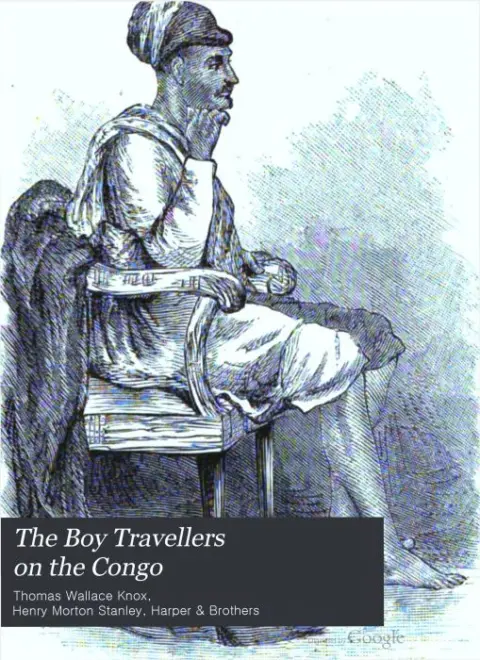
THE CLASSIC COLLECTION · 1887
"The Boy Travellers on the Congo" by Thomas W. Knox is a historical account written in the late 19th century. It tells the adventures of two youths, Frank and Fred, as they journey alongside the famous explorer Henry M. Stanley through Africa, exploring the vast and largely uncharted regions of the continent. The narrative is informative and engaging, aiming to present both the spirit of adventure and the scientific endeavors involved in exploring the Congo. At the start of the narrative, the story follows Stanley as he embarks on a voyage aboard the steamer Eider from New York, where he meets Doctor Bronson and his nephews, Frank and Fred. The boys express admiration for Stanley's previous explorations and hope to follow in his footsteps by crossing Africa. Upon reaching Zanzibar, preparations for an expedition are made, involving the selection of porters, the purchasing of supplies, and discussions about the challenges ahead. Throughout this opening segment, readers get a glimpse of the excitement and anticipation building as the characters prepare for an incredible journey into the heart of Africa, setting the stage for their thrilling adventures.
Introduction adapted from the source catalogue; source summaries may be automatically generated.
Free to read · English · 138,719 words · No account needed
MAKE TIME FOR A GOOD BOOK
On by default. Untick to stop anonymous reading totals. Each page counts after 10 seconds in view. How this works.
Anonymous counting is on unless you have switched it off.
"The stranger, of course, is intensely interested in the life existing near the African equator, now first revealed to him, and all that he sees and hears of figures and faces and sounds is being freshly impressed on his memory. Figures and faces are picturesque enough. Happy, pleased-looking men of black, yellow, or tawny color, with long, white cotton shirts, move about with quick, active motion, and cry out, regardless of order, to their friends or mates in the Swahili or Arabic language, and their friends or mates respond with equally loud voice and lively gesture, until, with fresh arrivals, there appears to be a Babel created, wherein English, French, Swahili, and Arabic accents mix with Hindi, and, perhaps, Persian.
"In the midst of such a scene I stepped into a boat to be rowed to the house of my old friend, Mr. Augustus Sparhawk, of the Bertram Agency. I was welcomed with all the friendliness and hospitality of my first visit, when, three years and a half previously, I arrived at Zanzibar to set out for the discovery of Livingstone.
"With Mr. Sparhawk's aid I soon succeeded in housing comfortably my three young Englishmen, Francis John and Edward Pocock and Frederick Barker, and my five dogs, and in stowing safely on shore the yawl Wave, the gig, and the tons of goods, provisions, and stores I had brought.
"Life at Zanzibar is a busy one to the intending explorer. Time flies rapidly, and each moment of daylight must be employed in the selection and purchase of the various kinds of cloth, beads, and wire in demand by the different tribes of the mainland through whose countries he purposes journeying. Strong, half-naked porters come in with great bales of unbleached cottons, striped and colored fabrics, handkerchiefs and red caps, bags of blue, green, red, white, and amber-colored beads, small and large, round and oval, and coils upon coils of thick brass wire. These have to be inspected, assorted, arranged, and numbered separately, have to be packed in portable bales, sacks, or packages, or boxed, according to their character and value. The house-floors are littered with cast-off wrappings and covers, box-lids, and a medley of rejected paper, cloth, zinc covers, and broken boards, sawdust, and other débris. Porters and servants and masters, employees and employers, pass backward and forward, to and fro, amid all this litter, roll bales over, or tumble about boxes; and a rending of cloth or paper, clattering of hammers, demands for the marking-pots, or the number of bale and box, with quick, hurried breathing and shouting, are heard from early morning until night.
Your reading position is saved on this browser. Take it to another device with a library code. Reading pages adapt to text, rather than matching a printed edition.
Henry M. (Henry Morton) Stanley
Thomas Wallace Knox
Henry M. (Henry Morton) Stanley
Thomas Wallace Knox
BEHIND THE BOOK
This eBook is for the use of anyone anywhere in the United States and most other parts of the world at no cost and with almost no restrictions whatsoever. You may copy it, give it away or re-use it under the terms of the Project Gutenberg License included with this eBook or online at www.gutenberg.org. If you are not located in the United States, you will have to check the laws of the country where you are located before using this eBook. Read the source licence.
The original source file, including credits and licence, is retained by this library. Request an original-format copy at no charge. Please include the book title and Project Gutenberg identifier #60328.
KEEP YOUR CURIOSITY GOING
Wilfrid Scawen Blunt
Wilfrid Scawen Blunt

E. W. (Edgar Watson) Howe
Cécile Tormay

Moritz Busch
Coulson Kernahan