Through the Dark Continent, Vol. 1 (of 2)
Henry M. (Henry Morton) Stanley
THE CLASSIC COLLECTION · 1887
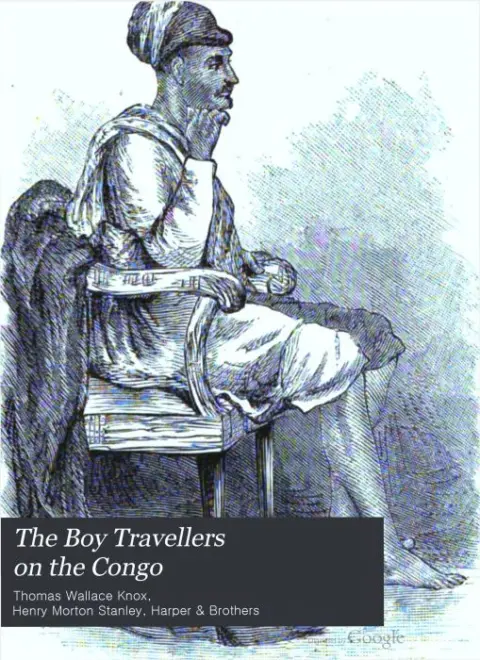
"The Boy Travellers on the Congo" by Thomas W. Knox is a historical account written in the late 19th century. It tells the adventures of two youths, Frank and Fred, as they journey alongside the famous explorer Henry M. Stanley through Africa, exploring the vast and largely uncharted regions of the continent. The narrative is informative and engaging, aiming to present both the spirit of adventure and the scientific endeavors involved in exploring the Congo. At the start of the narrative, the story follows Stanley as he embarks on a voyage aboard the steamer Eider from New York, where he meets Doctor Bronson and his nephews, Frank and Fred. The boys express admiration for Stanley's previous explorations and hope to follow in his footsteps by crossing Africa. Upon reaching Zanzibar, preparations for an expedition are made, involving the selection of porters, the purchasing of supplies, and discussions about the challenges ahead. Throughout this opening segment, readers get a glimpse of the excitement and anticipation building as the characters prepare for an incredible journey into the heart of Africa, setting the stage for their thrilling adventures.
Introduction adapted from the source catalogue; source summaries may be automatically generated.
Free to read · English · 138,719 words · No account needed
MAKE TIME FOR A GOOD BOOK
On by default. Untick to stop anonymous reading totals. Each page counts after 10 seconds in view. How this works.
Anonymous counting is on unless you have switched it off.
"At this settlement we observed for the first time spears all of wood, having their points sharp and hardened in fire and shafts eight to ten feet long. As each warrior possesses a sheaf of these weapons, besides a vast wooden shield, he is sufficiently armed against a native enemy, and might, by a little boldness, become a dangerous foe to an Arab.
"The currency throughout Manyema consists of cowries. Six cowries formed the ration money of the Wangwana, three cowries purchased a chicken, two procured ten maize-ears, one cowrie obtained the service of a native to grind the grain, two cowries were a day's hire for a porter; so that the Wangwana and Wanyamwezi were enjoying both abundance and relief from labor while we were travelling through Manyema.
"At Kabungwé I was alarmed at an insufferable odor that pervaded the air we breathed, for, whether in the house or without, the atmosphere seemed loaded with an intolerable stench. On inquiring of the natives whether there was any dead animal putrefying in the neighborhood, they pointed to the firewood that was burning, and to a tree--a species of laurel--as that which emitted the smell. Upon examination I found it was indeed due to this strange wood, which, however, only becomes offensive under the action of fire.
"Between Kabungwé and Mtuyu, our next camp, the country is extremely populous. Were all the villages we passed inhabited by brave men, a brigade of European troops could not move without precaution. The people, however, did not attempt to molest us, though an enormous number came out to stare at us and our donkeys.
"The natives are quick to adopt nicknames. In some places the Arabs were known by the name of Mwana Ngombé, 'lords of cows.'
"The Sarmeen of my first expedition received from his comrades, for his detective qualities, the name of Kachéché, or the 'weasel.'
"Sambuzi received the title of Mta-uza, or the 'spoiler;' and one of his subordinates was called Kiswaga, or 'fleet-foot.'
"Kalulu's name was formerly Ndugu Mali, 'brother of money.'
"Wadi Safeni had a young relative in the expedition entitled Akili Mali, or 'one who is wise with his money.'
"In the same manner countries receive appellations distinctive of
peculiarities, such as,
Unya-Nyembé, land of hoes.
U-Yofu, land of elephants.
Unya-Mbewa, land of goats.
Unya-Nkondo, land of sheep.
U-Konongo, land of travellers.
Unya-Nguruwé, land of hogs.
U-Nguru, land of mountains.
U-Kusu, land of parrots.
U-Ganda, land of drums.
U-Lungu or U-Rungu, plain land.
Ma-Rungu, plateau land.
U-Kutu, land of ears (long ears?).
U-Karanga, land of ground nuts.
U-Lua, or U-Rua, land of lakes.
U-Emba, lake land.
U-Bwari, land of food.
Your reading position is saved on this browser. Take it to another device with a library code. Reading pages adapt to text, rather than matching a printed edition.
Henry M. (Henry Morton) Stanley
Thomas Wallace Knox
Henry M. (Henry Morton) Stanley
Thomas Wallace Knox
BEHIND THE BOOK
This eBook is for the use of anyone anywhere in the United States and most other parts of the world at no cost and with almost no restrictions whatsoever. You may copy it, give it away or re-use it under the terms of the Project Gutenberg License included with this eBook or online at www.gutenberg.org. If you are not located in the United States, you will have to check the laws of the country where you are located before using this eBook. Read the source licence.
The original source file, including credits and licence, is retained by this library. Request an original-format copy at no charge. Please include the book title and Project Gutenberg identifier #60328.
KEEP YOUR CURIOSITY GOING
Wilfrid Scawen Blunt
Wilfrid Scawen Blunt

E. W. (Edgar Watson) Howe
Cécile Tormay

Moritz Busch
Coulson Kernahan