Hunters three: Sport and adventure in South Africa
Thomas Wallace Knox
THE CLASSIC COLLECTION · 1886
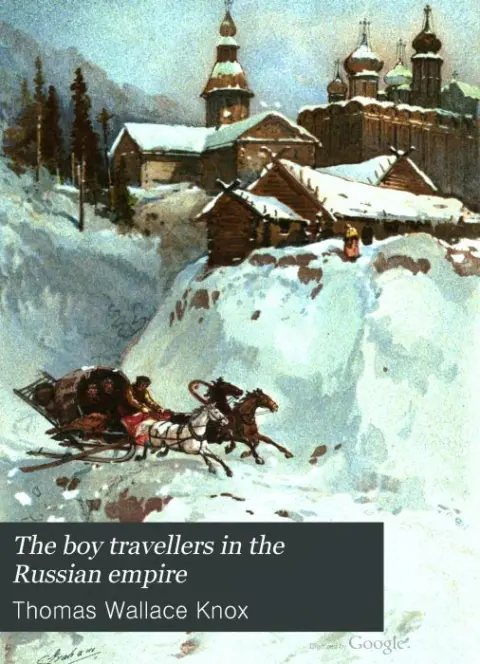
"The Boy Travellers in The Russian Empire" by Thomas Wallace Knox is a travel account written in the late 19th century. The narrative follows two young characters, Frank Bassett and Fred Bronson, as they embark on a journey through various regions of Russia, including explorations across Siberia, visits to historical sites, and experiences with local cultures. The text also incorporates historical context, helping readers understand the backdrop of their adventures. At the start of the book, Frank and Fred, accompanied by Dr. Bronson, prepare for their adventure in Vienna before departing for the salt mines of Wieliczka. The opening describes their excitement, historical sights, and cultural observations, such as the significant Jewish presence in Cracow. As they travel, they delve into details about the unique features of the city, including its architecture and the local community, setting the stage for a rich exploration of the Russian Empire and highlighting their youthful curiosity and eagerness to learn.
Introduction adapted from the source catalogue; source summaries may be automatically generated.
Free to read · English · 138,984 words · No account needed
MAKE TIME FOR A GOOD BOOK
On by default. Untick to stop anonymous reading totals. Each page counts after 10 seconds in view. How this works.
Anonymous counting is on unless you have switched it off.
"It is also called Novgorod Veliki," said Fred, "which means Novgorod the Great. In the fifteenth century it had a population of four hundred thousand, and was really entitled to be called the great. At present it has less than twenty thousand inhabitants, and its industries are of little importance compared to what they used to be.
"It has a trade in flax, corn, and hemp," the youth continued, "and its manufactures are principally in tobacco, leather, sail-cloth, vinegar, and candles. In former times an important fair was held here, and merchants came to Novgorod from all parts of Europe and many countries of Asia. Afterwards the fair was removed to Nijni Novgorod, on the Volga, and the ancient city became of little consequence except for its historical interest."
"The Slavs founded a town there in the fourth century," said Frank. "About the year 862 the Russian monarchy had its beginning at Novgorod; in 1862 there was a millennial celebration there, and a magnificent monument was erected to commemorate it."
"This is a good place for you to tell us about the early history of
Russia," said the Doctor.
"I have been studying it," Frank replied, "and find that previous to the ninth century the country was occupied by the Slavs, who founded the towns of Novgorod and Kief. Each of these places was the capital of an independent Slavic principality. Very little is known of the history of the Slavs in those times. The Varangians, a northern people, made war upon them. The Slavs resisted, but finally invited Rurik, the Prince of the Varangians, to come and rule over them. The Northmen, or Varangians, were called 'Russ' by the Slavs, and from them the new monarchy was called Russia. Rurik came with his two brothers, Sineus and Truvor, and at Novgorod laid the foundation of this empire that now covers one-eighth of the land surface of the globe.
"The story is admirably told in verse by Bayard Taylor. I have copied the lines from his poetical volume, and will read them to you."
In a full, clear voice the youth then read as follows, having previously explained that Mr. Taylor was present at the millennial celebration already mentioned:
Novgorod, Russia, Sept. 20, 1862.
"'A thousand years! Through storm and fire,
With varying fate, the work has grown,
Till Alexander crowns the spire,
Where Rurik laid the corner-stone.
"'The chieftain's sword, that could not rust,
But bright in constant battle grew,
Raised to the world a throne august--
A nation grander than he knew.
"'Nor he, alone; but those who have,
Through faith or deed, an equal part:
The subtle brain of Yaroslav,
Vladimir's arm and Nikon's heart;
Your reading position is saved on this browser. Take it to another device with a library code. Reading pages adapt to text, rather than matching a printed edition.
Thomas Wallace Knox
Thomas Wallace Knox
Thomas Wallace Knox
Thomas Wallace Knox
BEHIND THE BOOK
This eBook is for the use of anyone anywhere in the United States and most other parts of the world at no cost and with almost no restrictions whatsoever. You may copy it, give it away or re-use it under the terms of the Project Gutenberg License included with this eBook or online at www.gutenberg.org. If you are not located in the United States, you will have to check the laws of the country where you are located before using this eBook. Read the source licence.
The original source file, including credits and licence, is retained by this library. Request an original-format copy at no charge. Please include the book title and Project Gutenberg identifier #60086.
KEEP YOUR CURIOSITY GOING
Wilfrid Scawen Blunt
Wilfrid Scawen Blunt

E. W. (Edgar Watson) Howe
Cécile Tormay

Moritz Busch
Coulson Kernahan