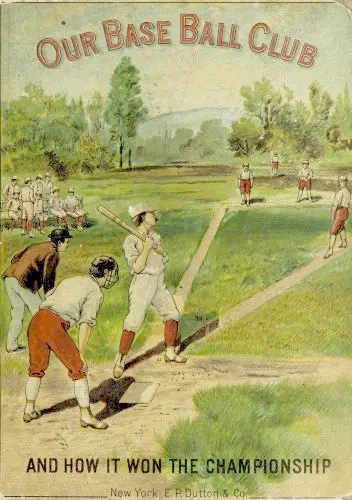
Our Base Ball Club and How It Won the Championship
Noah Brooks
THE CLASSIC COLLECTION · 1891
"The Boy Settlers: A Story of Early Times in Kansas" by Noah Brooks is a historical novel written in the late 19th century. The story follows a group of settlers, particularly focusing on three boys—Charlie and Alexander Howell, and their cousin Oscar Bryant—who are inspired by tales of bravery and adventure from their elders to migrate westward to Kansas during the tumultuous era of settlement and the struggle over slavery in the territories. At the start of the narrative, the boys are introduced in Dixon, Illinois, where they absorb stories of the past, particularly tales of the Black Hawk War. As tensions rise over slavery in Kansas, their fathers decide to relocate the families westward to seek better opportunities and to take part in the fight for freedom. The opening chapters set the stage for their journey, highlighting their motivations, the political backdrop of the time, and their initial preparations as they prepare to embark on this transformative adventure, filled with hopes, dreams, and the stirring call to participate in shaping a new society.
Introduction adapted from the source catalogue; source summaries may be automatically generated.
Free to read · English · 60,480 words · No account needed
MAKE TIME FOR A GOOD BOOK
On by default. Untick to stop anonymous reading totals. Each page counts after 10 seconds in view. How this works.
Anonymous counting is on unless you have switched it off.
"We cross the prairie as of old
The pilgrims crossed the sea,
To make the West, as they the East,
The homestead of the free!"
"Oh, well; I can't bother about poetry, now," said the father, hastily. "I have some prose work on hand, just about this time. I'm trying to drive these pesky cattle, and I don't make a very good fist at it. Your Uncle Aleck has gone on ahead, and left me to manage the team; but it's new business to me."
"John G. Whittier is the name at the top of these verses. I've heard of him. He's a regular-built poet,--lives somewhere down East."
"I can't help that, sonny; get on the other side of those steers, and see if you can't gee them around. Dear, dear, they're dreadful obstinate creatures!"
That night, however, when they were comfortably and safely camped in Quindaro, amid the live-oaks and the tall sycamores that embowered the pretty little town, Oscar again brought the newspaper to his father, and, with kindling eyes, said,--
"Read it out, daddy; read the piece. Why, it was written just for us, I do declare. It is called 'The Kansas Emigrants.' We are Kansas Emigrants, aren't we?"
The father smiled kindly as he looked at the flushed face and bright eyes of his boy, and took from him the paper folded to show the verses. As he read, his eyes, too, flashed and his lip trembled.
"Listen to this!" he cried. "Listen to this! It is like a trumpet call!" And with a voice quivering with emotion, he began the poem,--
"We cross the prairie as of old
The pilgrims crossed the sea,
To make the West, as they the East,
The homestead of the free!"
"Something has got into my eyes," said Mr. Howell, as the last stanza was read. "Great Scott! though, how that does stir a man's blood!" And he furtively wiped the moisture from his eyes. It was time to put out the light and go to sleep, for the night now was well advanced. But Mr. Bryant, thoroughly aroused, read and re-read the lines aloud.
"Sing 'em," said his brother-in-law, jokingly. Bryant was a good singer, and he at once tuned up with a fine baritone voice, recalling a familiar tune that fitted the measure of the poem.
"Oh, come now, Uncle Charlie," cried Sandy, from his blankets in the corner of the tent, "that's 'Old Dundee.' Can't you give us something lively? Something not quite so solemn?"
Your reading position is saved on this browser. Take it to another device with a library code. Reading pages adapt to text, rather than matching a printed edition.
Noah Brooks
Noah Brooks
BEHIND THE BOOK
This eBook is for the use of anyone anywhere in the United States and most other parts of the world at no cost and with almost no restrictions whatsoever. You may copy it, give it away or re-use it under the terms of the Project Gutenberg License included with this eBook or online at www.gutenberg.org. If you are not located in the United States, you will have to check the laws of the country where you are located before using this eBook. Read the source licence.
The original source file, including credits and licence, is retained by this library. Request an original-format copy at no charge. Please include the book title and Project Gutenberg identifier #29129.
KEEP YOUR CURIOSITY GOING
Cécile Tormay

Moritz Busch
Coulson Kernahan
John L. Ransom

Maurice Baring
Frances Wright