THE CLASSIC COLLECTION✦The ocean wireless boys of the iceberg patrolCLASSIC FREE BOOKS
The ocean wireless boys of the iceberg patrol
John Henry Goldfrap
THE CLASSIC COLLECTION · 1912
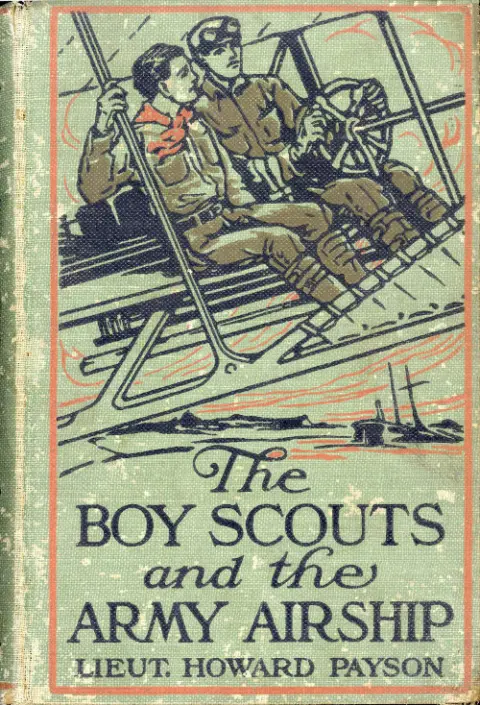
"The Boy Scouts for Uncle Sam" by Lieut. Howard Payson is an adventure novel written in the early 20th century. The story revolves around the Eagle Patrol of the Boy Scouts, led by Rob Blake, who are characterized by their resourcefulness, bravery, and strong sense of camaraderie. As the narrative unfolds, the patrol engages in exciting missions that align with national interests, setting the stage for thrilling escapades that test their skills and character. At the start of the book, the Eagle Patrol finds themselves back home in Hampton after a successful adventure involving the discovery of an old pirate's treasure. They share lighthearted banter and reminisce about their previous outings when they are unexpectedly visited by Lieutenant Duvall and Ensign Daniel Hargreaves from the Navy, who present them with a secret mission involving the safeguarding of a high-tech submarine, the "Peacemaker." The chapter ends with a sense of foreboding as the boys glimpse a potential spy lurking near their meeting room, hinting at the thrilling adventures and dangers that lie ahead.
Introduction adapted from the source catalogue; source summaries may be automatically generated.
Free to read · English · 43,158 words · No account needed
MAKE TIME FOR A GOOD BOOK
On by default. Untick to stop anonymous reading totals. Each page counts after 10 seconds in view. How this works.
Anonymous counting is on unless you have switched it off.
The ensign nodded and laughed.
"Our friend Rob here is getting a bit pale, too," he said; "and as we don't want a sea-sick crew, maybe we had better seek the seclusion of Davy Jones' locker."
An instant later the Peacemaker was plunging downward. At a depth of twenty feet the angry motion of the waves was unfelt. In those dim depths all was as quiet and undisturbed as if the elements were at perfect peace above.
Down, down dropped the submarine till her depth indicator showed that she was submerged five hundred fathoms.
"The chart gives seven hundred hereabouts," commented Ensign Hargreaves, glancing at it; "so I guess we are safe for forty miles more before the floor of the ocean slopes upward. We must go up a bit higher then."
The inventor nodded.
"I understand," he said, and then, "we are now running at what speed?"
The ensign turned to the speed indicator.
"A trifle under twenty miles an hour," he said.
Mr. Barr glanced at the clock before him, which was illuminated by a
tiny shaded electric bulb.
"I'll keep on this course at this speed for about two hours then," he
determined.
"That will be all right, I imagine," was the rejoinder, "but don't keep on too long. The bed of the sea, according to the chart, rises up very rapidly further on. It must be almost cliff-like in its sudden elevation."
"I'll be on the lookout," the inventor assured him.
Rob descended the ladder once more and reentered the engine room to find out how Merritt was getting along. He found the young engineer seated on the leather lounge alongside the engines watching them lovingly.
"Work smoothly, don't they?" he said.
"They sure do," was the other's response; "smoothly as a Geneva watch."
The boys sat chatting on various matters, and the time flew along rapidly till Rob suddenly looked at his watch.
"Almost two hours. It's time we were rising," he said.
"What do we want to rise for? It's deep enough here, isn't it?"
"That's just it. The ensign says that the chart shows that a sort of submarine cliff looms up right ahead of us somewhere hereabouts."
"Great ginger snaps! I thought the bottom of the sea was as level as a
floor."
"Not a bit of it. It's as full of mountainous regions and flat, depressed plains and valleys as the Rockies themselves."
"Gee whiz! I'd hate to hit one of them. I----"
Merritt stopped short. A terrific crash shook the submarine from stem to stern. Rob saved himself from falling into the machinery by seizing a rail.
Your reading position is saved on this browser. Take it to another device with a library code. Reading pages adapt to text, rather than matching a printed edition.
John Henry Goldfrap
John Henry Goldfrap
John Henry Goldfrap
John Henry Goldfrap
BEHIND THE BOOK
This eBook is for the use of anyone anywhere in the United States and most other parts of the world at no cost and with almost no restrictions whatsoever. You may copy it, give it away or re-use it under the terms of the Project Gutenberg License included with this eBook or online at www.gutenberg.org. If you are not located in the United States, you will have to check the laws of the country where you are located before using this eBook. Read the source licence.
The original source file, including credits and licence, is retained by this library. Request an original-format copy at no charge. Please include the book title and Project Gutenberg identifier #32460.
KEEP YOUR CURIOSITY GOING
Coulson Kernahan

Maurice Baring
Frances Wright
Cécile Tormay

Frederic Jesup Stimson

W. H. P. (William Henry Pope) Jarvis