THE CLASSIC COLLECTION✦The ocean wireless boys of the iceberg patrolCLASSIC FREE BOOKS
The ocean wireless boys of the iceberg patrol
John Henry Goldfrap
THE CLASSIC COLLECTION · 1911
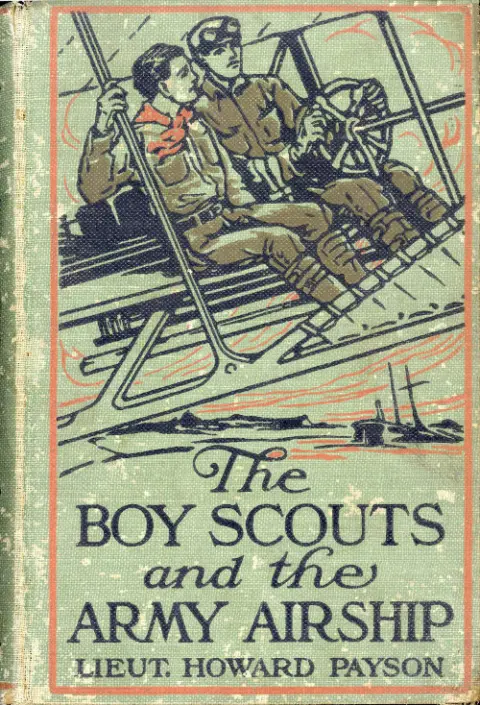
"The Boy Scouts and the Army Airship" by Lieut. Howard Payson is a children's adventure novel written in the early 20th century. The book centers around the exciting exploits of the Boy Scouts, particularly the Eagle and Hawk Patrols, as they engage in thrilling contests and face off against rival groups and unforeseen dangers. The narrative promises an action-packed journey filled with camaraderie, competition, and the spirit of adventure characteristic of youthful exploration. At the start of the story, the boys are participating in a spirited contest called “Spearing the Sturgeon,” showcasing their skills in whaleboat racing and teamwork. The scene is filled with cheers from excited onlookers as the Eagle Patrol, led by the determined Rob Blake, competes against the Hawk Patrol, directed by the competitive Freeman Hunt. The energy of their contest is palpable, reflecting the rivalry between the two groups, and hinting at deeper conflicts to unfold as the story progresses. The opening establishes a tone of adventure and introduces critical characters and themes of sportsmanship, rivalry, and the camaraderie of youth.
Introduction adapted from the source catalogue; source summaries may be automatically generated.
Free to read · English · 51,786 words · No account needed
MAKE TIME FOR A GOOD BOOK
On by default. Untick to stop anonymous reading totals. Each page counts after 10 seconds in view. How this works.
Anonymous counting is on unless you have switched it off.
“Well, I guess we’d better pick up the remains and go home,” said Tubby, dragging out a splintered wing-tip from the snow.
“Hold on a minute,” said Rob, “let’s wait here and see what those fellows can do. I guess they’ve come out here to try that big, new sled.”
Sure enough, a few seconds later there came a loud screech from the top
of the hill.
“Here they come,” volunteered Tubby, bending forward.
High up the hill, outlined sharply against the snow, there came rushing toward them a flying object. It seemed to fairly whiz over the frozen surface. Hardly had they sighted it before it flashed past with yells of defiance from its occupants, and vanished into the darkness cast by a clump of big fir trees.
“Well!” exclaimed Rob, “they’ve got a flyer; no mistake about that.”
“It’ll be faster yet when they get those runners rubbed down,” vouchsafed Merritt; “it only came in this afternoon from New York. They got it from a big sporting-goods house.”
“Maybe the same one Jack got his flying machine from,” chuckled Paul, smiling over the remembrance of the bully’s discomfiture on the occasion of the aeroplane model contest, as told in the first volume of this series.
“Shouldn’t wonder,” responded Tubby, in reply to Paul’s observation.
“Where did they get the money from?” wondered Merritt. “That sled must
have cost a lot.”
“Oh, Hunt’s father gives him plenty of money,” was Rob’s response, “and the others are not exactly poor. They could easily afford such a sled for the gratification of winning the cup away from us.”
“I guess that’s about all they’ve gone into the competition for,”
suggested Paul.
The others agreed with him. It would be a big feather in the caps of the arch enemies of the Boy Scouts if they could capture any of the events which were to take place on the hill after Christmas, especially the big cup event.
“It’s up to us to look out for any crooked work, then,” said Tubby, as, with arms full of such parts of the shattered Pegasus as seemed worth keeping, they started for home. “Those fellows won’t stick at anything as we know.”
“Oh, don’t be too hard on them,” was Rob’s comment; “there’s good in most chaps if you look for it.”
“Hum,” sniffed Merritt, “you’d have to go prospecting with a pickaxe and dynamite to find it in Jack Curtiss’ crowd.”
“And then use a microscope,” commented Tubby, in spite of Rob’s protests that they ought to use “fair play.”
Your reading position is saved on this browser. Take it to another device with a library code. Reading pages adapt to text, rather than matching a printed edition.
John Henry Goldfrap
John Henry Goldfrap
John Henry Goldfrap
John Henry Goldfrap
BEHIND THE BOOK
This eBook is for the use of anyone anywhere in the United States and most other parts of the world at no cost and with almost no restrictions whatsoever. You may copy it, give it away or re-use it under the terms of the Project Gutenberg License included with this eBook or online at www.gutenberg.org. If you are not located in the United States, you will have to check the laws of the country where you are located before using this eBook. Read the source licence.
The original source file, including credits and licence, is retained by this library. Request an original-format copy at no charge. Please include the book title and Project Gutenberg identifier #62792.
KEEP YOUR CURIOSITY GOING
Coulson Kernahan

Maurice Baring
Frances Wright
Cécile Tormay

Frederic Jesup Stimson

W. H. P. (William Henry Pope) Jarvis