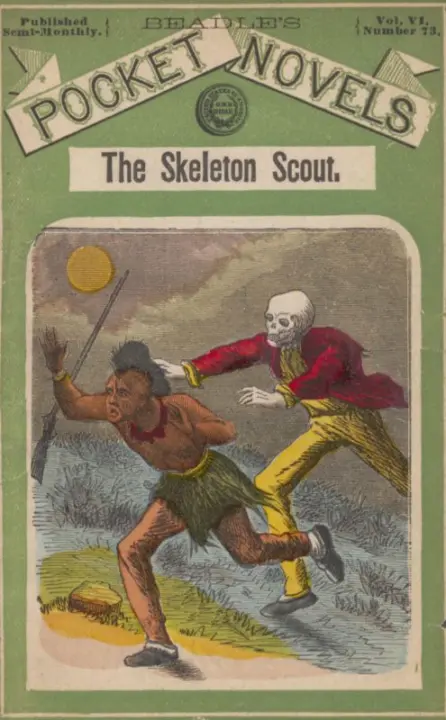
The skeleton scout; or, The border block
Albert W. Aiken
THE CLASSIC COLLECTION · 1884
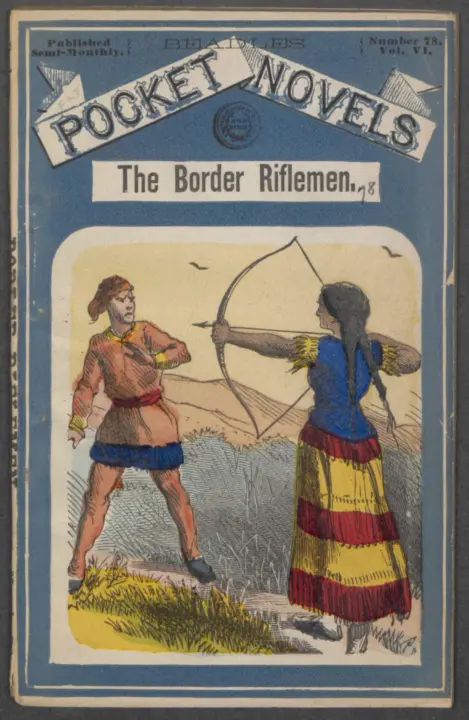
"The Border Riflemen; or, The Forest Fiend. A Romance of the Black-Hawk Uprising" by Lieut. Lewis W. Carson is a historical romance novel written in the early 1870s. The book appears to delve into the tensions of the Black-Hawk Uprising, focusing on the interactions between settlers and Native Americans during this turbulent period. The story opens with the introduction of key characters like Sadie Wescott and Cooney Joe, setting the stage for an exploration of conflicts that arise from cultural misunderstandings and personal vendettas. The opening of the novel introduces readers to a serene frontier setting, abruptly interrupted by tension between characters. We meet Sadie Wescott, a brave young woman facing the unwanted advances of William Jackwood, who threatens violence when rejected. Just as things escalate, Cooney Joe confronts Jackwood to defend Sadie. This confrontation hints at deeper issues, as tensions are rising on the frontier due to growing unrest among Native Americans, led by figures like Black-Hawk. Through this vivid portrayal of interpersonal conflicts and simmering tensions, the opening sets a dramatic backdrop for the unfolding struggle against the backdrop of historical events.
Introduction adapted from the source catalogue; source summaries may be automatically generated.
Free to read · English · 34,484 words · No account needed
MAKE TIME FOR A GOOD BOOK
On by default. Untick to stop anonymous reading totals. Each page counts after 10 seconds in view. How this works.
Anonymous counting is on unless you have switched it off.
They parted from her sadly, and as the flat receded from the shore, they saw her standing in a dejected attitude, leaning on her bow. It was many a day before they saw her again.
The battle was at its hight. Black-Hawk had risked all upon a cast of the die, and had found it a losing game. Melton, Cooney Joe and Tom Bantry were there, fighting gallantly, and as the Indians began to break up, they charged a resolute knot of warriors who stood their ground stubbornly, dealing death on every side.
There was a moment of wild confusion, and Charles Melton found himself face to face with a desperate man, in his war-paint, who assailed him with demoniac fury. Just then Melton’s horse fell, shot through the heart, and his adversary sprung at him with a wild cry of joy, raising a hatchet above his devoted head.
“Death to you, Melton,” he screamed. “I am Will Jackwood, and you die by my hand. If I lost her, at least you shall never possess her.”
Melton, pinned to the earth by his fallen horse, lifted his hand to ward off the blow, but hampered as he was he could offer but slight resistance, and the knife, his only defense, was forced from his hand, and the hatchet gleamed above him.
He had just time to catch the gleam of ferocious joy in the eyes of his enemy, and had given up hope, when a rifle cracked, and Jackwood, throwing up his arms, clutched at the bloody cloth upon his breast, tried once more to lift his weapon, and then, with a snarl of demoniac malice, dropped dead in his tracks, while Cooney Joe, with a rifle smoking in his hand, ran to aid his fallen leader, who was quickly placed upon his feet.
“Who is he?” cried Joe, angrily. “Ha! Black Will, by the mortal. Rubbed
out at last.”
This was his epitaph. He died as he had lived, boldly and defiantly, and found a soldier’s grave.
The power of Black-Hawk was broken, and the old chief a fugitive, soon to be a prisoner in the hands of the whites. Then it was that Samuel Wescott kept his promise to Minneoba, and gave her a shelter under his roof. The teachings of Sadie soon changed the forest maiden so much, that she loved a domestic life, and when Sadie was married, soon after Black-Hawk’s visit to the east, Minneoba was there, and witnessed the ceremony. When it was finished, Cooney Joe stopped the clergyman:
“Stop a little, stranger,” he said, sheepishly. “Got another little job for you, I have.”
Your reading position is saved on this browser. Take it to another device with a library code. Reading pages adapt to text, rather than matching a printed edition.
Albert W. Aiken
Albert W. Aiken
Albert W. Aiken
Albert W. Aiken
BEHIND THE BOOK
This eBook is for the use of anyone anywhere in the United States and most other parts of the world at no cost and with almost no restrictions whatsoever. You may copy it, give it away or re-use it under the terms of the Project Gutenberg License included with this eBook or online at www.gutenberg.org. If you are not located in the United States, you will have to check the laws of the country where you are located before using this eBook. Read the source licence.
The original source file, including credits and licence, is retained by this library. Request an original-format copy at no charge. Please include the book title and Project Gutenberg identifier #66064.
KEEP YOUR CURIOSITY GOING
Cécile Tormay

Moritz Busch
Coulson Kernahan
John L. Ransom

Maurice Baring
Frances Wright