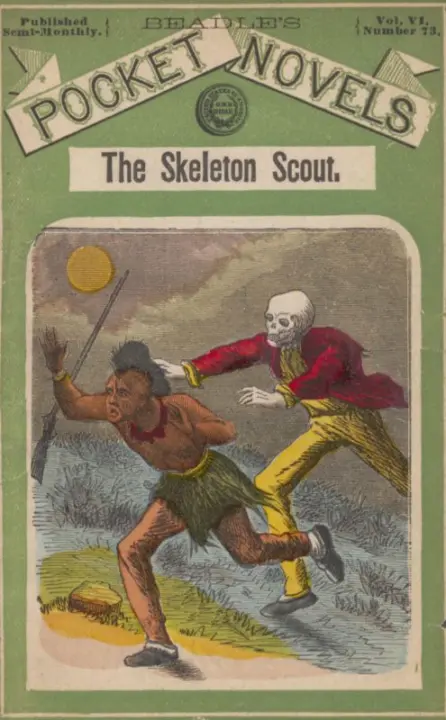
The skeleton scout; or, The border block
Albert W. Aiken
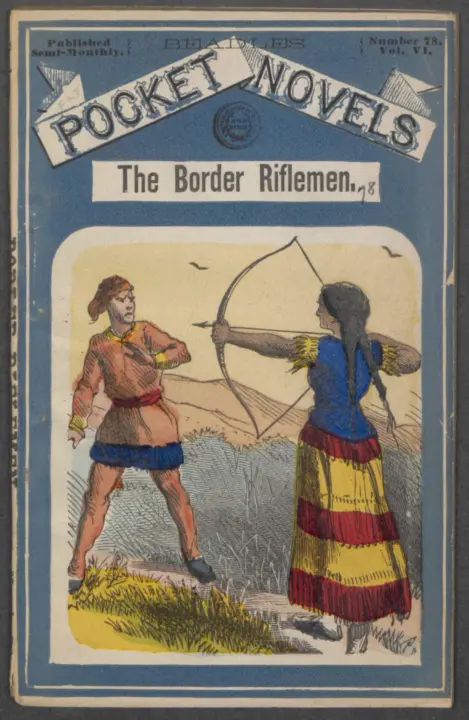
THE CLASSIC COLLECTION · 1884
"The Border Riflemen; or, The Forest Fiend. A Romance of the Black-Hawk Uprising" by Lieut. Lewis W. Carson is a historical romance novel written in the early 1870s. The book appears to delve into the tensions of the Black-Hawk Uprising, focusing on the interactions between settlers and Native Americans during this turbulent period. The story opens with the introduction of key characters like Sadie Wescott and Cooney Joe, setting the stage for an exploration of conflicts that arise from cultural misunderstandings and personal vendettas. The opening of the novel introduces readers to a serene frontier setting, abruptly interrupted by tension between characters. We meet Sadie Wescott, a brave young woman facing the unwanted advances of William Jackwood, who threatens violence when rejected. Just as things escalate, Cooney Joe confronts Jackwood to defend Sadie. This confrontation hints at deeper issues, as tensions are rising on the frontier due to growing unrest among Native Americans, led by figures like Black-Hawk. Through this vivid portrayal of interpersonal conflicts and simmering tensions, the opening sets a dramatic backdrop for the unfolding struggle against the backdrop of historical events.
Introduction adapted from the source catalogue; source summaries may be automatically generated.
Free to read · English · 34,484 words · No account needed
MAKE TIME FOR A GOOD BOOK
On by default. Untick to stop anonymous reading totals. Each page counts after 10 seconds in view. How this works.
Anonymous counting is on unless you have switched it off.
“It is false, Indian,” cried Will Jackwood. “Here, in the midst of your wild band, I defy you to prove that while you were true to me, I failed to do my duty like a man. But when you dared to take away my prisoner, my wife that is to be, in that day I leave you, never to return.”
“Go,” replied Black-Hawk. “I have been deceived in the son of Red-Bird. His father died in the white man’s prison, and now he basely turns away when the battle is nigh.”
“Stay with me, Wild Rose,” cried Minneoba. “My father is a strong chief and will protect you from harm.”
“I can not—I dare not,” replied Sadie. “If I stay with you, my friends, who are his prisoners, must die.”
“My father will take them away from him,” said Minneoba, looking pleadingly at the old chief.
“Let him do so—let him make himself a dog, if he dares,” replied Jackwood. “I will tell his baseness throughout the tribes, and not a man of them all dare look me in the face until I am righted.”
The chief hung his head, for he had pledged his sacred word that Jackwood should keep his prisoners. The scoundrel knew his character too well to doubt for a moment that the Indian would keep his word, and let them go away with the prisoners. Minneoba pleaded in vain, and with loud lamenting, followed the compact force of Jackwood to the edge of the forest, and saw them go away with the prisoners, closely guarded, and Sadie walking by the side of William Jackwood, with a hard, bitter look upon her beautiful face. Garrett, who recovered quickly from every evil, turned about and blew a kiss at Minneoba, who at once fitted an arrow to the string, and would have sent it after him, but that he took shelter among the men, laughing.
“‘The world is all before us where to choose,’ boys,” said Jackwood, “but one thing is certain, if this thing goes against the Indians, and of course it will, this territory won’t be very healthy for us. What do you say?”
“We’ll find a place to live, Cap,” replied Garrett. “The world owes us a living, and we’ll have it too, or else make trouble.”
“Don’t you think we had better find a hiding-place and see what is going to happen? There will be pretty pickings for us if the day should, by any chance, favor the Indians, even for a time.”
“I know the place you mean, Cap,” said Jack Fish, who had come in before they marched. “The neatest hiding-place in the West.”
Your reading position is saved on this browser. Take it to another device with a library code. Reading pages adapt to text, rather than matching a printed edition.
Albert W. Aiken
Albert W. Aiken
Albert W. Aiken
Albert W. Aiken
BEHIND THE BOOK
This eBook is for the use of anyone anywhere in the United States and most other parts of the world at no cost and with almost no restrictions whatsoever. You may copy it, give it away or re-use it under the terms of the Project Gutenberg License included with this eBook or online at www.gutenberg.org. If you are not located in the United States, you will have to check the laws of the country where you are located before using this eBook. Read the source licence.
The original source file, including credits and licence, is retained by this library. Request an original-format copy at no charge. Please include the book title and Project Gutenberg identifier #66064.
KEEP YOUR CURIOSITY GOING
Cécile Tormay

Moritz Busch
Coulson Kernahan
John L. Ransom

Maurice Baring
Frances Wright