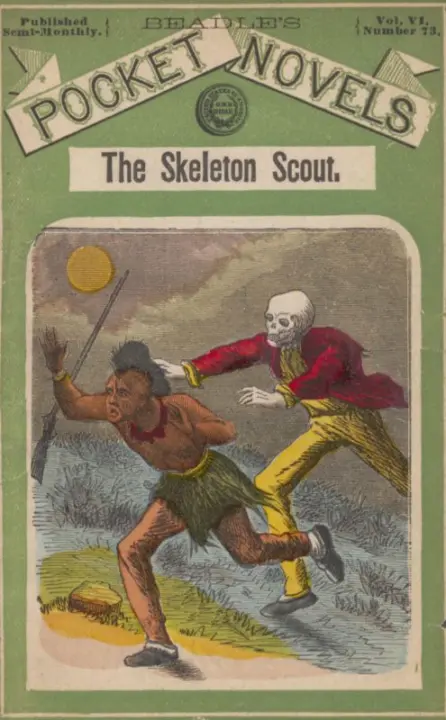
The skeleton scout; or, The border block
Albert W. Aiken
THE CLASSIC COLLECTION · 1884
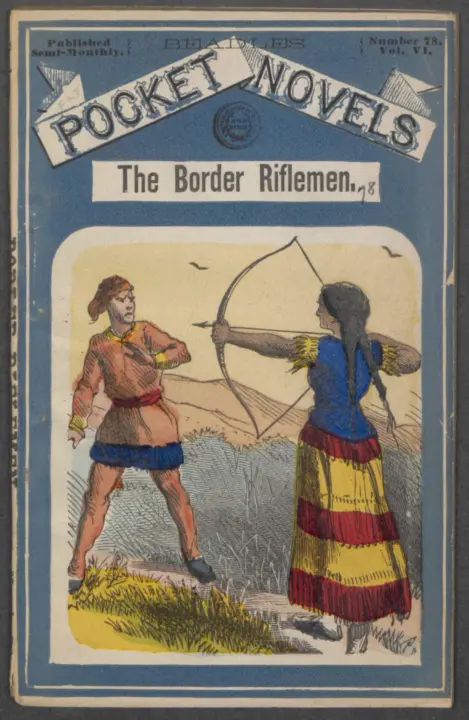
"The Border Riflemen; or, The Forest Fiend. A Romance of the Black-Hawk Uprising" by Lieut. Lewis W. Carson is a historical romance novel written in the early 1870s. The book appears to delve into the tensions of the Black-Hawk Uprising, focusing on the interactions between settlers and Native Americans during this turbulent period. The story opens with the introduction of key characters like Sadie Wescott and Cooney Joe, setting the stage for an exploration of conflicts that arise from cultural misunderstandings and personal vendettas. The opening of the novel introduces readers to a serene frontier setting, abruptly interrupted by tension between characters. We meet Sadie Wescott, a brave young woman facing the unwanted advances of William Jackwood, who threatens violence when rejected. Just as things escalate, Cooney Joe confronts Jackwood to defend Sadie. This confrontation hints at deeper issues, as tensions are rising on the frontier due to growing unrest among Native Americans, led by figures like Black-Hawk. Through this vivid portrayal of interpersonal conflicts and simmering tensions, the opening sets a dramatic backdrop for the unfolding struggle against the backdrop of historical events.
Introduction adapted from the source catalogue; source summaries may be automatically generated.
Free to read · English · 34,484 words · No account needed
MAKE TIME FOR A GOOD BOOK
On by default. Untick to stop anonymous reading totals. Each page counts after 10 seconds in view. How this works.
Anonymous counting is on unless you have switched it off.
“Look here, men,” he said. “I’m Tom Bantry. You don’t know me and mebbe you don’t want to. I’ve been one of Dick Garrett and Will Jackwood’s men—I have. Now why don’t you kill me?”
“Don’t see my way to that clear,” said Joe. “Now, Tom Bantry, what d’ye
want here?”
“I’ve, quit ’em,” replied Tom, energetically. “I couldn’t stand it, boys, ’pon my word, I couldn’t. I feel mean as dirt ’cause I’ve been with ’em so long; but I tell you I didn’t think they was so mean till last night when they killed poor Mr. Wescott.”
“What’s that you say?” cried Melton, coming forward. “Who killed him; how was he killed?”
“Dick Garrett did it,” replied Tom, in a choking voice. “The ’square give him some cheek, and he had him throwed into the river. Boys, I’m a rough boatman, but I jumped in after him, and they left us alone in the dark on the river. I tried to save him, but it wan’t no use; the current took him under.”
“I believe this man, for one,” said Melton. “He never would dare to come here with such a tale as that unless it was really true. What do you say, boys?”
“He’s all right,” replied Joe, “but ef he ain’t, let him look out, ’cause I shoot awful close, odd times; I do, by gracious. So Dick Garrett is jined with Napope?”
“That ain’t all, you know,” said Tom Bantry. “They hev sent off a messenger to the village, and if you don’t have lively times round here, then I don’t want a picayune.”
“Perhaps we had better retreat.”
“You can’t do it; they’ve got scouts all through the woods, and you’d hev the hull posse on your backs in twenty minnits by the clock, so don’t try that on, ’square. No, it’s goin’ to be a b’ar-fight, and you can’t find a better place than this to fight in.”
“I believe the man is right,” said Melton. “I say, Folks, is your hand so bad you can’t pull a trigger?”
“Sorry to say ’tis, Cap,” replied the man; “I can’t do nothing.”
He had been hit in the hand during the fight that morning, and the cords had been so injured as to make it impossible for him to fire a rifle.
“Then you may as well let this man have your rifle, Folks,” said the captain. “I take it for granted you mean to fight?”
Your reading position is saved on this browser. Take it to another device with a library code. Reading pages adapt to text, rather than matching a printed edition.
Albert W. Aiken
Albert W. Aiken
Albert W. Aiken
Albert W. Aiken
BEHIND THE BOOK
This eBook is for the use of anyone anywhere in the United States and most other parts of the world at no cost and with almost no restrictions whatsoever. You may copy it, give it away or re-use it under the terms of the Project Gutenberg License included with this eBook or online at www.gutenberg.org. If you are not located in the United States, you will have to check the laws of the country where you are located before using this eBook. Read the source licence.
The original source file, including credits and licence, is retained by this library. Request an original-format copy at no charge. Please include the book title and Project Gutenberg identifier #66064.
KEEP YOUR CURIOSITY GOING
Cécile Tormay

Moritz Busch
Coulson Kernahan
John L. Ransom

Maurice Baring
Frances Wright