THE CLASSIC COLLECTION✦The ocean wireless boys of the iceberg patrolCLASSIC FREE BOOKS
The ocean wireless boys of the iceberg patrol
John Henry Goldfrap
THE CLASSIC COLLECTION · 1911
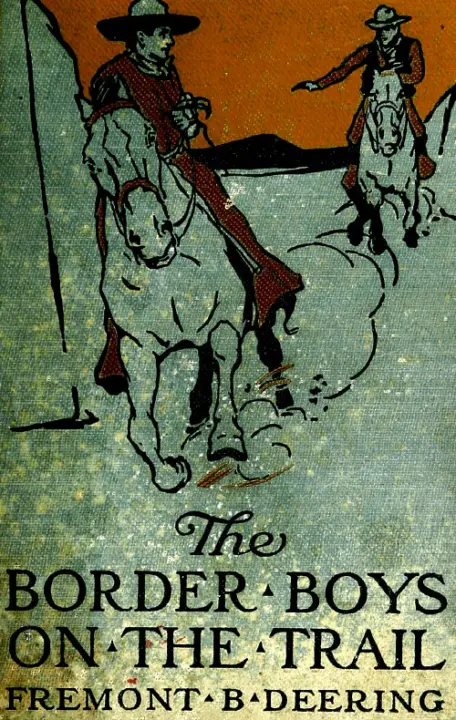
"The Border Boys on the Trail" by Fremont B. Deering is a novel written in the early 20th century. The story follows two boys, Ralph Stetson and Jack Merrill, who venture to the New Mexico border region, where they get caught up in a series of dangerous adventures involving cattle rustlers. As they navigate the unfamiliar landscape and its challenges, they rely on their wits and friendship. The opening of the novel introduces Ralph and Jack as they arrive in the scanty frontier town of Maguez, New Mexico. They are accompanied by their professor, Wintergreen, who is eager to study the local history and culture. The narrative quickly shifts from a mundane arrival to a more thrilling atmosphere as the boys witness a chaotic scene involving a Chinese cook and a threatening Mexican man, Black Ramon De Barrios. In a series of incidents, Ralph's luck and bravery are put to the test, particularly when he finds himself amidst a runaway pony incident, leading to a life-threatening situation with the current of a rushing canal. The stage is set for the boys’ adventures, fraught with excitement and danger while hinting at the presence of more treachery ahead.
Introduction adapted from the source catalogue; source summaries may be automatically generated.
Free to read · English · 50,696 words · No account needed
MAKE TIME FOR A GOOD BOOK
On by default. Untick to stop anonymous reading totals. Each page counts after 10 seconds in view. How this works.
Anonymous counting is on unless you have switched it off.
"Eh--oh!" gasped the professor, coming out of a brown study in which he had had his eyes fixed abstractedly on the paper, "yes, yes, of course. But, young man, your eyes are better than mine, and I want to ask you a question--do you notice anything on that paper?"
"Why, yes, a few marks; looks like dirt," said Ralph carelessly. "The sunlight shows them up. Nice sort of correspondence paper." He laughed mirthlessly.
"No, but," insisted the professor, "it looks to me as if characters of some kind were inscribed on them and----"
Ralph had suddenly risen and snatched up one of the sheets. A closer scrutiny had shown him that the papers were indeed covered with some sort of writing which they had not noticed before.
"You're right, professor," he exclaimed, "they are written on. See! the marks are getting clearer. But--but why didn't we see any writing before."
"Because," exclaimed the professor, "the papers have been written on with invisible fluid of some kind. Their exposure to the warm rays of the sun has brought out the writing."
"It's getting clearer," said Ralph, eagerly perusing the sheet he held. "I can't quite make it out yet, though."
He exposed the sheet he held to the sunlight, while Walt Phelps leaned interestedly over his shoulder.
"Why-why," the boy stuttered, "it's something about this church. Look here, I can see the 'Church of St. Gabriel, the old mission,' as plain as anything, and-and, why, professor," shouted the boy, half wild with excitement, "I believe that this paper, by some wonderful chance, may be the means of getting us out of here."
"Let me see," demanded the professor, taking the paper from the boy's trembling hands. Sure enough, it was covered with characters written closely, and seemingly hastily.
"'This record, made the seventeenth day of August, 1909,'" he read out, "'is to be kept in case of accidents. The secret passage lies four squares from the fifth square from the last window on the right hand side toward the altar. The old altar rail pulls back, exposing the trapdoor. Treasure in passage, one hundred paces from north of tunnel in wall, to right.' Give me that other page, Ralph, quick!"
The professor's voice shook strangely, and his dim eyes shone behind his spectacles. Rapidly he warmed the page Ralph handed him in the sunlight, and more writing leaped into view.
Your reading position is saved on this browser. Take it to another device with a library code. Reading pages adapt to text, rather than matching a printed edition.
John Henry Goldfrap
John Henry Goldfrap
John Henry Goldfrap
John Henry Goldfrap
BEHIND THE BOOK
This eBook is for the use of anyone anywhere in the United States and most other parts of the world at no cost and with almost no restrictions whatsoever. You may copy it, give it away or re-use it under the terms of the Project Gutenberg License included with this eBook or online at www.gutenberg.org. If you are not located in the United States, you will have to check the laws of the country where you are located before using this eBook. Read the source licence.
The original source file, including credits and licence, is retained by this library. Request an original-format copy at no charge. Please include the book title and Project Gutenberg identifier #48680.
KEEP YOUR CURIOSITY GOING
Coulson Kernahan

Maurice Baring
Frances Wright
Cécile Tormay

Frederic Jesup Stimson

W. H. P. (William Henry Pope) Jarvis