THE CLASSIC COLLECTION✦The boys’ book of buccaneersCLASSIC FREE BOOKS
The boys’ book of buccaneers
A. Hyatt (Alpheus Hyatt) Verrill
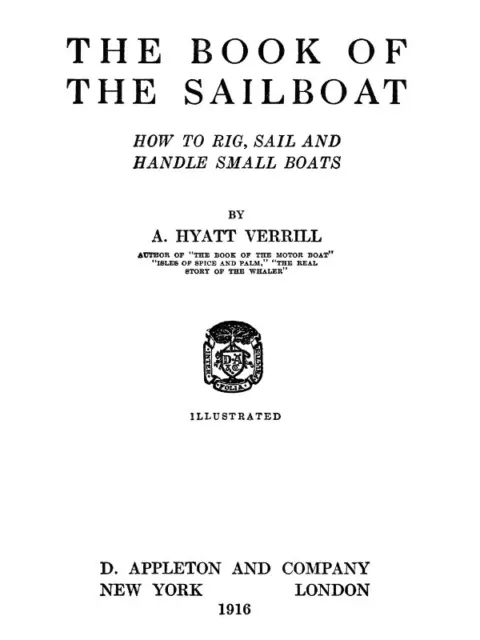
THE CLASSIC COLLECTION · 1916
"The Book of the Sailboat: How to Rig, Sail and Handle Small Boats" by A. Hyatt Verrill is a practical guidebook written in the early 20th century. The book focuses on small sailboats, covering essential topics such as rigging, sailing techniques, and care for these vessels. It aims to educate readers about the evolution of boats, different types suited for various purposes, and the fundamental principles of sailing, making it a valuable resource for both novice and experienced sailors. The opening of the text begins with a historical overview of boat development, tracing back to primitive crafts used by early humans. Verrill highlights the evolution of various boat types, illustrating how ancient boats like dugouts and canoes have influenced modern designs. He emphasizes the importance of understanding a boat's construction and functionality, as he introduces the various components and systems that make up small boats, setting the stage for detailed discussions on rigging and sailing techniques in the subsequent chapters. The tone is informative and engaging, catering to readers interested in maritime culture and practical sailing knowledge.
Introduction adapted from the source catalogue; source summaries may be automatically generated.
Free to read · English · 49,781 words · No account needed
MAKE TIME FOR A GOOD BOOK
On by default. Untick to stop anonymous reading totals. Each page counts after 10 seconds in view. How this works.
Anonymous counting is on unless you have switched it off.
=Reef.= To reduce the area of a sail. A line or group of sunken
rocks.
=Reeve.= To run a rope through anything.
=Rooting.= Burying by the head.
=Run.= The submerged after-part of the hull.
=Scud.= To run before a wind. A kind of cloud.
=Seize.= To make fast or bind.
=Selvage.= A strap made of yarns loosely bound together.
=Sheave.= The wheel within a block or any wheel over which a rope
runs.
=Sheer.= To vary from a direct course. The curve from bow to stern
horizontally.
=Sheet.= A rope attached to a sail and by which the sail is held and worked. On a square sail, ropes which spread the sails.
=Snorter or snotter.= A rope strap into which the heel of a sprit
is slipped.
=Soldier’s wind.= A beam wind.
=Spill.= To throw the wind out of a sail.
=Splice.= A method of joining two objects together so the joint is no larger than the rest of the object.
=Spring.= To crack or bend a spar. A rope made fast to a cable, to some spot ashore, to a buoy or mooring, or to another vessel and then led aft in order to swing a vessel’s stern in any desired direction. To start a plank. To start a leak.
=Sprit.= A light spar used to extend a sail.
=Squatting.= Settling down by the stern.
=Starboard.= The right-hand side.
=Stay.= A rope or wire used as a support to a spar.
=Sternboard.= To move backward stern first.
=Tack.= To proceed against the wind by zigzags. The forward corner
of a fore-and-aft sail.
=Tackle.= Any arrangement of ropes and blocks.
=Taut.= Tight.
=Truck.= The top of a mast.
=Unbend.= To cast off; to unfasten.
=Veer.= To turn. To pay out cable.
=Wake.= The track left by a vessel in the water.
=Watch.= A division of the crew. The length of time a man is on
duty.
=Wear.= To turn a boat’s head into the wind and then around until she has the wind on the opposite side.
=Weather helm.= When a tiller or helm must be kept to windward to prevent a boat from flying into the wind.
=Weathering.= Surviving anything, such as a gale or storm. Getting
to windward of anything.
=Weigh.= To hoist or lift, especially to lift the anchor.
=Wind’s eye.= The exact direction from which the wind blows.
=Yaw.= To swerve wildly or violently from a true course despite
the action of the rudder.
Transcriber’s note:
All figure references in the text have been regularized.
Table of Contents, ‘Latteen’ changed to ‘Lateen,’ “sails. Lateen, lug,
gunter”
Page 29, full stop changed to comma after ‘say,’ “he will say,
“Starboard”
Your reading position is saved on this browser. Take it to another device with a library code. Reading pages adapt to text, rather than matching a printed edition.
A. Hyatt (Alpheus Hyatt) Verrill
A. Hyatt (Alpheus Hyatt) Verrill
A. Hyatt (Alpheus Hyatt) Verrill
A. Hyatt (Alpheus Hyatt) Verrill
BEHIND THE BOOK
This eBook is for the use of anyone anywhere in the United States and most other parts of the world at no cost and with almost no restrictions whatsoever. You may copy it, give it away or re-use it under the terms of the Project Gutenberg License included with this eBook or online at www.gutenberg.org. If you are not located in the United States, you will have to check the laws of the country where you are located before using this eBook. Read the source licence.
The original source file, including credits and licence, is retained by this library. Request an original-format copy at no charge. Please include the book title and Project Gutenberg identifier #54051.
KEEP YOUR CURIOSITY GOING

Charles G. (Charles Griffith) Ross
Hannah Webster Foster

Emily Lawless
Edwin Hamlin Carr

Charles De Lano Hine
Andrew Ure