THE CLASSIC COLLECTION✦The boys’ book of buccaneersCLASSIC FREE BOOKS
The boys’ book of buccaneers
A. Hyatt (Alpheus Hyatt) Verrill
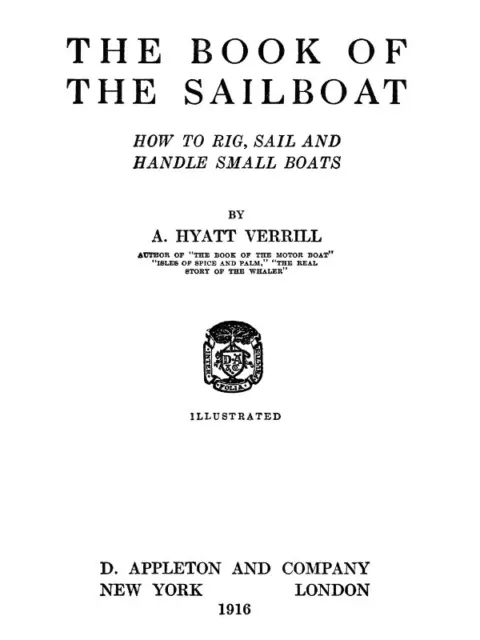
THE CLASSIC COLLECTION · 1916
"The Book of the Sailboat: How to Rig, Sail and Handle Small Boats" by A. Hyatt Verrill is a practical guidebook written in the early 20th century. The book focuses on small sailboats, covering essential topics such as rigging, sailing techniques, and care for these vessels. It aims to educate readers about the evolution of boats, different types suited for various purposes, and the fundamental principles of sailing, making it a valuable resource for both novice and experienced sailors. The opening of the text begins with a historical overview of boat development, tracing back to primitive crafts used by early humans. Verrill highlights the evolution of various boat types, illustrating how ancient boats like dugouts and canoes have influenced modern designs. He emphasizes the importance of understanding a boat's construction and functionality, as he introduces the various components and systems that make up small boats, setting the stage for detailed discussions on rigging and sailing techniques in the subsequent chapters. The tone is informative and engaging, catering to readers interested in maritime culture and practical sailing knowledge.
Introduction adapted from the source catalogue; source summaries may be automatically generated.
Free to read · English · 49,781 words · No account needed
MAKE TIME FOR A GOOD BOOK
On by default. Untick to stop anonymous reading totals. Each page counts after 10 seconds in view. How this works.
Anonymous counting is on unless you have switched it off.
=Clew.= The after corner of a fore-and-aft sail. The two lower
corners of a square sail.
=Close hauled.= Sailing as nearly as possible into the wind.
=Cockpit.= The open after part of a boat.
=Course.= The direction in which a boat is to proceed. The lower sails on square-rigged vessels.
=Crank or cranky.= Not stable. Unable to carry sail well. To tip
easily. Unsteady.
=Cringle.= A thimble or eye worked in a sail and through which a
rope may be passed.
=Crotch.= A support of crossed pieces of wood, or metal, in which the boom rests when the sail is furled.
=Cutwater.= The extreme forward edge of the bow.
=Davits.= Curved iron or wooden objects to which boats are
hoisted.
=Downhaul.= Rope used to haul down sails.
=Dowse.= To lower rapidly. Also to extinguish.
=Draught or draft.= The amount of water in which a boat is
immersed when afloat.
=Earrings.= Lines passed through cringles.
=Ease off.= To slacken.
=Ensign.= The national flag of any country.
=Entrance.= The lower part of a vessel’s stem.
=Fag end.= The end that is frayed.
=Fall off.= To move away from the wind.
=Fathom.= Six feet.
=Fid.= A sharp, tapered tool used in splicing rope.
=Fill away.= To have the wind fill the after surfaces of the sails and the vessel proceed on her course.
=Fore reach.= To pass to windward of another vessel when close
hauled.
=Foul.= Anything entangled. To come into contact.
=Furl.= To stow a sail.
=Gaff.= The spar that supports the top of a fore-and-aft sail. A pole with a sharp hook on the end.
=Gangway.= The place where people come aboard. An opening in a vessel’s side. Room to pass.
=Garboard strakes.= The planks next to the keel on a boat’s
bottom.
=Gasket.= A lashing of rope or a strip of canvas used to secure
sails, etc.
=Go about.= To tack. To alter the course so the sail fills on the
other side.
=Grapnel.= A four-pronged anchor.
=Griping.= Carrying a hard weather helm.
=Grommet.= A ring of rope. A metal ring used in place of an eyelet
in a sail.
=Ground tackle.= The anchor, cable and fittings.
=Halyards or Halliards.= Ropes used to hoist sails.
=Handsomely.= Carefully, smartly.
=Handy billy.= A small tackle used in hauling on a rope.
=Hanks.= Metal rings for attaching sails to stays so they will
slide easily.
=Heave to.= To stop a vessel’s movement by so arranging sails that she will lie head to the wind and almost stationary.
=Heeling.= Tipping to one side.
=Hitch.= A kind of knot.
=In irons.= When headway is lost and the boat will not answer her
helm.
Your reading position is saved on this browser. Take it to another device with a library code. Reading pages adapt to text, rather than matching a printed edition.
A. Hyatt (Alpheus Hyatt) Verrill
A. Hyatt (Alpheus Hyatt) Verrill

A. Hyatt (Alpheus Hyatt) Verrill
A. Hyatt (Alpheus Hyatt) Verrill
BEHIND THE BOOK
This eBook is for the use of anyone anywhere in the United States and most other parts of the world at no cost and with almost no restrictions whatsoever. You may copy it, give it away or re-use it under the terms of the Project Gutenberg License included with this eBook or online at www.gutenberg.org. If you are not located in the United States, you will have to check the laws of the country where you are located before using this eBook. Read the source licence.
The original source file, including credits and licence, is retained by this library. Request an original-format copy at no charge. Please include the book title and Project Gutenberg identifier #54051.
KEEP YOUR CURIOSITY GOING

Charles G. (Charles Griffith) Ross
Hannah Webster Foster

Emily Lawless
Edwin Hamlin Carr

Charles De Lano Hine
Andrew Ure