THE CLASSIC COLLECTION✦The boys’ book of buccaneersCLASSIC FREE BOOKS
The boys’ book of buccaneers
A. Hyatt (Alpheus Hyatt) Verrill
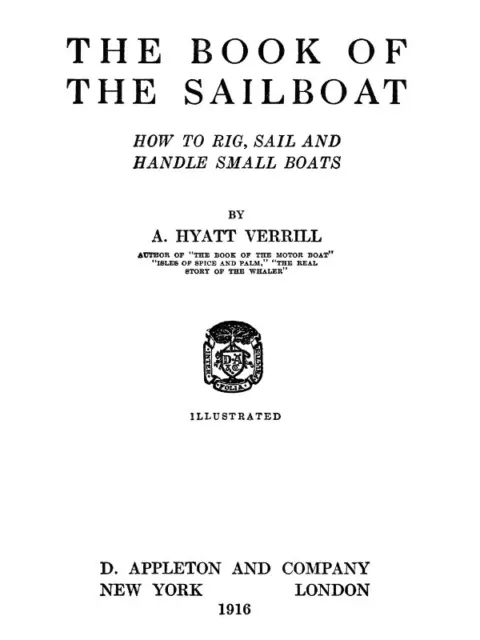
THE CLASSIC COLLECTION · 1916
"The Book of the Sailboat: How to Rig, Sail and Handle Small Boats" by A. Hyatt Verrill is a practical guidebook written in the early 20th century. The book focuses on small sailboats, covering essential topics such as rigging, sailing techniques, and care for these vessels. It aims to educate readers about the evolution of boats, different types suited for various purposes, and the fundamental principles of sailing, making it a valuable resource for both novice and experienced sailors. The opening of the text begins with a historical overview of boat development, tracing back to primitive crafts used by early humans. Verrill highlights the evolution of various boat types, illustrating how ancient boats like dugouts and canoes have influenced modern designs. He emphasizes the importance of understanding a boat's construction and functionality, as he introduces the various components and systems that make up small boats, setting the stage for detailed discussions on rigging and sailing techniques in the subsequent chapters. The tone is informative and engaging, catering to readers interested in maritime culture and practical sailing knowledge.
Introduction adapted from the source catalogue; source summaries may be automatically generated.
Free to read · English · 49,781 words · No account needed
MAKE TIME FOR A GOOD BOOK
On by default. Untick to stop anonymous reading totals. Each page counts after 10 seconds in view. How this works.
Anonymous counting is on unless you have switched it off.
Finally, if you lower sails in a squall, be sure to spill the sail before lowering away, as otherwise it may catch a puff of wind, balloon out and capsize the boat. If you wish to reef in squalls either anchor or throw out a drogue to keep head-on to the puffs.
If the squalls are very heavy and there is plenty of space to leeward lower the sails, throw out a drogue or anchor or scud before the wind under bare poles until the squalls decrease sufficiently to permit you to reef.
In handling boats an ounce of prevention is worth many tons of cure, and if you keep your weather eye open, as sailors say, there will seldom be occasion for you to face difficulties unprepared. Changes of wind or weather are almost invariably presaged by certain signs or symptoms which may readily be noticed and understood and everyone who sails a boat should learn to recognize the signs which indicate certain conditions.
Of course if one has a barometer the approaching weather conditions may be determined very easily, but even without this instrument a person who is weatherwise may usually foretell the approach of good or bad weather or of rain or wind many hours in advance.
Among the commonest and most noticeable indications are the following, and only in very rare instances will these signs fail:
Unusual twinkling of stars,
Double horns to the moon,
Halos around stars or Increasing wind, or rain with
moon, “Wind dogs” a liability of wind.
Wind shifting from west to Increase of wind from the east other direction.
Rosy sky at sunset Fine weather.
Sickly, greenish-colored
sunset Wind and rain.
Dark red or crimson sunset Rain.
Bright-yellow sky at sunset Wind.
Pale-yellow, or saffron,
sunset Rain.
Mixed red and yellow sunset Rain and squally weather.
Remarkably clear atmosphere
with distant objects
standing above the water Wind, usually from the
and seemingly in air northwest, and often rain.
Heavy dews Fine weather.
Fogs Change in weather and little wind.
Misty clouds on hills,
remaining stationary,
increasing or descending Rain and wind.
Misty clouds on hills,
rising or dispersing Fairer weather.
Red morning sky Bad weather and wind.
Gray morning sky Fine weather.
High dawn (dawn seen above a
bank of clouds) Wind.
Low dawn (daylight breaking
close to the horizon) Fair.
Soft, delicate clouds Fair and light winds.
Hard-edged, oily clouds Wind.
Dark, gloomy sky Windy.
Light, bright sky Fine weather.
Small, inky clouds Rain.
Light “scud,” or small
clouds moving across
heavier clouds Wind and rain.
Light, scudding clouds by
themselves Wind and dry weather.
Your reading position is saved on this browser. Take it to another device with a library code. Reading pages adapt to text, rather than matching a printed edition.
A. Hyatt (Alpheus Hyatt) Verrill
A. Hyatt (Alpheus Hyatt) Verrill

A. Hyatt (Alpheus Hyatt) Verrill
A. Hyatt (Alpheus Hyatt) Verrill
BEHIND THE BOOK
This eBook is for the use of anyone anywhere in the United States and most other parts of the world at no cost and with almost no restrictions whatsoever. You may copy it, give it away or re-use it under the terms of the Project Gutenberg License included with this eBook or online at www.gutenberg.org. If you are not located in the United States, you will have to check the laws of the country where you are located before using this eBook. Read the source licence.
The original source file, including credits and licence, is retained by this library. Request an original-format copy at no charge. Please include the book title and Project Gutenberg identifier #54051.
KEEP YOUR CURIOSITY GOING

Charles G. (Charles Griffith) Ross
Hannah Webster Foster

Emily Lawless
Edwin Hamlin Carr

Charles De Lano Hine
Andrew Ure