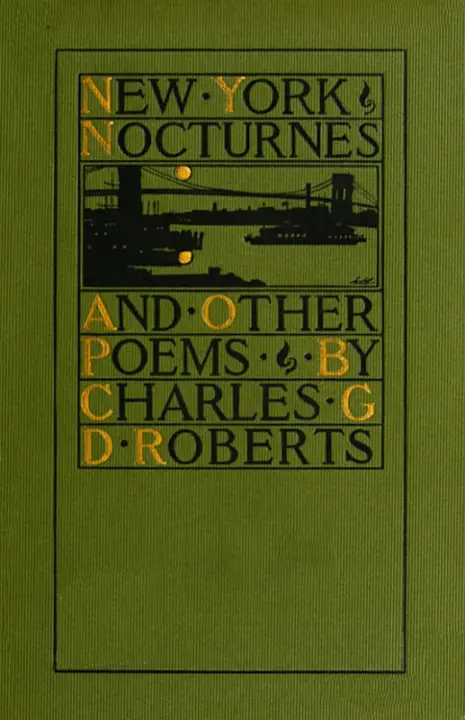
New York Nocturnes, and Other Poems
Charles G. D., Sir Roberts
THE CLASSIC COLLECTION · 1896
"The Book of the Native" by Sir Charles G. D. Roberts is a collection of poetry written in the late 19th century. The book explores themes of nature, kinship, and the human experience, delving into the connections between humanity and the natural world. Roberts’ work reflects the Canadian landscape and spirit, celebrating the simplicity and beauty of rural life through lyrical verses. In this collection, the poet expresses a profound appreciation for the natural world, illustrating the cycles of life, growth, and renewal through imagery drawn from rural scenes and seasonal changes. The poems range in tone from reflective to celebratory, capturing moments of quiet beauty and deep emotion. Themes of kinship with nature, the passage of time, and the quest for understanding are prevalent, as Roberts invites the reader to share in his observations of both the external world and the internal journey of the soul. Through poems like "The Silent of the Frost" and "A Child's Prayer at Evening," he weaves a tapestry of thoughts that resonate with the universal human experience.
Introduction adapted from the source catalogue; source summaries may be automatically generated.
Free to read · English · 9,520 words · No account needed
MAKE TIME FOR A GOOD BOOK
On by default. Untick to stop anonymous reading totals. Each page counts after 10 seconds in view. How this works.
Anonymous counting is on unless you have switched it off.
She was fain to cross the brook, was the dainty, dainty maid; But first she lifted up her elfin eyes To see if there were cavalier or clown a-near to aid,-- And the water-bubbles blinked in surprise.
The brook bared its pebbles to persuade her dainty feet, But the dainty, dainty maid was not content. She had spied a simple country lad (for dainty maid unmeet), And the shy water twinkled as it went.
As the simple lad drew nigh, then this dainty, dainty maid, (O maidens, well you know how it was done!) Stood a-gazing at her feet until he saw she was afraid Of the water there a-whimpling in the sun.
Now that simple lad had in him all the makings of a man; And he stammered, “I had better lift you over!” Said the dainty, dainty maid--“Do you really think you can?” And the water hid its laughter in the clover.
So he carried her across, with his eyes cast down, And his foolish heart a-quaking with delight. And the maid she looked him over with her elfin eyes of brown; And the impish water giggled at his plight.
He reached the other side, he set down the dainty maid; But he trembled so he couldn’t speak a word. Then the dainty, dainty maid--“Thank you, Sir! Good-day!” she said. And the water-bubbles chuckled as they heard.
Oh, she tripped away so lightly, a-Maying in the morn, That dainty, dainty maiden of degree; She left the simple country lad a-sighing and forlorn Where the mocking water twinkled to the sea.
Whitewaters
Beside the wharf at Whitewaters
The loitering ebb with noon confers;
And o’er the amber flats there seems
A sleep to brood of sun and dreams.
The white and clustering cottages,
Thick shadowed by their windless trees,
Inhabit such a calm, that change
Goes by and lets her face grow strange.
And not far off, on tiptoe seen,
The brown dike and the sky between,
A shifting field that heaves and slides,--
The blue breast of the Minas tides.
A-through the little harbor go
The currents of the scant Pereau,
Drawn slowly, drawn from springs unseen
Amid the marsh’s vasts of green.
Up from the wharf at Whitewaters,
Where scarce a slim sandpiper stirs,
A yellow roadway climbs, that feels
Few footsteps and infrequent wheels.
It climbs to meet the westering sun
Upon the heights of Blomidon,--
Bulwark of peace, whose bastioned form
Out-bars the serried hosts of storm.
Down to the wharf at Whitewaters,
The children of the villagers
One drowsy, windless hour of noon
Deep in the green mid-heart of June,
Your reading position is saved on this browser. Take it to another device with a library code. Reading pages adapt to text, rather than matching a printed edition.
Charles G. D., Sir Roberts
Charles G. D., Sir Roberts
Charles G. D., Sir Roberts
Charles G. D., Sir Roberts
BEHIND THE BOOK
This eBook is for the use of anyone anywhere in the United States and most other parts of the world at no cost and with almost no restrictions whatsoever. You may copy it, give it away or re-use it under the terms of the Project Gutenberg License included with this eBook or online at www.gutenberg.org. If you are not located in the United States, you will have to check the laws of the country where you are located before using this eBook. Read the source licence.
The original source file, including credits and licence, is retained by this library. Request an original-format copy at no charge. Please include the book title and Project Gutenberg identifier #57250.
KEEP YOUR CURIOSITY GOING

Eric Mackay
Edmund Gosse
Sophia Margaretta Hensley
Gilbert Parker
George MacDonald

Elizabeth Bibesco