Lives of Fair and Gallant Ladies. Vol 2.
Pierre de Bourdeille Brantôme
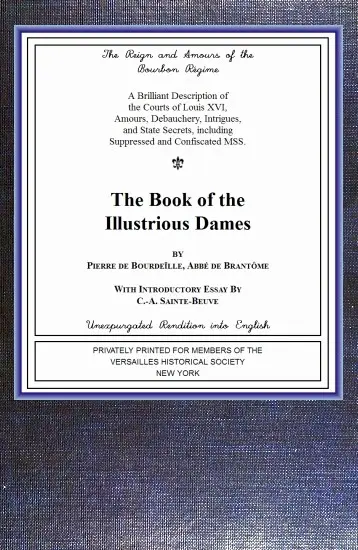
THE CLASSIC COLLECTION · 1899
"The Book of the Ladies" by Pierre de Bourdeille Brantôme is a historical account written in the late 16th century. The text explores the lives and virtues of various notable women of the French court, particularly focusing on significant queens such as Anne de Bretagne and Catherine de' Medici. Through detailed accounts and engaging anecdotes, Brantôme provides insight into their personalities, challenges, and the roles they played in history, portraying them as influential figures shaping the social and political fabric of their time. At the start of the book, the author introduces his own perspective and background, establishing his credibility as someone who has witnessed the courts of France and interacted with its key figures. He emphasizes the importance of honoring the contributions of women in history, beginning with a detailed examination of Anne de Bretagne's life. Brantôme describes her marriage to King Charles VIII, her influence on French politics, and her notable personal attributes, such as beauty and intelligence, while also touching upon her complexities, including her sense of vengeance when wronged. The opening portion sets a tone of admiration and respect for these illustrious dames, positioning Brantôme not only as a storyteller but also as a defender of their legacies against historical neglect.
Introduction adapted from the source catalogue; source summaries may be automatically generated.
Free to read · English · 101,730 words · No account needed
MAKE TIME FOR A GOOD BOOK
On by default. Untick to stop anonymous reading totals. Each page counts after 10 seconds in view. How this works.
Anonymous counting is on unless you have switched it off.
“By the Salic law, written for all subjects, where there were no sons the daughters inherited the patrimony; and this should rule the crown also, so that Mesdames the daughters of France, in default of sons, should take it; nevertheless, they are perpetually excluded by custom and the private law of the house of France, based on the arrogance of Frenchmen, who cannot endure to be governed by women.” And elsewhere he says: “One cannot help being amazed at the long ignorance that has attributed this custom to the Salic law, which is quite the contrary of it.”
King Charles V., treating of the marriage of Queen Marie of France, his daughter, with Guillaume, Count of Hainault, in the year 1374, stipulated for the renunciation by the said count of all right to the kingdom and to Dauphiné; which is a great point, for see the contradictions!
Certainly if women could handle arms like men they could make themselves accredited; but by way of compensation, they have their beautiful faces; which, however, are not recognized as they deserve; for surely it is better to be governed by beautiful, lovely, and honourable women than by tiresome, conceited, ugly, and sullen men such as I have seen in this France of ours.
I would like to know if this kingdom has found itself any better for an infinitude of conceited, silly, tyrannical, foolish, do-nothing, idiotic, and crazy kings--not meaning to accuse our brave Pharamond, Clodion, Clovis, Pépin, Martel, Charles, Louis, Philippe, Jean, François, Henri, for they are all brave and magnanimous, those kings, and happy they who were under them--than it would have been with an infinitude of the daughters of France, very able, very prudent, and very worthy to govern. I appeal to the regency of the mothers of kings to show this, to wit:--
Frédégonde, how did she administer the affairs of France during the minority of King Clothaire, her son, if not so wisely and dexterously that he found himself before he died monarch of Gaul and of much of Germany?
The like did Mathilde, wife of Dagobert, as to Clovis II., her son; and, long after, Blanche, mother of Saint-Louis, who behaved so wisely, as I have read, that, just as the Roman emperors chose to call themselves “Augustus” in commemoration of the luck and prosperity of Augustus, the great emperor, so the former queen-mothers after the decease of the kings, their husbands, desired each to be called “Reine Blanche,” in honourable memory of the government of that wise princess. Though M. du Tillet contradicts this a little, I have heard it from a very great senator.
Your reading position is saved on this browser. Take it to another device with a library code. Reading pages adapt to text, rather than matching a printed edition.
Pierre de Bourdeille Brantôme
Pierre de Bourdeille Brantôme
BEHIND THE BOOK
This eBook is for the use of anyone anywhere in the United States and most other parts of the world at no cost and with almost no restrictions whatsoever. You may copy it, give it away or re-use it under the terms of the Project Gutenberg License included with this eBook or online at www.gutenberg.org. If you are not located in the United States, you will have to check the laws of the country where you are located before using this eBook. Read the source licence.
The original source file, including credits and licence, is retained by this library. Request an original-format copy at no charge. Please include the book title and Project Gutenberg identifier #42515.
KEEP YOUR CURIOSITY GOING
Cécile Tormay

Moritz Busch
John L. Ransom
Frances Wright
Cécile Tormay

Mabel Potter Daggett