
Dead letters
Maurice Baring
THE CLASSIC COLLECTION · 1903
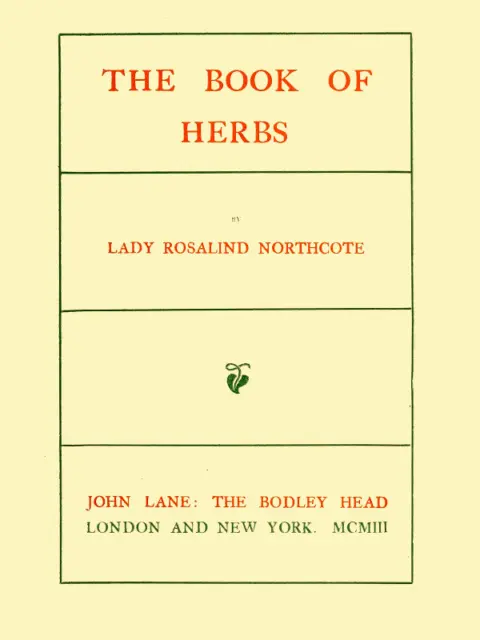
"The Book of Herbs" by Lady Rosalind Northcote is a practical gardening handbook written in the early 20th century. The book delves into the various types of herbs, their uses, and their significance across history, with a particular focus on those commonly found in British gardens. Northcote aims to not only educate readers on the cultivation of herbs but also to revive knowledge and appreciation for these plants, many of which have fallen out of favor. At the start of the book, the author introduces the concept of herbs, emphasizing the difficulty in defining what qualifies as a herb. She suggests that herbs encompass aromatic plants suitable for consumption, while acknowledging that some do not fit neatly into this category. The opening portion also hints at the rich historical and cultural significance of herbs, with references to their use in cooking, medicine, and various rituals. Northcote highlights the enduring appeal of herbs and underscores the need for a rediscovery of traditional knowledge associated with these plants, setting the stage for a comprehensive exploration that follows.
Introduction adapted from the source catalogue; source summaries may be automatically generated.
Free to read · English · 62,033 words · No account needed
MAKE TIME FOR A GOOD BOOK
On by default. Untick to stop anonymous reading totals. Each page counts after 10 seconds in view. How this works.
Anonymous counting is on unless you have switched it off.
For less festive occasions it had other meanings: “As for Rosmarine, I lett it runne all over my garden walls, not onlie because my bees love it, but because it is the herb sacred to remembrance, and therefore to friendship; whence a sprig of it hath a dumb language that maketh it the chosen emblem of our funeral wakes and in our buriall grounds.” Sir Thomas More thought this, but others beside him “lett Rosmarine run all over garden walls,” though perhaps they had less sentiment about it; Hentzner (Travels) (1598) says that it was a custom “exceedingly common in England.” At Hampton Court, Rosemary was “so planted and nailed to the walls as to cover them entirely.”[74] The bushes were sometimes set “by women for their pleasure,[75] to grow in sundry proportions, as in the fashion of a cart, a peacock or such things as they fancy,” or the branches were twined amongst others to make an arbour. Brown refers to this:--
Within an arbour, shadow’d by a vine
Mix’d with Rosemary and Eglantine.
Br. Pastorals, book i.
Rosemary was one of the chief funeral herbs. Herrick says:--
Grow it for two ends, it matters not at all,
Be’t for my bridall or my buriall.
Sprigs of it were distributed to the mourners before they left the house, which they carried to the churchyard and threw on the coffin when it had been lowered into the grave. In Romeo and Juliet Friar Laurence says:--
Dry up your tears and stick your Rosemary
On this fair corse
Brand quotes passages from Gay, Dekker, Cartwright, Shirley, Misson, Coles, “The British Apollo” and “The Wit’s Interpreter,” which connect Rosemary with burials; and it was also planted on graves.
Coles says it was used with other evergreens to decorate churches at Christmas-time, and Folkard that, “In place of more costly incense, the ancients often employed Rosemary in their religious ceremonies. An old French name for it was Incensier. It was conspicuous on a very remarkable occasion in history. In “A Perfect Journall, etc., of that memorable Parliament begun at Westminster, Nov. 3, 1640,” is the following passage, “Nov. 28. That afternoon Master Prin and Master Burton came in to London, being met and accompanied with many thousands of horse and foot, and rode with rosemary and bayes in their hands and hats; which is generally esteemed the greatest affront that ever was given to the courts of justice in England.” The “affront” lay in the general rejoicing that attended this overthrowing of the sentence passed by the Star Chamber, and the causes which led to this enthusiasm were these: “Some years before,” Prynne, Burton, and Bastwick had written against the Government and the Bishops, and for this offence had been sentenced to pay a fine of £5000 each, to have their ears cut off, to stand in the pillory and to be imprisoned for life. “All of which,” says Clarendon, “was executed with rigour and severity enough.” “After being first imprisoned in England, Mr Pyrnne was sent to a castle in the island of Jersey, Dr Bastwick to Scilly, and Mr Burton to Guernsey.” Bastwick’s wife seized the first moment that the Commons were assembled (in Nov. 1640) to present a petition, with the result that on the fourth day after Parliament met, orders for their release were sent to the Governors of the respective castles. Clarendon, who, of course, had no sympathy, but much dislike for them, admits: “When they came near London, multitudes of people of several conditions, some on horseback, others on foot, met them some miles from the town; very many having been a day’s journey; and they were brought about two of the clocke in the afternoon in at Charing Cross, and carried into the city by above ten thousand persons with boughs and flowers in their hands, the common people strewing flowers and herbs in the ways as they passed, making great noise and expressions of joy for their deliverance and return; and in those acclamations, mingling loud and virulent exclamations against the bishops, “who had so cruelly persecuted such godly men.” An appendix,[76] devoted to this incident, further describes their entry, “The two branded persons riding first, side by side, with branches of rosemary in their hands, and two or three hundred horse closely following them, and multitudes of foot on either side of them, walking by them, every man on horseback or on foot having bays or rosemary in their hats or hands, and the people on either side of the street strewing the way as they passed with herbs, and such other greens as the season afforded, and expressing great joy for their return.” This splendid reception must have revealed very plainly to the Government the mind and temper of the people. Nowadays the exuberance of the mob in greeting popular heroes is much what it seems to have been then, only they do not generally express it in such a pretty way as strewing rosemary and bays.
Your reading position is saved on this browser. Take it to another device with a library code. Reading pages adapt to text, rather than matching a printed edition.
BEHIND THE BOOK
This eBook is for the use of anyone anywhere in the United States and most other parts of the world at no cost and with almost no restrictions whatsoever. You may copy it, give it away or re-use it under the terms of the Project Gutenberg License included with this eBook or online at www.gutenberg.org. If you are not located in the United States, you will have to check the laws of the country where you are located before using this eBook. Read the source licence.
The original source file, including credits and licence, is retained by this library. Request an original-format copy at no charge. Please include the book title and Project Gutenberg identifier #60050.
KEEP YOUR CURIOSITY GOING
Maurice Baring
Francis Greenleaf Allinson & Anne C. E. (Anne Crosby Emery) Allinson
Stuart Dodgson Collingwood
Percy Keese Fitzhugh
Mary Macleod & Edmund Spenser

Cooke Don-Carlos