
Dead letters
Maurice Baring
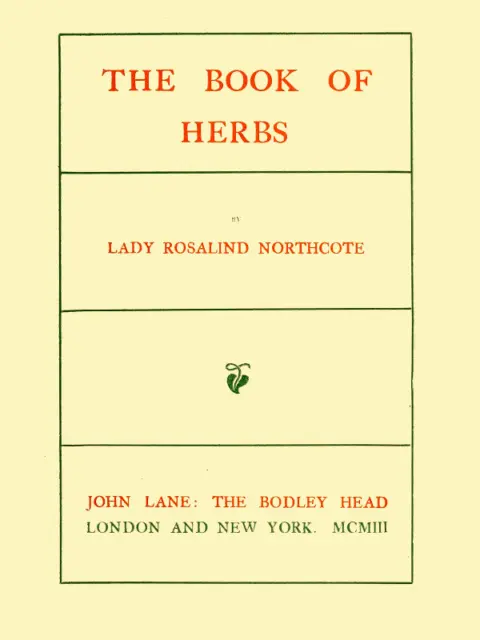
THE CLASSIC COLLECTION · 1903
"The Book of Herbs" by Lady Rosalind Northcote is a practical gardening handbook written in the early 20th century. The book delves into the various types of herbs, their uses, and their significance across history, with a particular focus on those commonly found in British gardens. Northcote aims to not only educate readers on the cultivation of herbs but also to revive knowledge and appreciation for these plants, many of which have fallen out of favor. At the start of the book, the author introduces the concept of herbs, emphasizing the difficulty in defining what qualifies as a herb. She suggests that herbs encompass aromatic plants suitable for consumption, while acknowledging that some do not fit neatly into this category. The opening portion also hints at the rich historical and cultural significance of herbs, with references to their use in cooking, medicine, and various rituals. Northcote highlights the enduring appeal of herbs and underscores the need for a rediscovery of traditional knowledge associated with these plants, setting the stage for a comprehensive exploration that follows.
Introduction adapted from the source catalogue; source summaries may be automatically generated.
Free to read · English · 62,033 words · No account needed
MAKE TIME FOR A GOOD BOOK
On by default. Untick to stop anonymous reading totals. Each page counts after 10 seconds in view. How this works.
Anonymous counting is on unless you have switched it off.
There was a very strong belief that the flowers followed the sun, and many allusions are made to this; amongst them, two melancholy lines which are said to have been drawn from some “Meditations” by Charles I., written at Carisbrooke Castle.
“The marigold observes the sun,
More than my subjects me have done.”
Shakespeare refers often to this idea, and the flower was obviously “to earlier writers the emblem of constancy in affection and sympathy in joy and sorrow, though it was also the emblem of the fawning courtier who could only shine when everything is bright.” (Canon Ellacombe). Marigolds have figured in heraldry, for Marguerite of Valois, grandmother of Henri IV., chose for her armorial device a marigold turning towards the sun, with the motto, Je ne veux suivre que lui seul. About the fifteenth century the Marigold was called Souvenir, and ladies wore posies of marigolds and heartsease mingled, that is, a bunch of “happiness stored in recollections,” a very pretty allegorical meaning. But it has been the symbol of memories anything but happy, for curiously enough, this sun’s flower means Grief in the language of flowers, and in many countries is connected with the idea of death. This thought occurs in Pericles and in the song in “Two noble Kinsmen.” In America, one name for them is death-flowers, because there is a tradition that they “sprang upon ground stained by the life-blood of these unfortunate Mexicans who fell victims to the love of gold and arrogant cruelty of the early Spanish settlers in America.”[46] However, to restore the balance of happiness, one learns that to dream of Marigolds augurs wealth, prosperity, success, and a rich and happy marriage! In Fuller’s “Antheologia, or the Speech of Flowers”--a most amusing tale--the Marigold occupies a prominent place. The scene opens with a dispute in the Flowers’ Parliament between the Tulip and the Rose. “Whilst this was passing in the Upper House of Flowers, no less were the transactions in the Lower House of the Herbs; where there was a general acclamation against Wormwood. Wormwood’s friends were casually absent that day, making merry at an entertainment, her enemies (let not that sex be angry for making Wormwood feminine) appeared in full body and made so great a noise, as if some mouths had two tongues in them.” Wormwood and the Tulip were eventually both cast out of the garden, and lying by the roadside addressed themselves to a passing Wild Boar, telling him of a hole in the hedge, by which he may creep into the garden and revenge them, and amuse himself by destroying the flowers. At the moment he enters, “Thrift, a Flower-Herb, was just courting Marigold as follows: ‘Mistress of all Flowers that grow on Earth, give me leave to profess my sincerest affections to you.... I have taken signal notice of your accomplishments, and among other rare qualities, particularly of this, your loyalty and faithfulness to the Sun, ... but we all know the many and sovereign virtues in your leaves, the Herb Generall in all pottage.” He then proceeds to praise himself, “I am no gamester to shake away with a quaking hand what a more fixed hand did gain and acquire. I am none of those who in vanity of clothes bury my quick estate as in a winding sheet.” The Marigold demurely hung her head and replied, “I am tempted to have a good opinion of myself, to which all people are prone, and we women most of all, if we may believe your opinions of us, which herein I am afraid are too true.” But she is not deceived by his flattery. “The plain truth is you love me not for myself, but for your advantage. It is Golden the arrear of my name, which maketh Thrift to be my suitor. How often and how unworthily have you tendered your affections even to a Penny royal itself, had she not scorned to be courted by you. But I commend the girl that she knew her own worth, though it was but a penny, yet it is a Royal one, and therefore not a match for every base Suitor, but knew how to value herself; and give me leave to tell you that Matches founded on Covetousness never succeed.” At this point in her spirited reply the Boar approached. “There is no such teacher as extremity; necessity hath found out more Arts than ever ingenuity invented. The Wall Gillyflower ran up to the top of the Wall of the Garden, where it hath grown ever since, and will never descend till it hath good security for its own safety.” Other thrilling scenes follow, and finally the Boar is put an end to by the gardener and “a Guard of Dogs.”
Your reading position is saved on this browser. Take it to another device with a library code. Reading pages adapt to text, rather than matching a printed edition.
BEHIND THE BOOK
This eBook is for the use of anyone anywhere in the United States and most other parts of the world at no cost and with almost no restrictions whatsoever. You may copy it, give it away or re-use it under the terms of the Project Gutenberg License included with this eBook or online at www.gutenberg.org. If you are not located in the United States, you will have to check the laws of the country where you are located before using this eBook. Read the source licence.
The original source file, including credits and licence, is retained by this library. Request an original-format copy at no charge. Please include the book title and Project Gutenberg identifier #60050.
KEEP YOUR CURIOSITY GOING
Maurice Baring
Francis Greenleaf Allinson & Anne C. E. (Anne Crosby Emery) Allinson
Stuart Dodgson Collingwood
Percy Keese Fitzhugh
Mary Macleod & Edmund Spenser

Cooke Don-Carlos