
Dead letters
Maurice Baring
THE CLASSIC COLLECTION · 1903
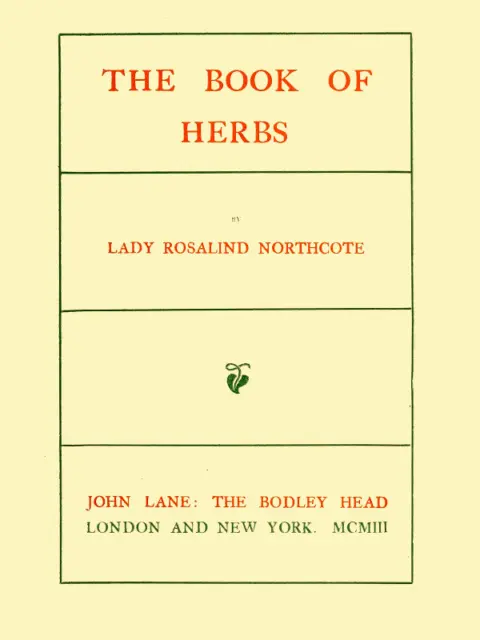
"The Book of Herbs" by Lady Rosalind Northcote is a practical gardening handbook written in the early 20th century. The book delves into the various types of herbs, their uses, and their significance across history, with a particular focus on those commonly found in British gardens. Northcote aims to not only educate readers on the cultivation of herbs but also to revive knowledge and appreciation for these plants, many of which have fallen out of favor. At the start of the book, the author introduces the concept of herbs, emphasizing the difficulty in defining what qualifies as a herb. She suggests that herbs encompass aromatic plants suitable for consumption, while acknowledging that some do not fit neatly into this category. The opening portion also hints at the rich historical and cultural significance of herbs, with references to their use in cooking, medicine, and various rituals. Northcote highlights the enduring appeal of herbs and underscores the need for a rediscovery of traditional knowledge associated with these plants, setting the stage for a comprehensive exploration that follows.
Introduction adapted from the source catalogue; source summaries may be automatically generated.
Free to read · English · 62,033 words · No account needed
MAKE TIME FOR A GOOD BOOK
On by default. Untick to stop anonymous reading totals. Each page counts after 10 seconds in view. How this works.
Anonymous counting is on unless you have switched it off.
1. Bays, sow or plant in January.
2. Bachelor’s Buttons.
3. Bottles, blue, red, and tawny.
4. Columbines.
5. Campions.
6. Cowslips (Tusser here meant Oxlips).
7. Daffodils or Daffodondillies.
8. Eglantine or Sweet-Brier.
9. Fetherfew.
10. Flower Amour, sow in May (Amaranthus).
11. Flower de Luce.
12. Flower-Gentle, white and red (Amaranthus).
13. Flower Nice.
14. Gillyflowers, red, white, and Carnations, set in spring and at
harvest in pots, pails, or tubs, or for summer, in beds.
15. Holyoaks, red, white, and Carnations (Hollyhocks).
16. Indian Eye, sow in May, or set in slips in March (Dianthus
Plumarius).
17. Lavender of all sorts.
18. Larksfoot (Larkspur).
19. Laus tibi (Narcissus Poeticus).
20. Lillium Convallium.
21. Lilies, red and white, sow or set in March and September.
22. Marigolds, double.
23. Nigella Romana.
24. Pansies, or Heartsease.
25. Paggles, green and yellow (Cowslips).
26. Pinks of all sorts.
27. Queen’s Gilliflowers (Hesperis Matronalis).
28. Rosemary.
29. Roses of all sorts.
30. Snapdragon.
31. Sops in wine (Pinks).
32. Sweet Williams.
33. Sweet Johns (Dianthus Barbatus).
34. Star of Bethlehem (Ornithogalum Umbellatum).
35. Star of Jerusalem (Tragopogon pratensis).
36. Stock Gilliflowers of all sorts.
37. Tuft Gilliflowers.
38. Velvet flowers, or French Marigolds (Tagetes patula).
39. Violets, yellow and white.
40. Wall Gilliflowers of all sorts.
1. Blessed Thistle.
2. Betony.
3. Dill.
4. Endive.
5. Eyebright.
6. Fennel.
7. Fumitory.
8. Hyssop.
9. Mints.
10. Plantane.
11. Roses, red and damask.
12. Respies (Rubus Idæus).
13. Saxifrage (Pimpinella saxifraga or Saxifraga granulata, or
perhaps, Carum Carvi).
14. Strawberries.
15. Sorrel.
16. Succory.
17. Woodroffe, for sweet waters and cakes.
1. Anise.
2. Archangel (Angelica).
3. Betony.
4. Chervil.
5. Cinquefoil (Potentida reptans).
6. Cummin.
7. Dragons (Arum Maculatum).
8. Dittary or garden ginger (Lepidium Latifolium).
9. Gromwell seed (Lithospernum officinale).
10. Hart’s tongue.
11. Horehound.
12. Lovage.
13. Liquorice.
14. Mandrake.
15. Mugwort.
16. Peony.
17. Poppy.
18. Rue.
19. Rhubarb.
20. Smallage.
21. Saxifrage.
22. Savin.
23. Stitchwort.
24. Valerian.
25. Woodbine.
Thus ends in brief,
Of herbs the chief,
To get more skill,
Read whom ye will;
Such mo to have,
Of field go crave.
ABERCROMBIE, “Every Man his own Gardener.”
AMHERST (Hon. Alicia), “A History of Gardening in England.”
ASHMOLE, “History of the Most Noble Order of the Garter.”
BACON, “Sylva Sylvarum; or, a Naturall Historie.”
BLOUNT, “Fragmenta Antiquitatis; or Jocular Tenures.”
BRAND, “Popular Antiquities.”
BRITTEN, “A Dictionary of English Plant Names.”
BROWNE (Sir Thomas), “Vulgar Errors.”
CLARENDON, “History of the Rebellion.”
COLES, “Art of Simpling.”
CULPEPPER, “The English Physitian.”
CULPEPPER, “Astrological Judgment of Diseases.”
DE GUBERNATIS, La Mythologie des Plantes.
DE LA QUINTINYE, “The Compleat Gard’ner.”
DILLON, Nineteenth Century, April 1894.
DYER (Thistleton), “The Folk-Lore of Plants.”
ELLACOMBE (Canon), “The Plant-Lore and Garden-Craft of Shakespeare.”
EVELYN (J.), “Acetaria, a Discourse of Sallets,” 1699.
FAVYN (André), Le Théâtre d’honneur et de Chevatries, 1620.
FAVYN (André), “Theatre of Honour.”
FERNIE, “Herbal Simples.”
FOLKARD, “Plant-Lore, Legends and Lyrics.”
FRIEND, “Flowers and Flower-Lore.”
FULLER, “Church History.”
FULLER, “Antheologia; or, the Speech of Flowers.”
GERARDE, “The Herball,” 1596.
THE “Grete Herball,” 1516.
GUILLIM, “Heraldry.”
HAKLUYT’S Voyages, “Remembrances for Master S.,” 1582.
HARRISON’S “Description of England.”
“History of Signboards.”
HOGG, “The Vegetable Kingdom and its Products.”
HUISH, “History of the Coronation of George IV.”
INGRAM, Flora Symbolica.
I. W., i.e. John Worlidge, Systema Agriculturæ, printed (London)
for Thos. Dring, 1681.
JONES, “Crowns and Coronations.”
LAMBERT (Miss), Nineteenth Century, September 1879, and May 1880.
Le Petit Albert, from the “Secrets of Albertus Magnus, of the
Virtues of Herbs, Stones and Certaine Beasts,” 1617.
LOUDON, “Encyclopædia of Gardening.”
LUPTON, “Book of Notable Things,” 1575.
MARKHAM (Gervase), “The Complete Housewife.”
MEAGER, “The New Art of Gardening,” 1697.
NEWTON, “An Herbal of the Bible,” 1587.
NICHOLAS (Sir N. H.), “History of the Orders of Knighthood of the
British Empire.”
PARKINSON, Paradisi in Sole, Paradisus terrestris, 1629.
PARKINSON, “Theatre of Plants,” 1640.
PECK, Desiderata Curiosa.
PEGGE’S Curalia.
PLATT (Sir Hugh), “The Garden of Eden,” 1653.
PLINY’S “Natural History,” Trans. by Philemon Holland.
Quarterly Review, June 1842.
RHIND, “History of the Vegetable Kingdom.”
ROBERTS (H.), “Complete Account of the Coronations of the Kings and
Queens of England.”
ROBINSON, “English Flower-Garden.”
ROSS, “View of all Religions,” 1653.
SELDEN, “Table Talk.”
SMITH, “Dictionary of the Bible.”
THORNTON, “Family Herbal.”
TIMBS, “Things Not Generally Known.”
TUSSER, “Five Hundred Points of Good Husbandry,” 1577.
WALTON (Isaac), “The Complete Angler.”
Your reading position is saved on this browser. Take it to another device with a library code. Reading pages adapt to text, rather than matching a printed edition.
BEHIND THE BOOK
This eBook is for the use of anyone anywhere in the United States and most other parts of the world at no cost and with almost no restrictions whatsoever. You may copy it, give it away or re-use it under the terms of the Project Gutenberg License included with this eBook or online at www.gutenberg.org. If you are not located in the United States, you will have to check the laws of the country where you are located before using this eBook. Read the source licence.
The original source file, including credits and licence, is retained by this library. Request an original-format copy at no charge. Please include the book title and Project Gutenberg identifier #60050.
KEEP YOUR CURIOSITY GOING
Maurice Baring
Francis Greenleaf Allinson & Anne C. E. (Anne Crosby Emery) Allinson
Stuart Dodgson Collingwood
Percy Keese Fitzhugh
Mary Macleod & Edmund Spenser

Cooke Don-Carlos