
Dead letters
Maurice Baring
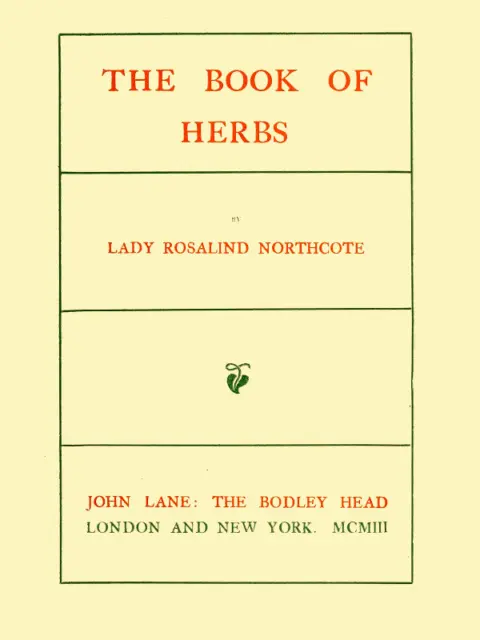
THE CLASSIC COLLECTION · 1903
"The Book of Herbs" by Lady Rosalind Northcote is a practical gardening handbook written in the early 20th century. The book delves into the various types of herbs, their uses, and their significance across history, with a particular focus on those commonly found in British gardens. Northcote aims to not only educate readers on the cultivation of herbs but also to revive knowledge and appreciation for these plants, many of which have fallen out of favor. At the start of the book, the author introduces the concept of herbs, emphasizing the difficulty in defining what qualifies as a herb. She suggests that herbs encompass aromatic plants suitable for consumption, while acknowledging that some do not fit neatly into this category. The opening portion also hints at the rich historical and cultural significance of herbs, with references to their use in cooking, medicine, and various rituals. Northcote highlights the enduring appeal of herbs and underscores the need for a rediscovery of traditional knowledge associated with these plants, setting the stage for a comprehensive exploration that follows.
Introduction adapted from the source catalogue; source summaries may be automatically generated.
Free to read · English · 62,033 words · No account needed
MAKE TIME FOR A GOOD BOOK
On by default. Untick to stop anonymous reading totals. Each page counts after 10 seconds in view. How this works.
Anonymous counting is on unless you have switched it off.
De Gubernatis quotes from a work on astrology attributed to King Solomon, and translated from the Hebrew (?) by Iroé Grego (published in Rome, 1750), with indignant comments on the “pagan” methods of the Church in dealing with sorceries. Directions how to make an aspersoir pour exorcisme are given in it, which, teaching, he says, simply add to the peasant’s existing load of superstition. Vervain, Periwinkle, Sage, Mint, Valerian, Ash and Basil are some of the plants chosen. “Tu n’y ajouteras point l’Hysope, mais le Romarin” (Rosemary). It is odd that Hyssop should be excluded, because it has always been a special defence against powers of darkness. In Palermo (again according to De Gubernatis), on the day of St Mark, the priests mount a hill in procession and bless the surrounding country, and the women gather quantities of the Hyssop growing about, and take it home to keep away from their houses the Evil Eye, and “toute autre influence magique.” Rosemary is celebrated, from this point of view, as from others. It was, say the Spaniards, one of the bushes that gave shelter to the Virgin Mary in the flight into Egypt, and it is still revered. Borrow, in “The Bible in Spain,” notices that, whereas in that country it is Romero, the Pilgrim’s Flower, in Portugal it is called Alecrim, a word of Scandinavian origin (from Ellegren, the Elfin plant), which was probably carried south by the Vandals. Other authorities think that “Alecrim” comes from the Arabians. The reference to Rosemary occurs in a delightful passage. Borrow was staying at an inn, when one evening “in rushed a wild-looking man mounted on a donkey.... Around his sombrero, or shadowy hat, was tied a large quantity of the herb, which in English is called Rosemary.... The man seemed frantic with terror, and said that the witches had been pursuing him and hovering over his head for the last two leagues.” On making inquiries, Borrow was told that the herb was “good against witches and mischances on the road.” He treats this view with great scorn, but says: “I had no time to argue against this superstition,” and with charming naïveté admits that, notwithstanding his austerity, when, next morning at departure, some sprigs of it were pressed upon him by the man’s wife for his protection, “I was foolish enough to permit her to put some of it in my hat.” The Sicilians thought that it was a favourite plant of the fairies, and that the young fairies, taking the form of snakes, lie amongst the branches. Dill, able to “hinder witches of their will,” was used in spells against witches, besides being employed by them. There was a strong belief that plants beloved by magicians, and powerful for evil in their hands, were equally powerful to avert evil when used in charms against witchcraft. Lunary, or Honesty, is another plant with a double edge. In France it is nicknamed Monnaie du Pape and Herbe aux Lunettes, and its shining seed-vessels have many pet names in English. “It has a natural power of dispelling evil spirits,” quotes Mr Friend, and explains this verdict by pointing that Lunary with its great silver disks, called after the moon, is disliked and avoided by evil spirits, who fear the light and seek darkness. Rue is used by witches and against them; in some parts of Italy a talisman against their power is made by sewing up the leaves in a little bag and wearing it near the heart. If the floor of a house be rubbed with Rue it is certain that all witches must fly from it. In Argentina grows the Nightmare flower, Flor de Pesadilla. The witches of that region extract from it a drug which causes nightmare lasting all night long, and they contrive to give it to whoever they wish to torment. Besides these, Pennyroyal and Henbane, Chervil and Vervain, Poppies, Mandrakes, Hemlock and Dittany were specially used by witches in making spells. Valerian, Wormwood, Elder, Pimpernel, Angelica, and all yellow flowers growing in hedgerows are antagonistic to them. Their dislike to yellow flowers may have arisen from these being often dedicated to the sun, and being therefore repellent to lovers of gloom and mystery. Angelica preserved the wearer from the power of witches or spells, and is, I think, the only herb quoted by Gerarde as a power against witchcraft. He does not condescend generally to consider superstitions other than medical. Of the herbs dedicated to the Evil One are Yarrow, sometimes known as the Devil’s Nettle; Ground-Ivy, called his Candlestick, and Houseleek, which he has rather unjustly appropriated. Mr Friend explains that in Denmark, “Old Thor” is a polite euphemism, and that the Houseleek really belonged to Thor, but has been passed on through confusion between the two. Yarrow or Milfoil has been used for divination in spells from England to China.
Your reading position is saved on this browser. Take it to another device with a library code. Reading pages adapt to text, rather than matching a printed edition.
BEHIND THE BOOK
This eBook is for the use of anyone anywhere in the United States and most other parts of the world at no cost and with almost no restrictions whatsoever. You may copy it, give it away or re-use it under the terms of the Project Gutenberg License included with this eBook or online at www.gutenberg.org. If you are not located in the United States, you will have to check the laws of the country where you are located before using this eBook. Read the source licence.
The original source file, including credits and licence, is retained by this library. Request an original-format copy at no charge. Please include the book title and Project Gutenberg identifier #60050.
KEEP YOUR CURIOSITY GOING
Maurice Baring
Francis Greenleaf Allinson & Anne C. E. (Anne Crosby Emery) Allinson
Stuart Dodgson Collingwood
Percy Keese Fitzhugh
Mary Macleod & Edmund Spenser

Cooke Don-Carlos